
When food defies expectations.
Imagine placing a tiny sphere into your mouth.
It looks like a solid object, but the moment you bite it, liquid bursts out.
Or imagine a dessert that looks like a cloud but tastes like strawberries.
How can chefs create these unusual textures?
The answer is molecular gastronomy.
It brings together food chemistry, physics and culinary creativity to transform familiar ingredients into extraordinary eating experiences.
Let's explore the science behind these edible creations.
01What is molecular gastronomy?
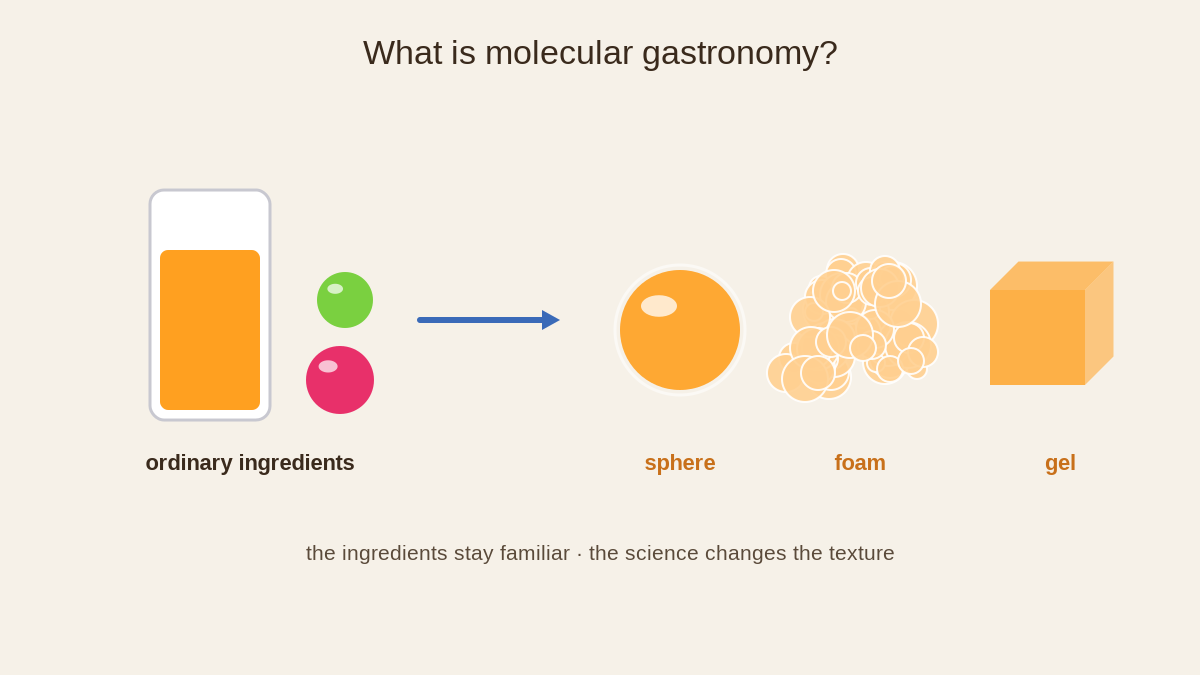
Molecular gastronomy explores the physical and chemical processes that happen during cooking.
Modernist cooking uses many food-science techniques to change how ingredients behave.
These techniques can create:
- Edible spheres.
- Stable foams.
- Transparent gels.
- Unusual textures.
- Liquid-filled edible membranes.
The goal is not simply to make food look unusual.
It is to explore how ingredients can behave in unexpected ways.
02The secret of edible spheres
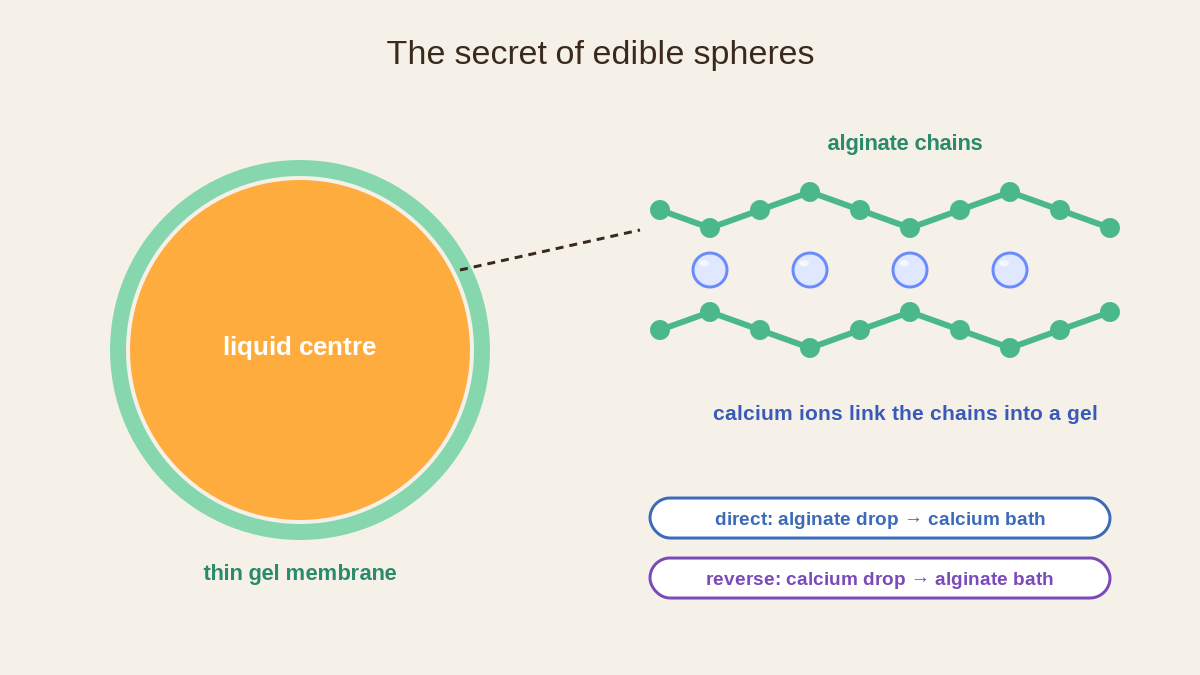
One of the most recognisable techniques is spherification.
It commonly involves sodium alginate and a calcium salt.
Sodium alginate is a food-grade polysaccharide obtained from brown seaweed.
When calcium ions interact with alginate, they connect parts of the polymer chains, creating a gel network.
This can produce a membrane around a liquid droplet.
The result is a delicate edible sphere.
There are two common approaches:
Direct spherification: An alginate-containing liquid is dropped into a calcium bath. A gel membrane develops around the droplet.
Reverse spherification: A calcium-containing liquid is placed into an alginate bath. This is useful for certain liquids and can help produce spheres whose centres remain liquid for longer.
The acidity and composition of the liquid can influence the process.
03How does liquid become foam?
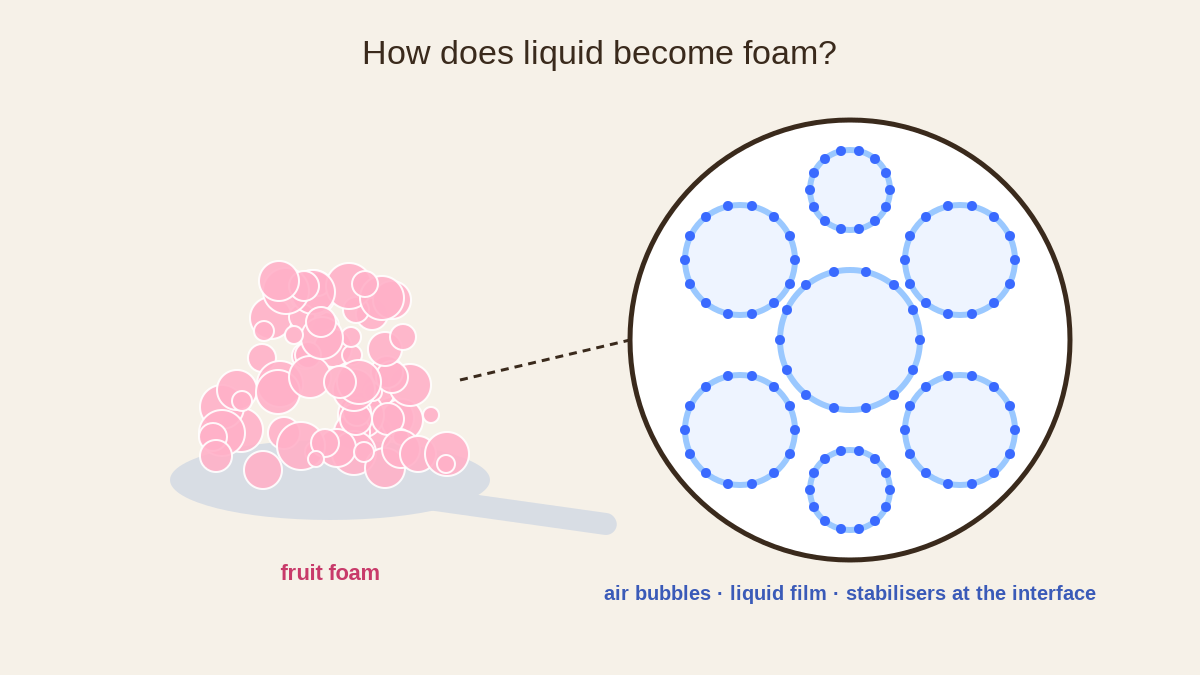
Foam is everywhere in food.
Think about whipped cream, cappuccino foam and meringue.
A foam contains gas bubbles dispersed throughout a liquid or solid structure.
But gas bubbles naturally tend to merge and escape.
To create a stable foam, chefs and food scientists use ingredients that help stabilise the air-liquid interface.
These may include proteins, emulsifiers and specialised hydrocolloids.
The result can be a light, airy texture that holds its shape long enough to serve.
04How do liquids become gels?
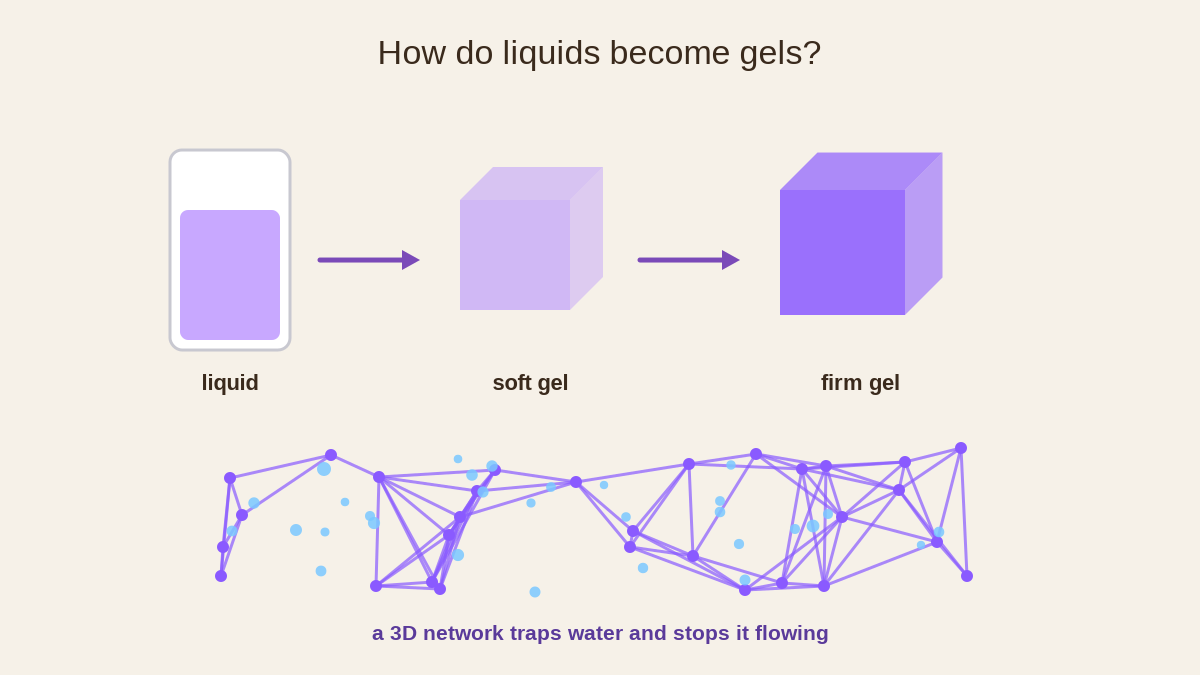
A gel may look solid, but it often contains a large amount of water.
How does this happen?
Certain molecules form a three-dimensional network.
This network traps liquid within its structure and prevents it from flowing freely.
Different gelling ingredients create different results.
For example:
- Gelatin creates elastic, soft gels.
- Agar can create relatively firm gels.
- Pectin is widely used in jams and fruit preparations.
- Alginate can create gels through interactions with calcium ions.
The choice of ingredient determines the texture and behaviour of the final product.
05Why food scientists love these techniques
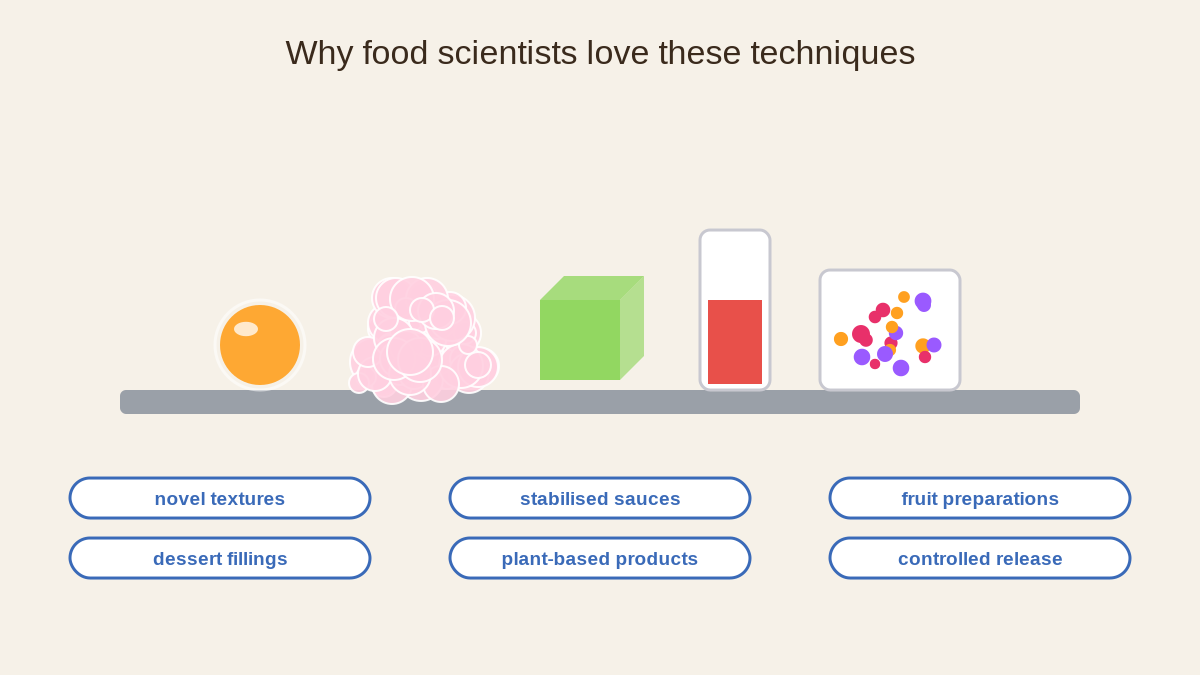
These techniques are not only for fine dining.
Food scientists use similar principles to develop:
- Novel food textures.
- Stabilised sauces.
- Fruit preparations.
- Dessert fillings.
- Plant-based products.
- Controlled-release food ingredients.
Understanding how molecules interact helps manufacturers design products with specific textures and functional properties.
06Try this: make edible fruit pearls
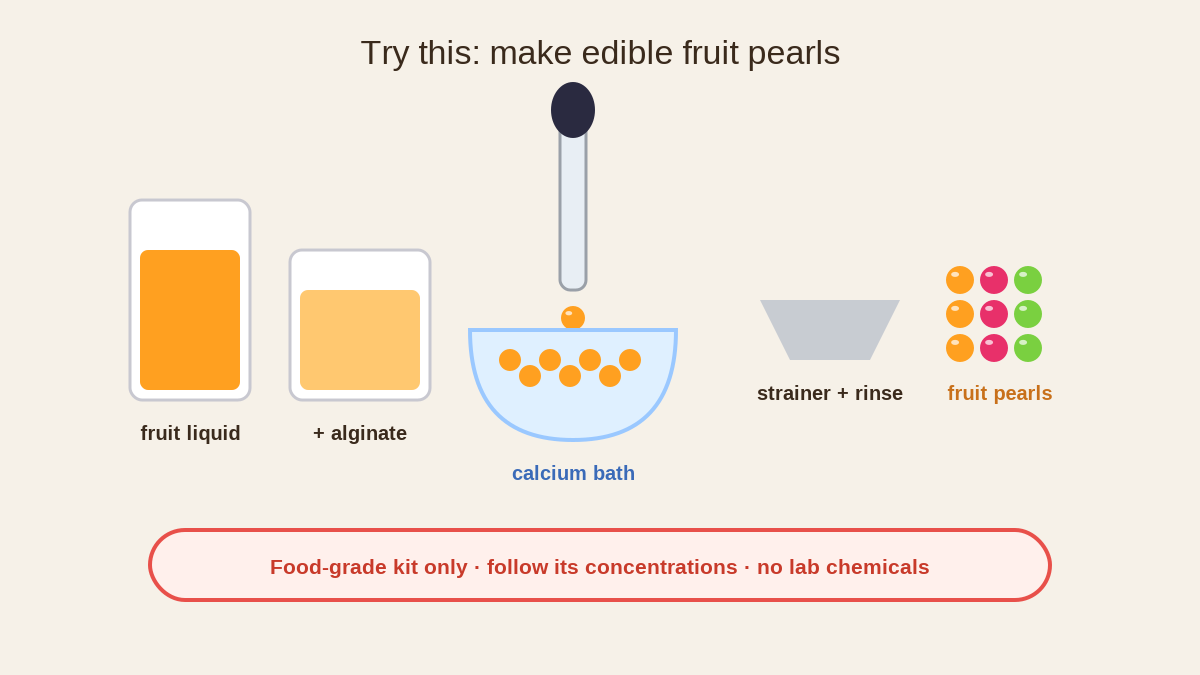
Want to explore spherification?
You can try a food-grade spherification kit by following its manufacturer's instructions.
Safety: Use food-grade ingredients, check the product specifications and follow the recommended concentrations. Very acidic juices may require formulation adjustments. Do not use laboratory chemicals or industrial-grade ingredients.
07The big takeaway
Molecular gastronomy shows that food can be transformed by controlling its microscopic structure.
A liquid can become a sphere. A sauce can become a foam. A simple mixture can become a delicate gel.
The ingredients may be familiar, but the science changes the experience.