
Chocolate is not just food. It is a crystal engineering experiment.
Imagine taking a beautiful chocolate bar out of its wrapper.
You break it.
It makes that satisfying little snap.
You place a piece on your tongue, and within seconds, it begins to disappear.
Now imagine leaving the same chocolate bar in a warm room.
A few hours later, it looks dull, develops whitish patches and loses its beautiful appearance.
What happened?
Did the chocolate go bad?
Not necessarily.
The answer lies in one of the most fascinating ingredients in food science: cocoa butter.
And its behaviour is far more complicated than simply melting and solidifying.
01Meet the star: cocoa butter
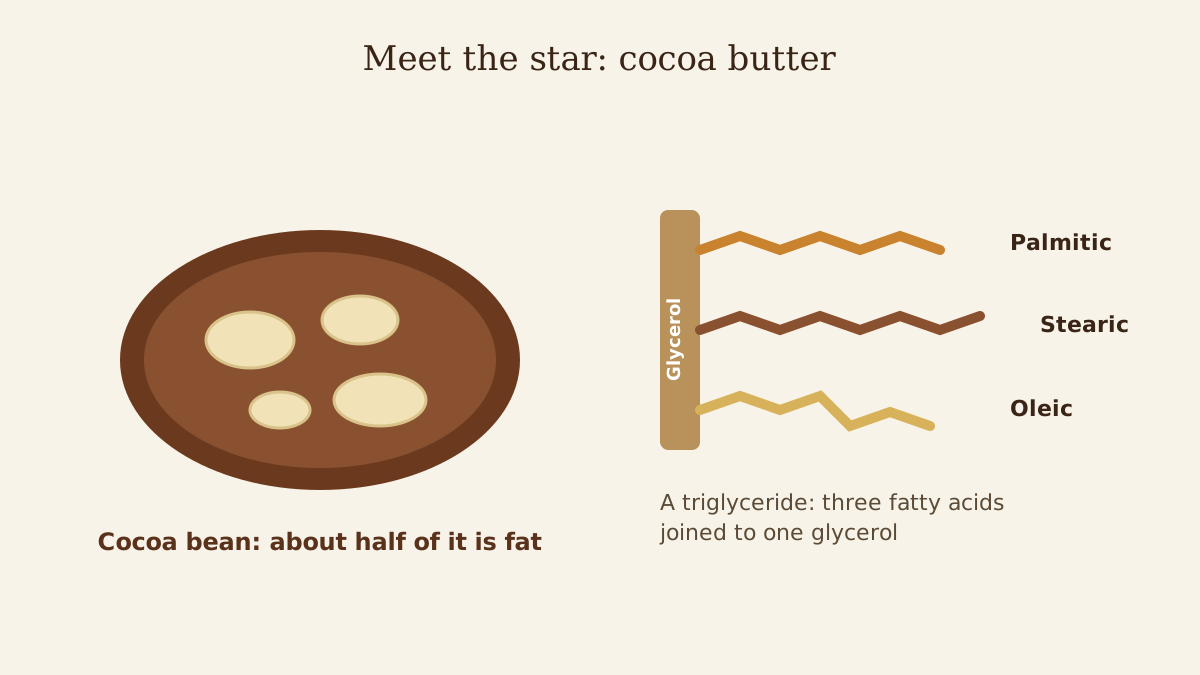
Chocolate contains several ingredients, but one of the most important for its physical properties is cocoa butter.
Cocoa butter is the natural fat extracted from cocoa beans.
It contains a mixture of fatty acids, mainly:
- Palmitic acid
- Stearic acid
- Oleic acid
These fatty acids are combined into triglyceride molecules.
What makes cocoa butter especially interesting is that these fat molecules can arrange themselves into different crystalline structures when the fat solidifies.
And this is where the real science begins.
02Six different personalities: the crystals of chocolate
Here's something most chocolate lovers don't know.
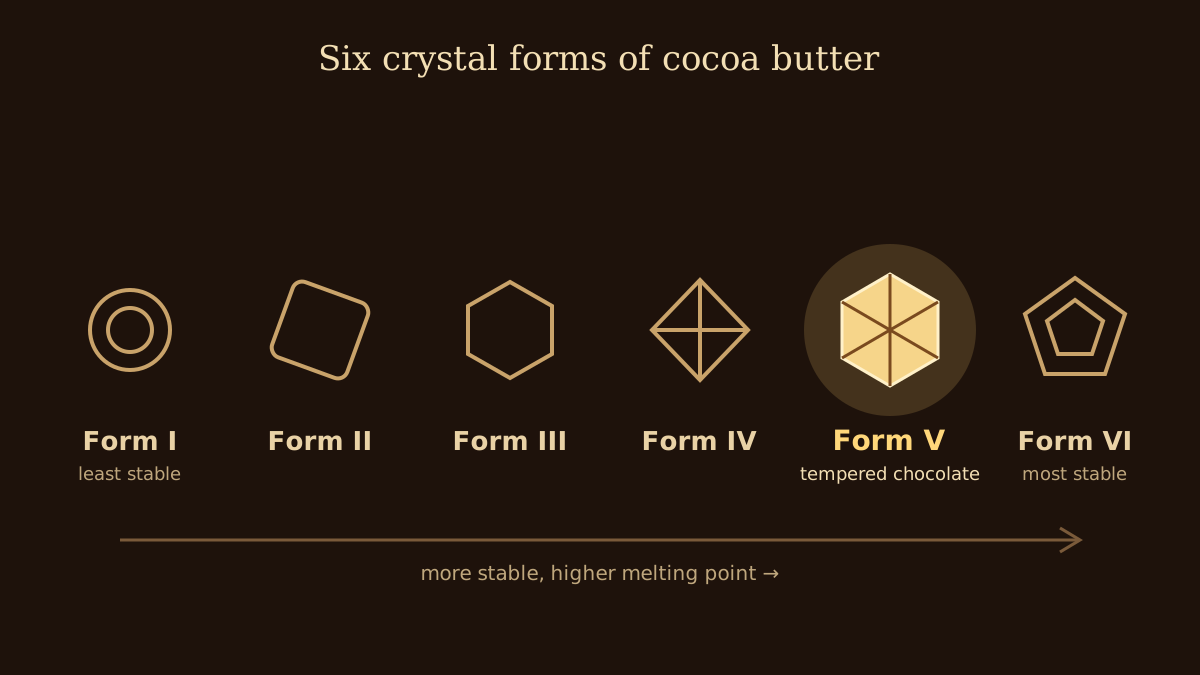
Cocoa butter can crystallize into six different polymorphic forms.
This phenomenon is called polymorphism.
In simple language, the same fat can solidify into different arrangements of molecules.
These six forms have different physical properties, including melting behaviour, stability and texture.
Not all crystal structures produce desirable chocolate.
Some create softer or less stable products.
Others can produce chocolate with a better appearance, texture and snap.
The challenge for chocolatiers is encouraging the right crystals to form.
03Why does chocolate melt in your mouth?
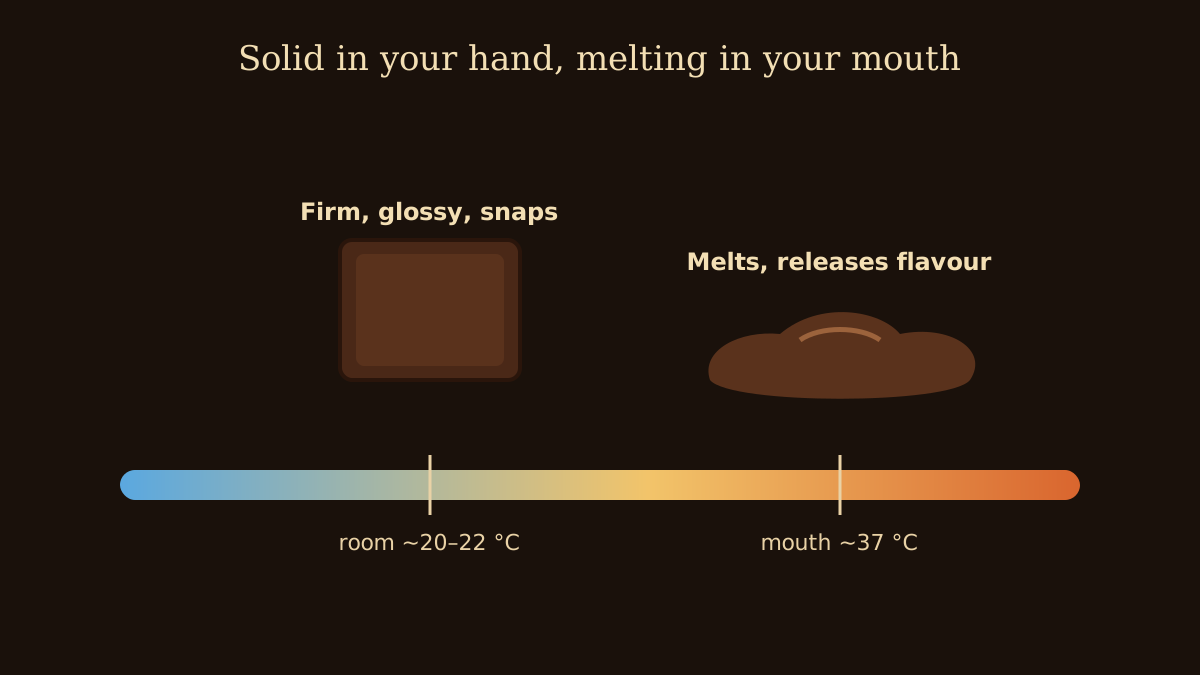
Have you ever noticed how chocolate can remain solid in your hand but melt beautifully when you eat it?
The secret is cocoa butter's melting behaviour.
Cocoa butter has a melting range that is close to body temperature.
Properly tempered chocolate is designed to remain solid at normal room temperatures while melting readily in the mouth.
As the chocolate warms, its crystalline fat structure melts.
This releases the other ingredients, allowing the chocolate to spread across your mouth and deliver its flavour and aroma.
This is why cocoa butter is so important to chocolate's characteristic eating experience.
04The mysterious white coating: why does chocolate turn white?
You open a chocolate wrapper and notice something strange.
The chocolate has developed a white or greyish coating.
It doesn't look particularly appetizing.
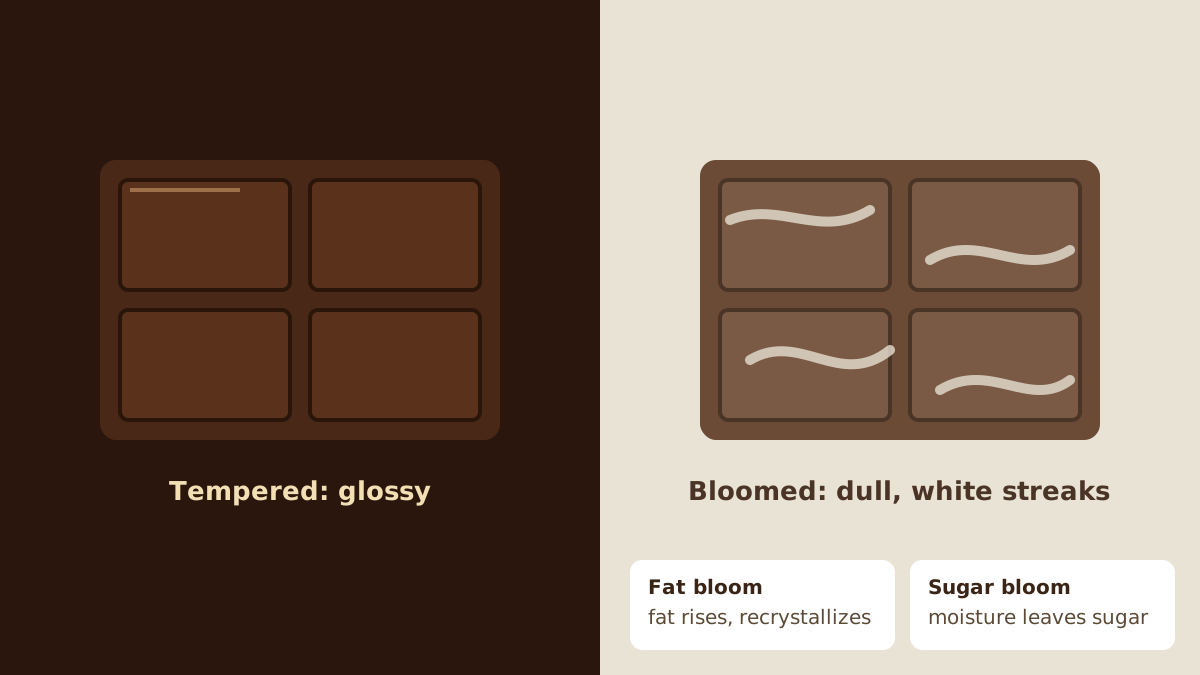
But this phenomenon is often called chocolate bloom.
There are two important types.
Fat bloom
Fat bloom occurs when cocoa butter or other fats migrate and recrystallize on the chocolate surface.
Temperature fluctuations can contribute to this process.
The surface becomes dull and develops whitish streaks or patches.
Sugar bloom
Sugar bloom is different.
It commonly occurs when moisture condenses on the chocolate surface.
The moisture dissolves some of the sugar.
When the water evaporates, sugar crystals remain on the surface.
This creates a rough, whitish appearance.
05The art of tempering: how chocolatiers control crystals
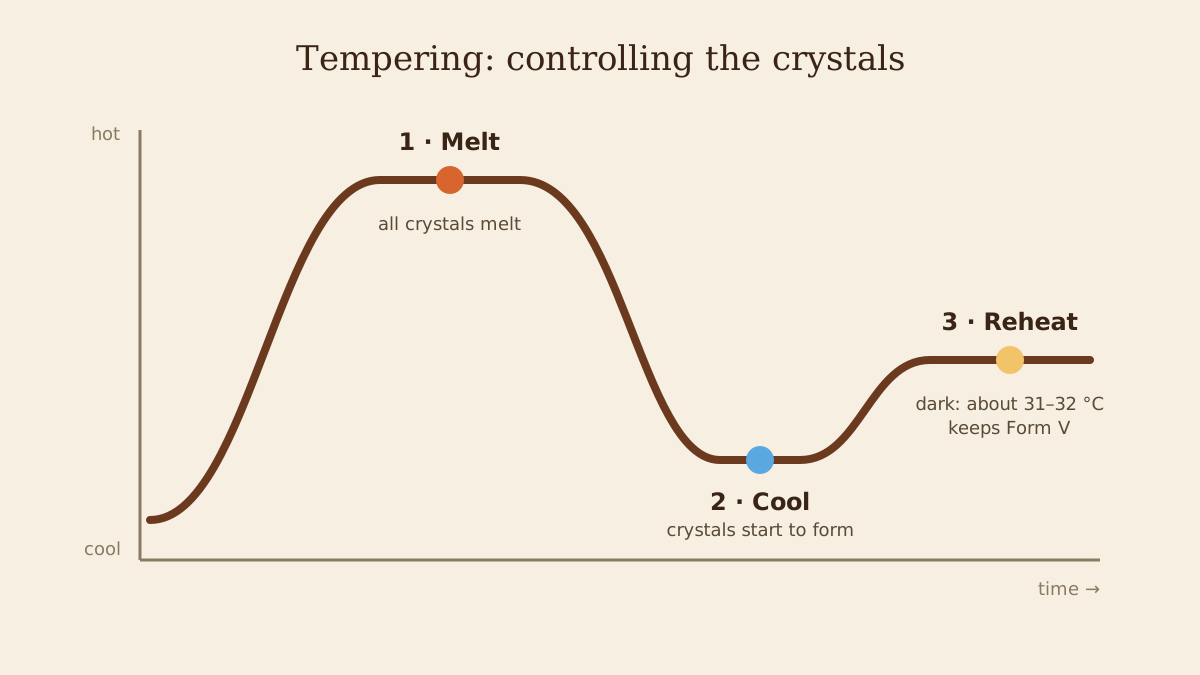
How do professional chocolatiers create chocolate that is glossy, firm and beautifully crisp?
They use a technique called tempering.
Tempering is a controlled process of heating, cooling and reheating chocolate to encourage the formation of desirable cocoa butter crystals.
A typical dark chocolate tempering process involves:
- Melting. Chocolate is heated sufficiently to melt existing cocoa butter crystals.
- Cooling. The chocolate is cooled under controlled conditions to encourage crystal formation.
- Reheating. The chocolate is gently warmed to a working temperature, melting less stable crystals while retaining desirable Form V crystals.
The exact temperatures depend on the chocolate formulation and manufacturer.
For many dark chocolates, a typical working range is around 31–32°C, but this is not universal.
Tempering is essentially the art of controlling fat crystallization.
06What happens under the microscope?
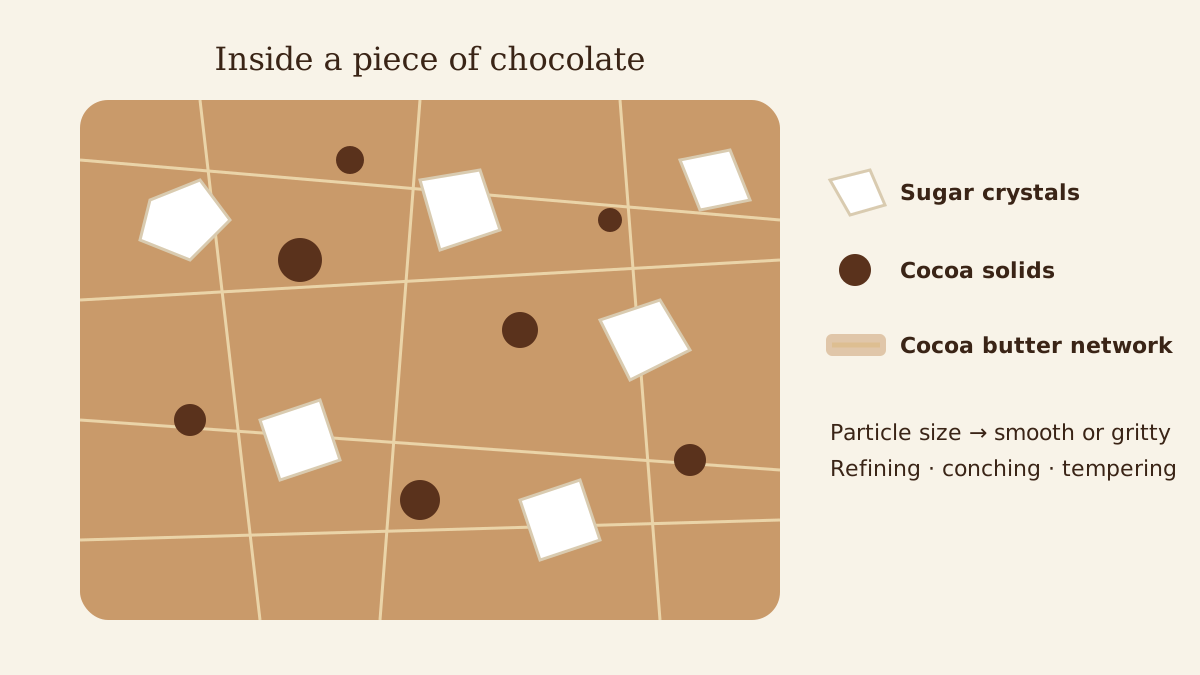
Chocolate might look smooth to the naked eye.
But internally, it is a complex mixture.
It contains:
- Cocoa butter.
- Sugar particles.
- Cocoa solids.
- Sometimes milk solids and additional fats, depending on the chocolate.
These ingredients form a concentrated suspension of solid particles within a continuous fat phase.
The cocoa butter crystals help create the structure that holds everything together.
The size and distribution of particles also influence how chocolate feels in your mouth.
This is why chocolate manufacturing involves much more than simply mixing cocoa and sugar.
Grinding, refining, conching and tempering all contribute to the final product.
07The ultimate experiment: can you temper chocolate at home?
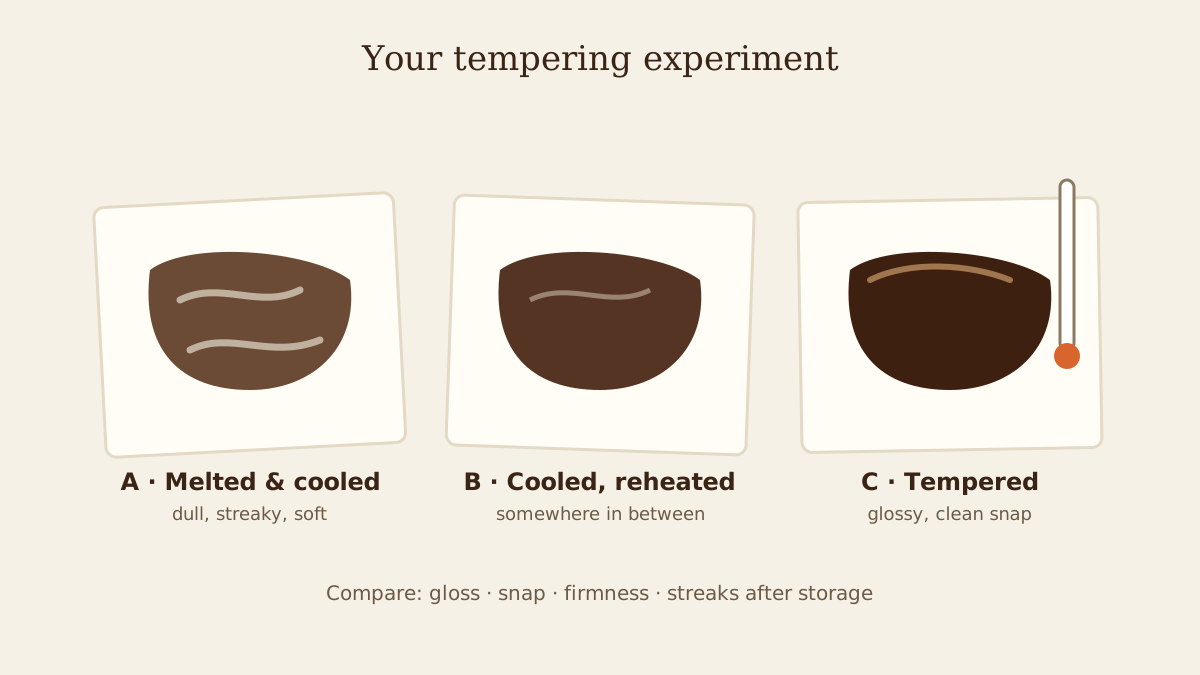
You don't need an industrial laboratory to explore chocolate crystallization.
You can observe some of the principles at home.
Your results will depend on the chocolate formulation and the actual crystal structures formed.
But you'll have a much better understanding of why chocolatiers take tempering so seriously.
08The bigger picture: food is structure
Chocolate teaches us something important about food science.
Sometimes, the ingredients alone don't determine the quality of a food.
Its internal structure matters just as much.
The way molecules arrange themselves can determine whether chocolate is glossy or dull, firm or soft, smooth or grainy.
A small change in temperature can influence an entire product's appearance and texture.
And that is what makes chocolate so fascinating.
A perfect chocolate bar isn't simply made. It is carefully engineered at the microscopic level.
09The final melt
The next time you break a chocolate bar and hear that satisfying snap, remember the invisible crystal structures responsible for it.
The next time chocolate melts on your tongue, remember the carefully balanced melting behaviour of cocoa butter.
And the next time you see white patches on a chocolate bar, remember that a little fat migration or sugar crystallization might be responsible.
Chocolate is more than a sweet treat.
It is a lesson in molecular organization, temperature control and food engineering.
Sometimes, the secret to perfect chocolate is hidden in a crystal you cannot even see.