Your mouth is experiencing heat. But the chilli isn't actually hot.
Take a bite of a spicy chilli.
Within seconds, your tongue begins to burn.
Your lips tingle. Your face might turn red. You start sweating, and suddenly you're reaching for a glass of water.
But here's the fascinating part.
The chilli hasn't actually increased the temperature inside your mouth.
So why does your brain think you're on fire?
The answer lies in a chemical compound that tricks your body's temperature and pain-sensing system.
Meet capsaicin.
01Meet capsaicin: the molecule behind the burn
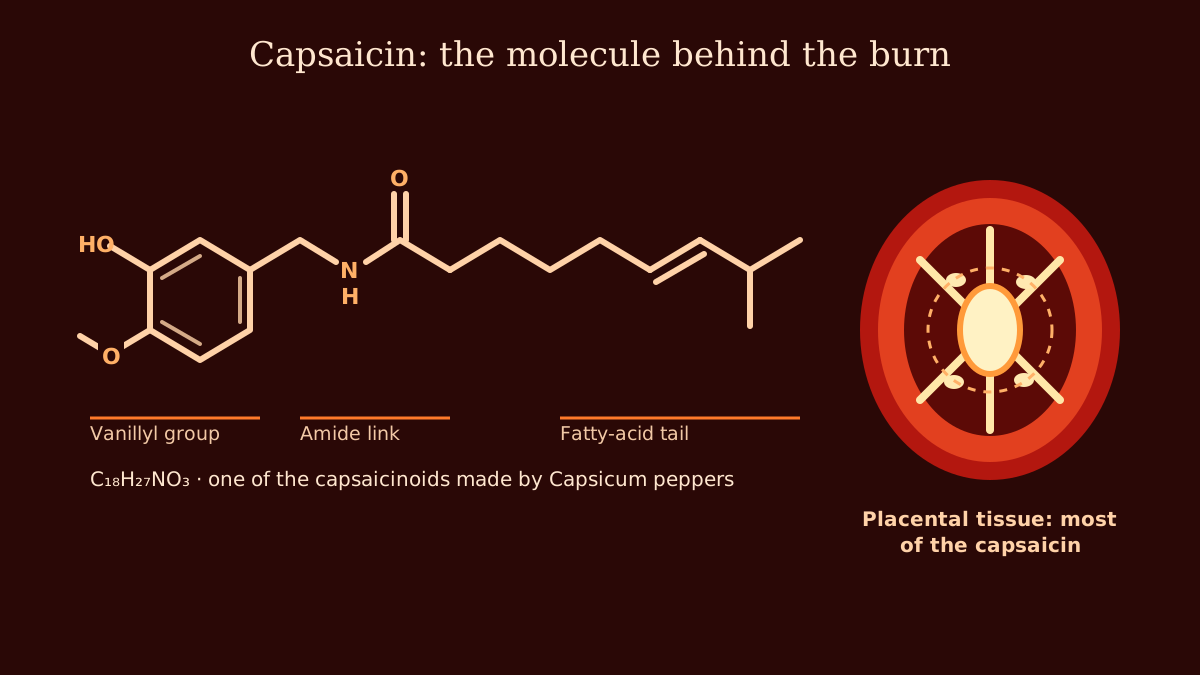
Capsaicin is the main compound responsible for the characteristic burning sensation of hot chilli peppers.
It belongs to a group of compounds called capsaicinoids.
These compounds are produced naturally by chilli peppers belonging to the genus Capsicum.
Interestingly, capsaicin is concentrated mainly in the pepper's internal placental tissue, where the seeds are attached.
The seeds themselves are not the main source of the heat, although they can become coated with capsaicin.
And here's the interesting part:
Capsaicin doesn't need to physically burn your mouth to make you feel like it does.
It interacts with a specific receptor in your nervous system.
02Your body's heat sensor is being tricked
Your body has specialized sensory receptors that help detect potentially harmful temperatures and other stimuli.
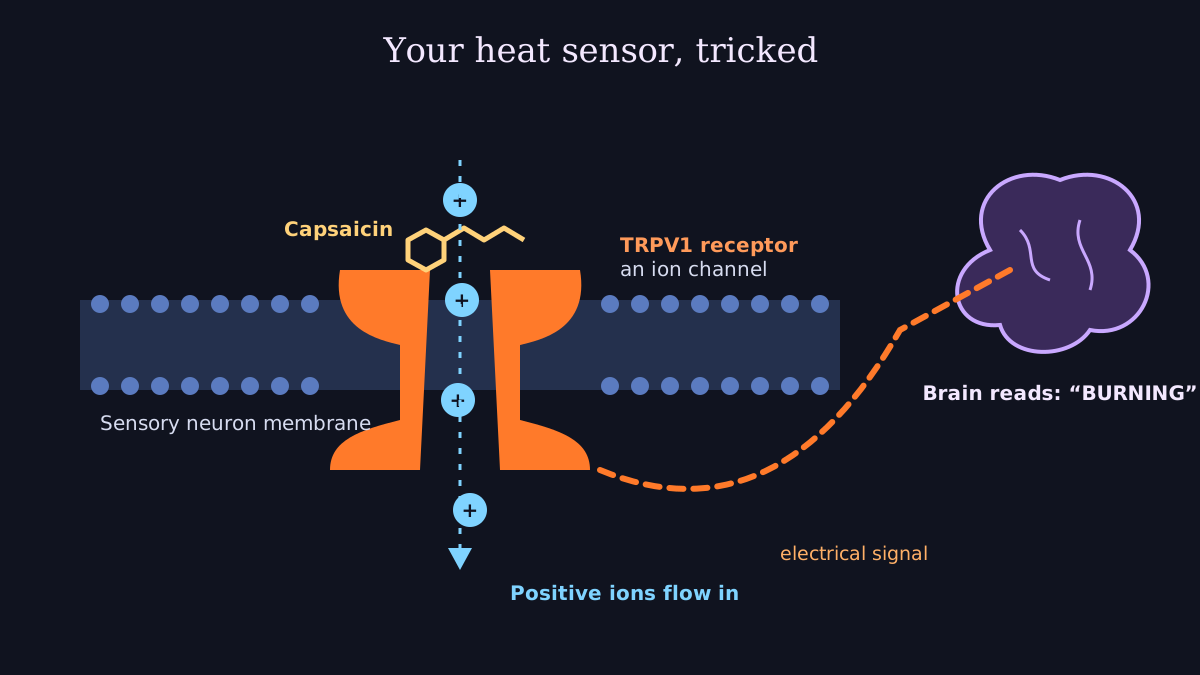
One particularly important receptor is called TRPV1.
TRPV1 stands for transient receptor potential vanilloid 1.
It responds to high temperatures and certain chemical stimuli.
Capsaicin can activate this receptor.
When capsaicin binds to TRPV1, it opens an ion channel, allowing positively charged ions to move into the sensory nerve cell.
This triggers electrical signals that travel towards the nervous system.
Your brain interprets these signals as a burning sensation.
03Why does spicy food make you sweat?
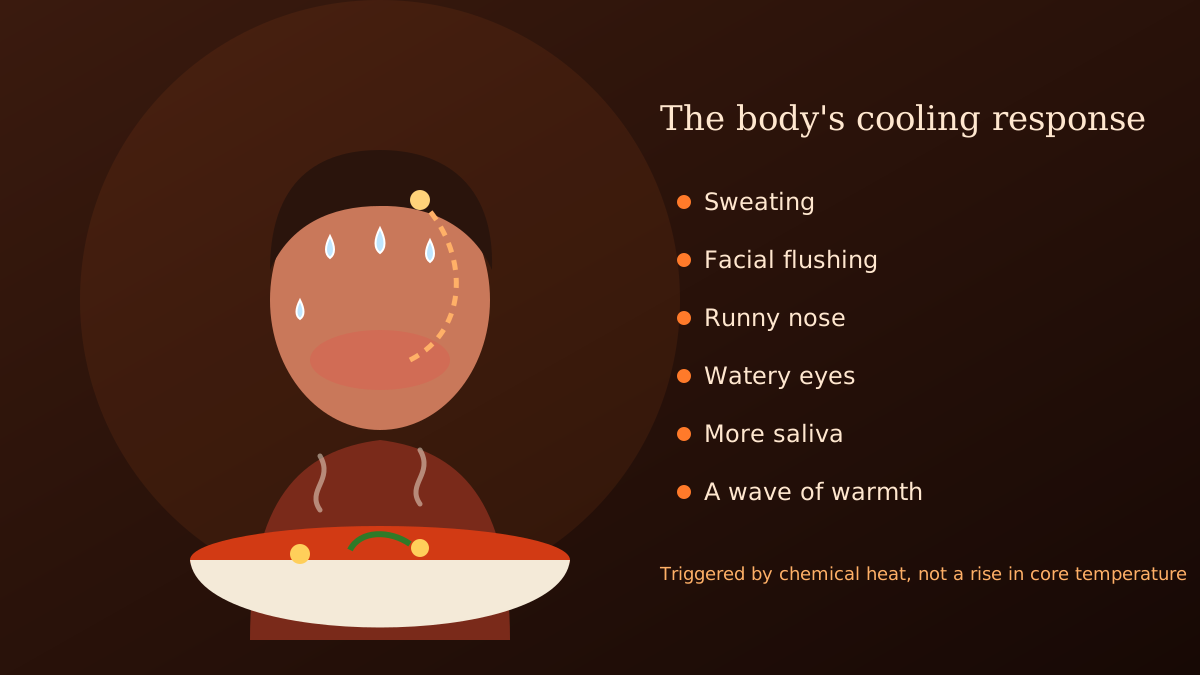
Ever noticed how eating extremely spicy food can make your forehead sweat?
This is not your imagination.
Capsaicin activates sensory pathways associated with heat and irritation.
The nervous system can respond with several reactions, including sweating and changes in blood flow.
Sweating is one of the body's natural cooling mechanisms.
When sweat evaporates from the skin, it helps remove heat.
But in this situation, the sweating response is triggered by the sensation of chemical heat rather than necessarily by a rise in your body's core temperature.
Other reactions can include:
- Facial flushing.
- A runny nose.
- Watery eyes.
- Increased salivation.
- A temporary feeling of intense warmth.
Your body is responding to a chemical signal as though it has encountered heat.
04Why does water make spicy food feel worse?
You've probably experienced this.
You eat something extremely spicy.
You immediately drink water.
And somehow, the burning sensation remains.
Why?
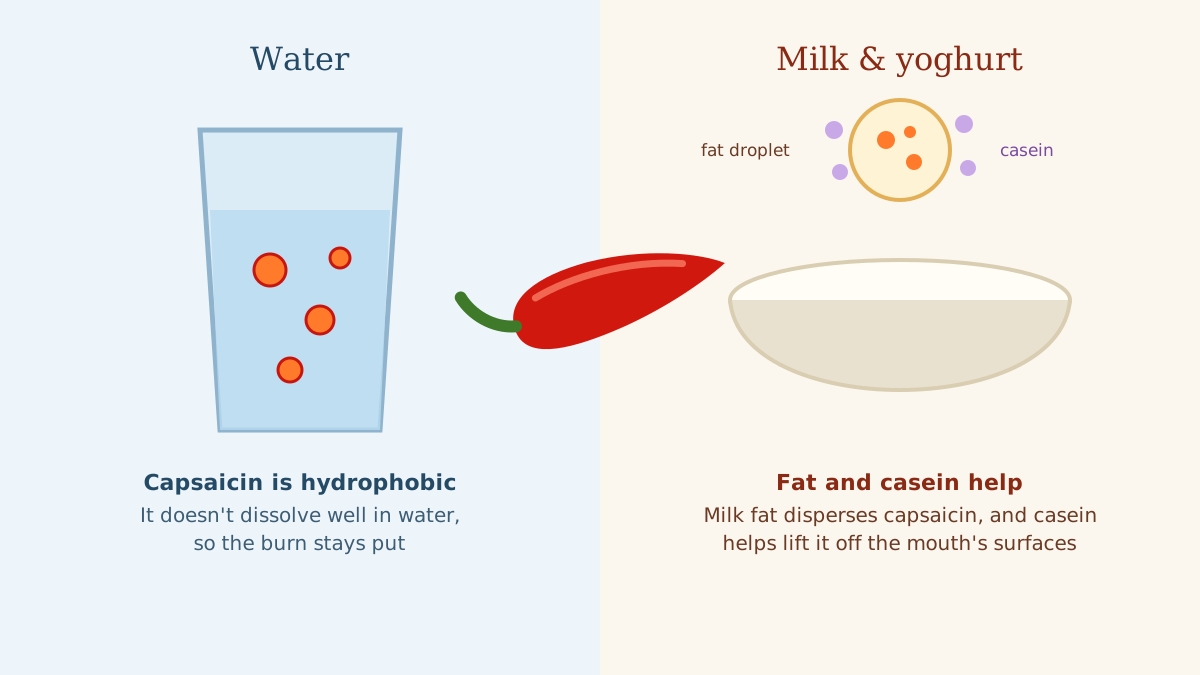
Capsaicin is relatively hydrophobic, meaning it does not dissolve readily in water.
It is much more compatible with fats and certain organic solvents.
This means drinking water doesn't efficiently remove capsaicin from the oily surfaces inside your mouth.
So what works better?
Dairy products
Milk and some dairy products can help reduce the burning sensation.
Milk contains fat, which can help disperse capsaicin.
It also contains casein, a milk protein that can help remove capsaicin from oral surfaces.
This is one reason why yoghurt, milk and certain dairy-based drinks are commonly served alongside spicy food.
05Why does spicy food feel different to different people?
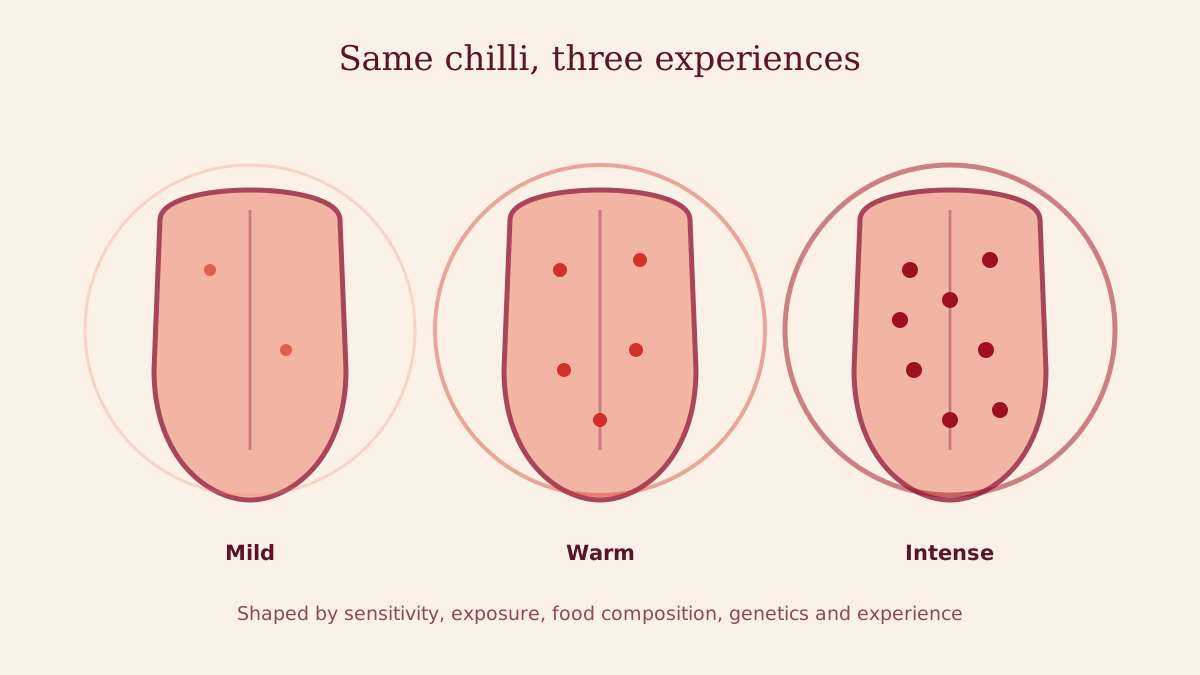
Have you ever wondered why one person can comfortably eat extremely spicy food while another struggles with a tiny piece of chilli?
There isn't just one explanation.
Spice perception can vary because of several factors:
1. Sensory sensitivity
People can differ in how strongly they perceive chemical irritation.
2. Previous exposure
Repeated exposure to spicy food can change how people experience and tolerate the sensation.
3. Food composition
Fat, protein, sweetness and acidity can influence the overall eating experience.
4. Individual differences
Genetics, physiology and previous experiences may contribute to variations in spice perception.
Spice tolerance isn't simply a matter of having a stronger tongue.
It's a combination of sensory biology, experience and food chemistry.
06The Scoville scale: how do we measure spiciness?
How do scientists and food manufacturers compare the heat of different chilli peppers?
One well-known measurement is the Scoville Heat Unit, or SHU.
The Scoville scale was developed by American pharmacist Wilbur Scoville in 1912.
Originally, it relied on a sensory dilution test involving human tasters.
Today, laboratory methods such as high-performance liquid chromatography can measure capsaicinoid concentrations more objectively.
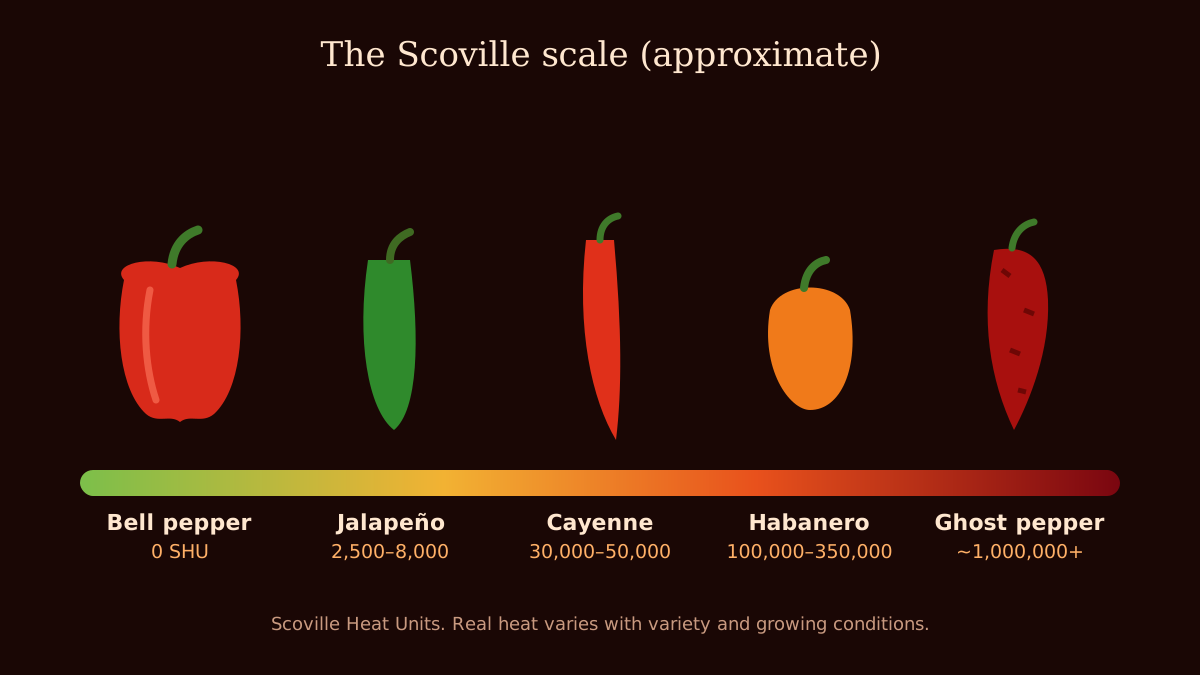
Some approximate examples:
- Bell pepper: 0 SHU.
- Jalapeño: 2,500–8,000 SHU.
- Cayenne pepper: 30,000–50,000 SHU.
- Habanero: 100,000–350,000 SHU.
- Ghost pepper: often around 1 million SHU or more.
These are approximate ranges. Actual heat varies with the pepper variety and growing conditions.
The fascinating thing is that spiciness isn't a basic taste like sweetness or bitterness.
It is primarily a chemesthetic sensation: a chemical sensation involving sensory nerves.
07Why do we sometimes enjoy something that hurts?

Here's perhaps the biggest mystery of spicy food.
If capsaicin activates pain-related sensory pathways, why do so many people actively enjoy eating chilli?
The answer is complicated.
Spicy food creates an intense sensory experience.
For some people, the combination of heat, flavour, aroma and the excitement of the sensation makes the experience enjoyable.
Repeated exposure can also change how people respond to capsaicin.
Some individuals enjoy the challenge and anticipation associated with spicy food.
But there is no single universal explanation for why people love chilli.
What we do know is that food enjoyment involves much more than taste alone.
It includes sensory perception, memory, culture, emotion and experience.
08The food industry's spicy secret
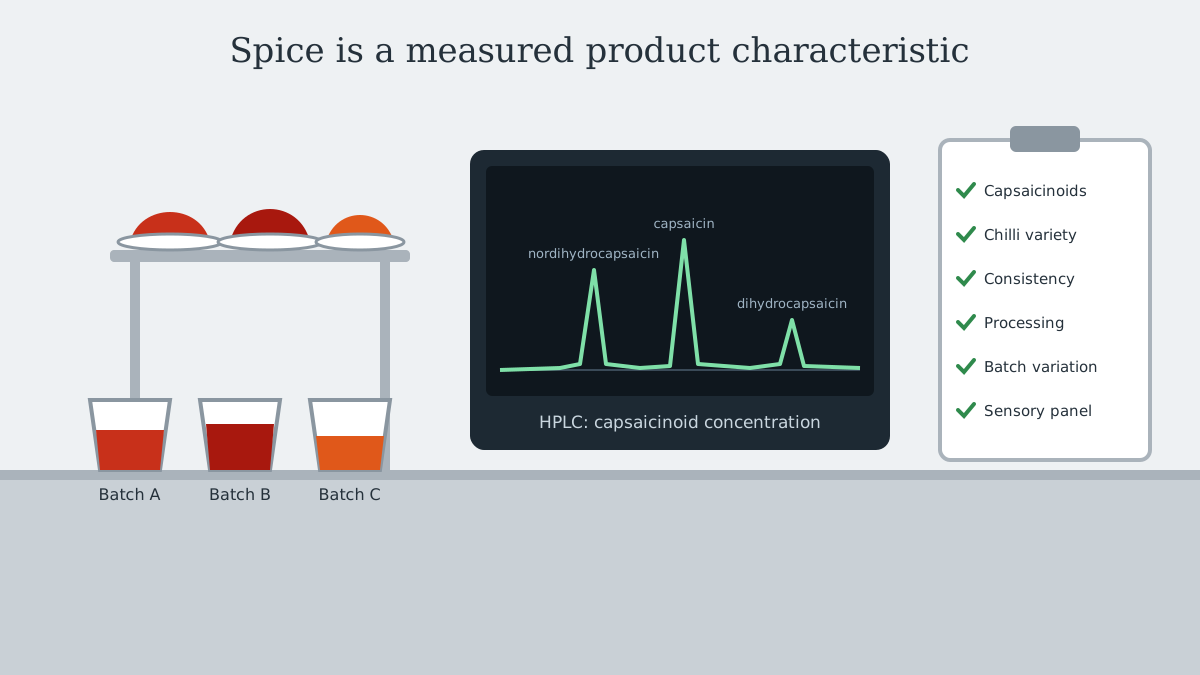
Spiciness isn't just a matter of adding more chilli powder.
Food manufacturers need to control heat consistently.
Imagine buying the same hot sauce twice and discovering that one bottle is significantly hotter than the other.
That would be a quality-control problem.
Food scientists and manufacturers evaluate chilli ingredients using several parameters:
- Capsaicinoid concentration.
- Chilli variety.
- Ingredient consistency.
- Processing conditions.
- Batch-to-batch variation.
- Sensory evaluation.
Laboratory techniques can help determine the capsaicinoid content of raw materials and finished products.
This allows manufacturers to develop products with more consistent heat profiles.
For the food industry, spice is not just flavour.
It is a measurable product characteristic.
09The final burn
The next time you bite into a chilli and feel that familiar burning sensation, remember:
The chilli hasn't necessarily heated your mouth.
A molecule has interacted with your sensory receptors.
Your nerves have sent signals.
Your brain has interpreted those signals as heat.
And your body has responded accordingly.
A tiny chemical compound has managed to convince your nervous system that dinner is on fire.
Sometimes, the hottest thing on your plate isn't temperature. It's chemistry.