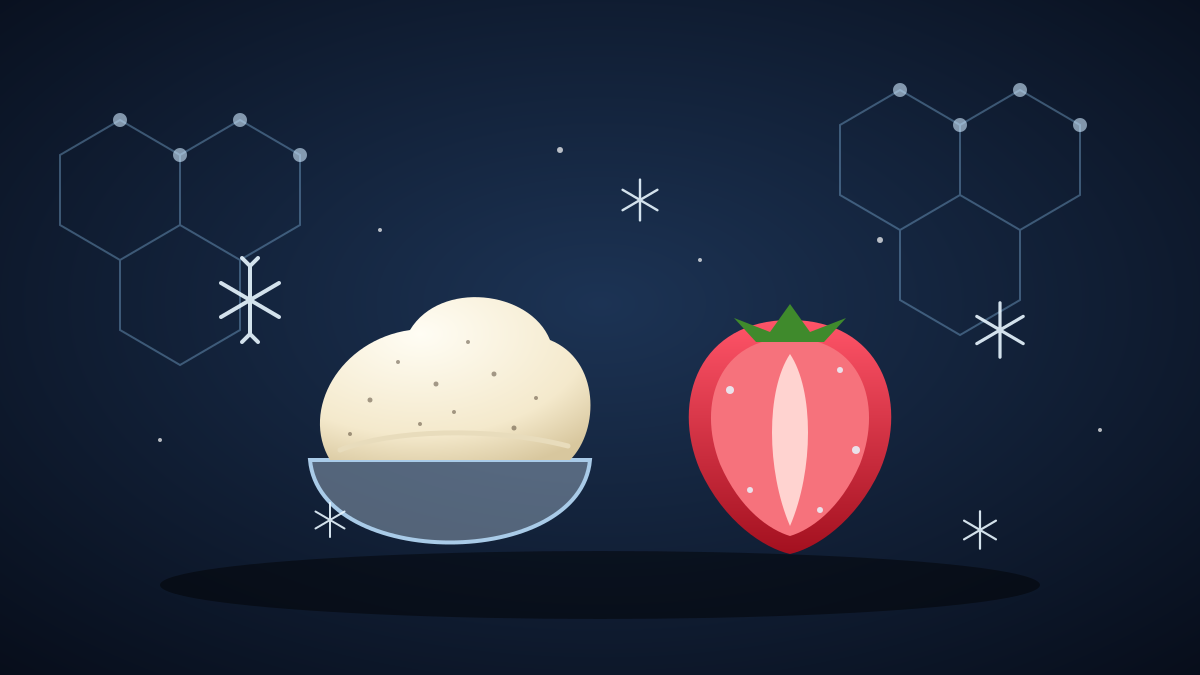
Freezing doesn't just make food cold. It changes its structure.
Put a strawberry in the freezer. Leave it overnight. Then allow it to thaw.
You might notice that it has lost its firmness. It may look smaller, softer and release a surprising amount of liquid.
Now think about ice cream.
It also contains frozen water, yet it can remain smooth, creamy and scoopable.
Why doesn't it become one giant block of ice?
The answer is hidden in the size of ice crystals, the movement of water, the ingredients surrounding those crystals and the speed at which food freezes.
Freezing is not simply about lowering temperature.
It is about controlling what happens to water.
01What happens when water freezes?
Water changes its arrangement
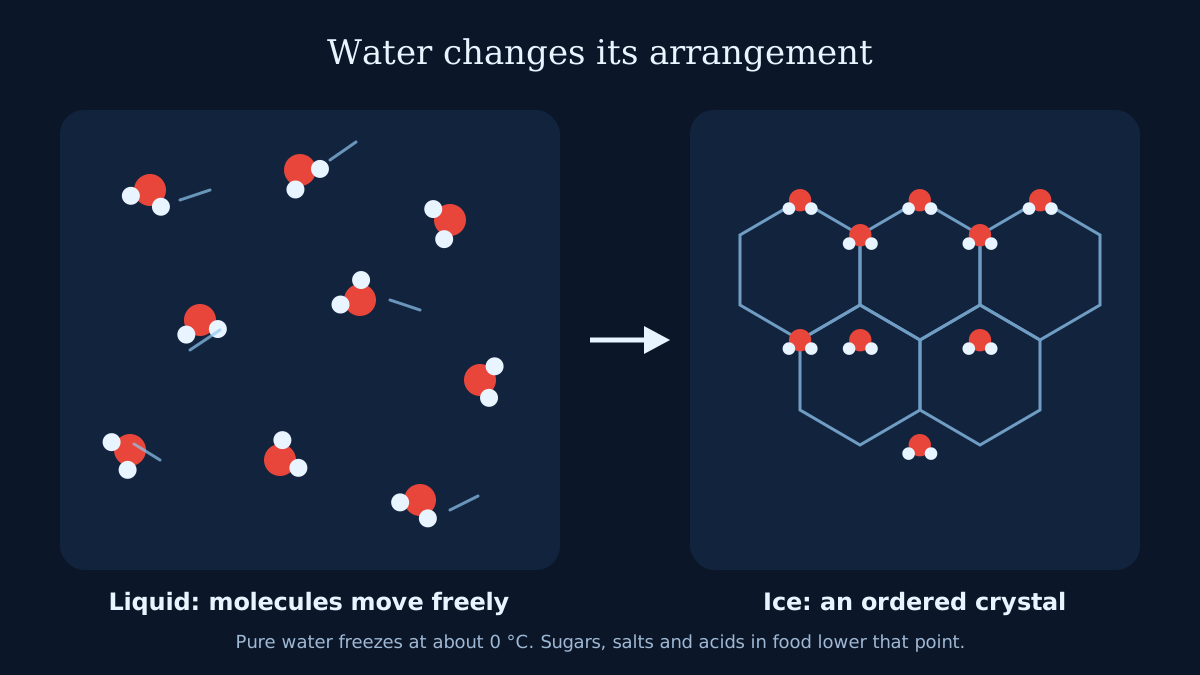
Water molecules are constantly moving.
As water cools, their movement slows. When conditions allow ice to form, water molecules arrange themselves into an organised crystalline structure.
In ordinary atmospheric conditions, pure water freezes at approximately 0°C.
But food is not pure water.
It contains sugars, salts, proteins, acids and other dissolved substances. These ingredients can lower the freezing point and influence how ice forms.
This is why different foods freeze differently.
When ice crystals form, they also push many dissolved substances into the remaining unfrozen liquid.
That means the unfrozen portion of a food can become more concentrated as freezing continues.
Freezing changes not only the physical state of water, but also the environment surrounding it.
02Why ice cream doesn't become a solid block
Ice cream is an entirely different frozen system
Ice cream is not simply frozen milk.
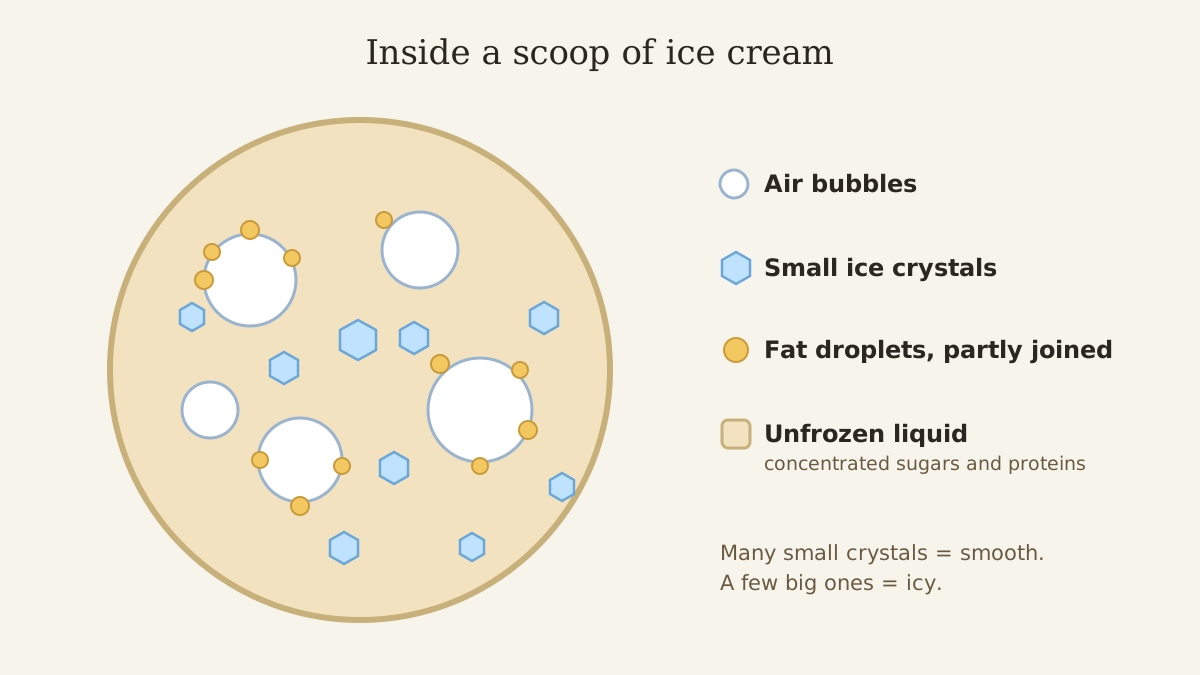
It is a complex mixture of several components:
- Water.
- Milk fat.
- Proteins.
- Sugars.
- Air.
- Stabilising ingredients.
During ice cream production, the mixture is frozen while being continuously agitated.
This process encourages the formation of many small ice crystals rather than a few large ones.
Air is also incorporated, while fat droplets partially join together to help create the product's structure.
Not all the water freezes. A concentrated unfrozen liquid remains between the ice crystals.
This combination gives ice cream its characteristic texture.
The goal of ice cream manufacturing is therefore not simply to freeze the mixture.
It is to control crystal formation, air incorporation and the structure of the surrounding ingredients.
03Why frozen strawberries become mushy
The problem is inside the cells
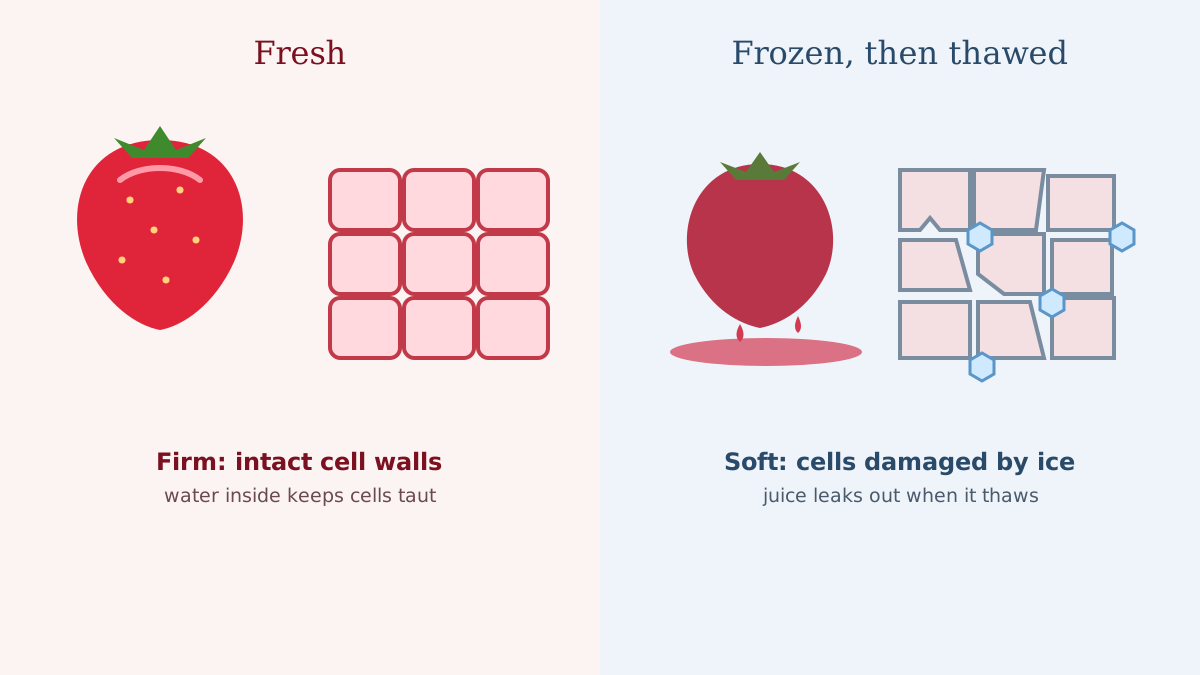
Fresh strawberries contain water inside their cells and in the spaces between them.
Their firm structure depends partly on intact cell walls and the pressure created by water inside the cells.
During freezing, ice crystals can form within and between plant cells.
As crystals grow, they can physically damage cellular structures.
Water also moves between different regions as ice forms.
When the strawberry thaws, the damaged cells cannot fully recover their original structure.
The result?
- Softer texture.
- Liquid leakage.
- Reduced firmness.
- A mushier appearance.
This is why frozen strawberries are excellent for smoothies, sauces and baking, but may not have the same texture as fresh strawberries when eaten plain.
04The secret of quick freezing
Speed makes a difference
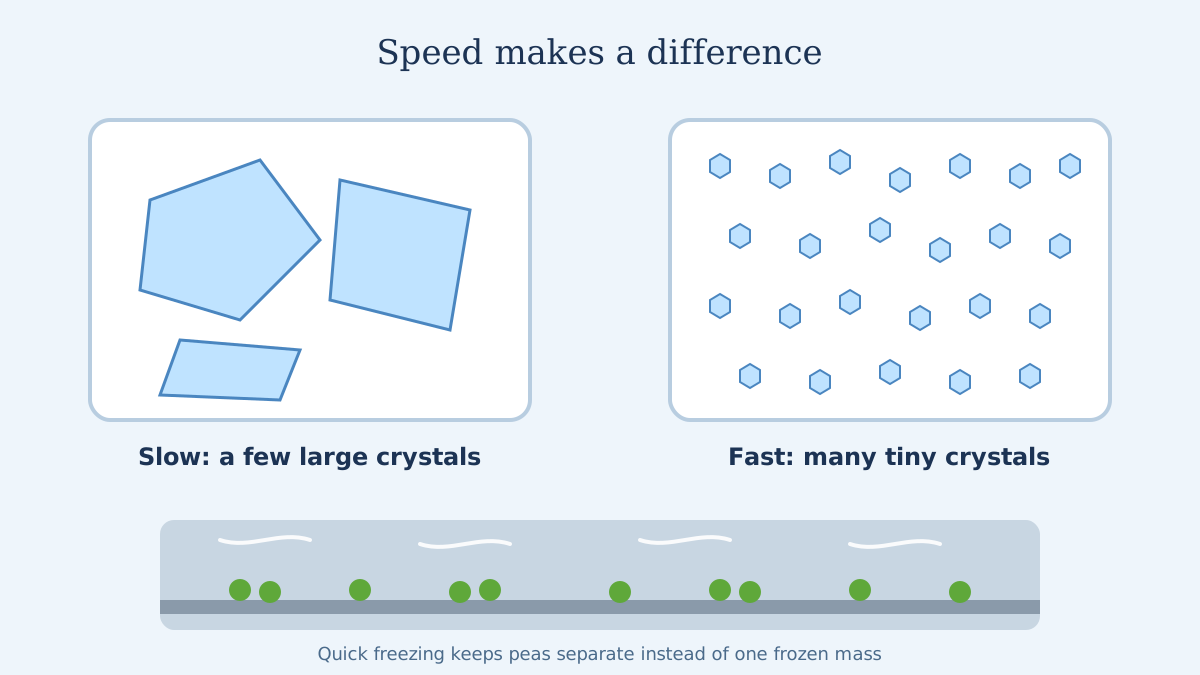
The speed of freezing can influence ice crystal size.
In general, faster freezing creates more ice crystal nuclei, giving water less time to accumulate into large crystals.
Slower freezing can allow crystals to grow larger.
This is why rapid freezing is important in many commercial food applications.
Industrial freezing systems may use:
- Blast freezers.
- Individual quick freezing systems.
- Plate freezers.
- Cryogenic freezing.
The appropriate system depends on the product, its shape, packaging and processing requirements.
For example, individually quick-frozen peas can remain separate instead of freezing into one large mass.
The objective is to freeze the product efficiently while preserving desirable quality characteristics.
05Why food gets freezer burn
Frozen doesn't always mean protected forever
Have you ever found food in your freezer with pale, dry-looking patches?
This may be freezer burn.
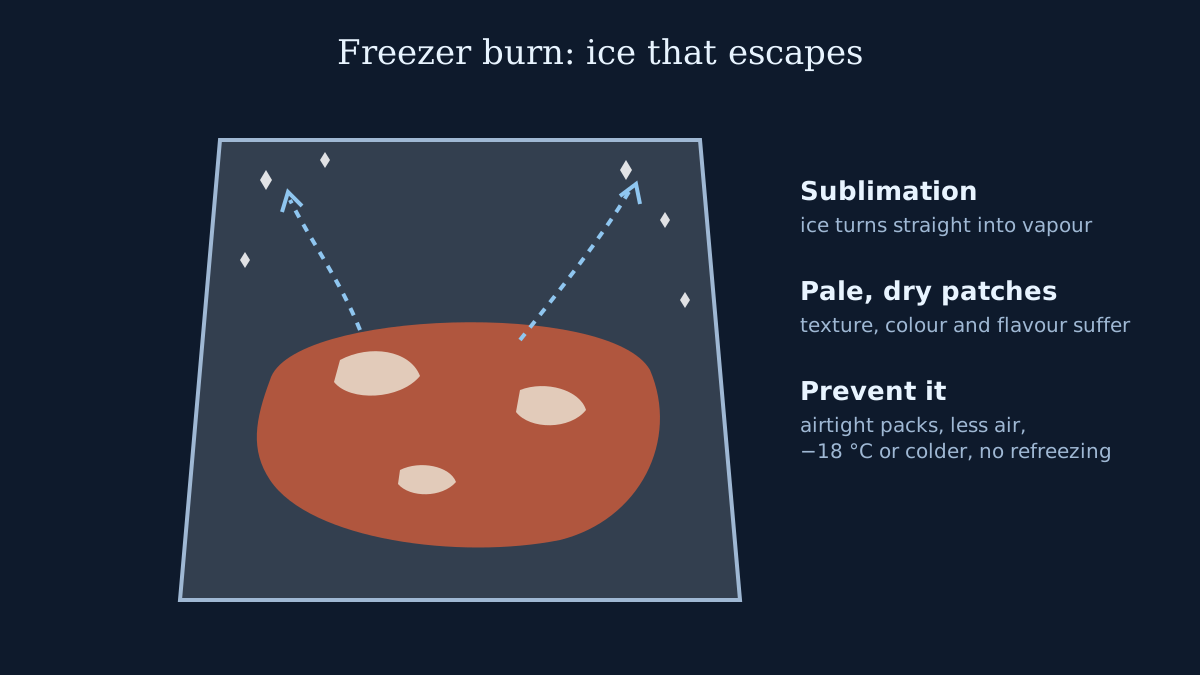
Freezer burn happens when moisture moves from the food surface and sublimates into the freezer environment.
Sublimation is the process in which ice changes directly into water vapour without first becoming liquid.
Poor packaging, air exposure and temperature fluctuations can make the problem worse.
Freezer burn mainly affects quality:
- Dry texture.
- Discolouration.
- Toughness.
- Changes in flavour.
It does not automatically mean the food is unsafe, although food safety still depends on handling, storage time and temperature.
Packaging is not just a container. It is part of the preservation system.
06The kitchen experiment: which freezes faster?
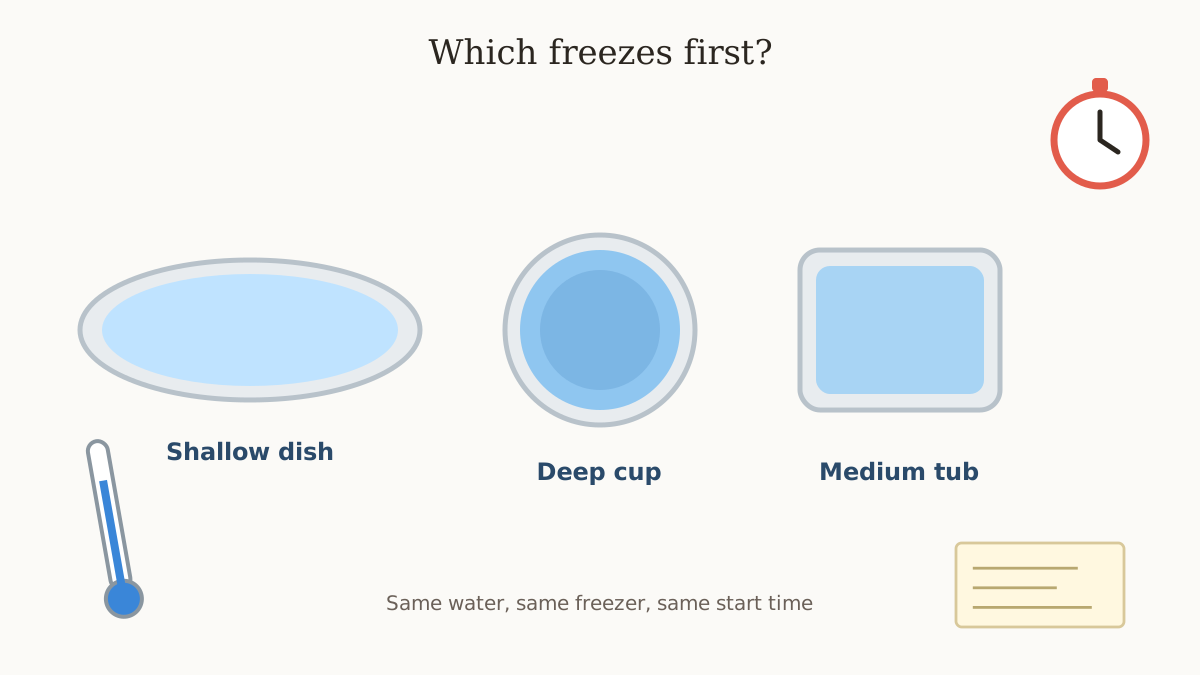
Can you observe the effect of freezing conditions?
What will you notice?
A shallow sample may freeze faster because it has a greater exposed surface area relative to its volume and a shorter distance for heat to travel.
The experiment demonstrates how geometry and heat transfer influence freezing.
For a more advanced investigation, compare the texture of two frozen fruit samples prepared under different freezing conditions.
07Freezing in the food industry
Freezing is a technology, not just a storage method
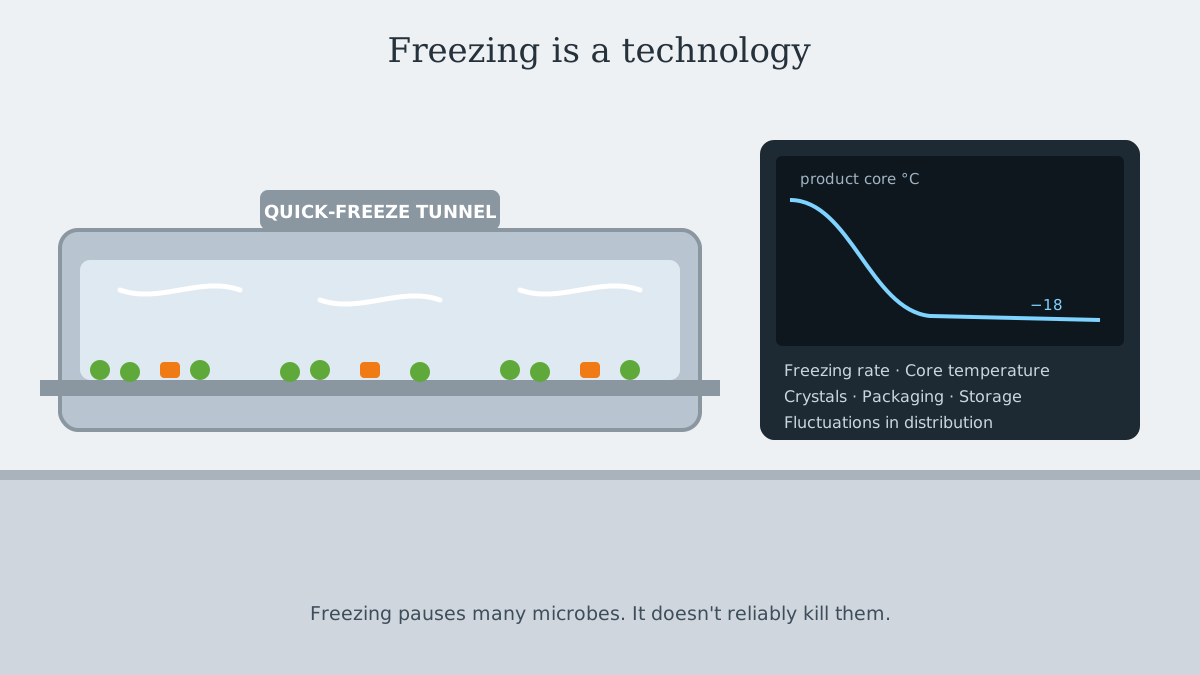
Food manufacturers use freezing to extend product shelf life and maintain quality.
But the process must be carefully controlled.
Food scientists monitor:
- Freezing rate.
- Product temperature.
- Ice crystal formation.
- Packaging integrity.
- Storage temperature.
- Temperature fluctuations during distribution.
A frozen product must also be handled correctly before freezing.
Freezing does not reliably destroy all microorganisms. Many survive in an inactive state and may become active again after thawing.
This is why freezing must be combined with appropriate hygiene, handling and temperature controls.
The science of freezing is ultimately about preserving quality while managing biological and physical changes.
08The beauty of ice
The difference between frozen and perfectly frozen
Ice is simple.
But freezing food is not.
The size of crystals, the speed of cooling, the ingredients in the food and the packaging around it all influence the final product.
A strawberry may become soft because its cellular structure has been damaged.
Ice cream remains creamy because its ingredients and manufacturing process create a carefully controlled frozen structure.
The next time you open your freezer, remember:
You are not just looking at cold food.
You are looking at water, chemistry, temperature and engineering working together.