It's more than just a little gas.
Imagine opening a cold bottle of sparkling water.
That familiar hiss escapes.
You pour it into a glass, and suddenly thousands of tiny bubbles begin racing towards the surface.
You take a sip.
There is a sharp, refreshing sensation. Almost a little sting. It feels completely different from drinking still water.
But why?
Why does carbonated water feel different on your tongue? Why does soda lose its appeal when it goes flat? And why does champagne seem to dance inside a glass?
The answer lies in a fascinating combination of chemistry, physics and sensory biology.
The bubbles aren't simply decoration.
They are changing the way you experience the drink.
01What actually creates the fizz?
Meet carbon dioxide: the invisible ingredient
The main ingredient responsible for the fizz in most carbonated drinks is carbon dioxide, or CO₂.
Carbon dioxide is a gas that can dissolve in liquids.
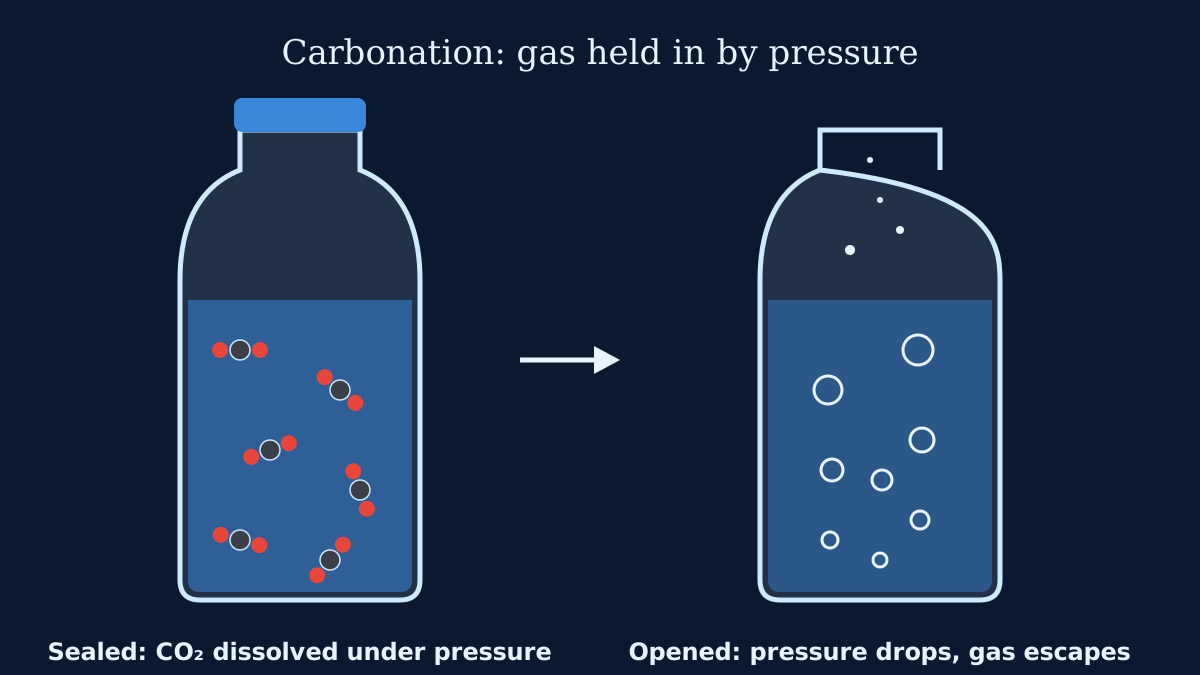
When a beverage is carbonated, carbon dioxide is introduced under pressure.
The pressure allows more gas to dissolve into the liquid than would remain dissolved under ordinary atmospheric conditions.
This process is known as carbonation.
When you open the bottle, the pressure suddenly decreases.
The liquid is now holding more dissolved carbon dioxide than it would normally retain at the new pressure.
The gas begins escaping.
Tiny bubbles form, grow and rise to the surface.
That is the fizz you see.
And the sound you hear when opening a soda bottle?
It is partly the rapid release of pressurised carbon dioxide from the beverage.
02Why does carbonated water taste sharp?
The chemistry behind the tingle
Carbon dioxide does more than create bubbles.
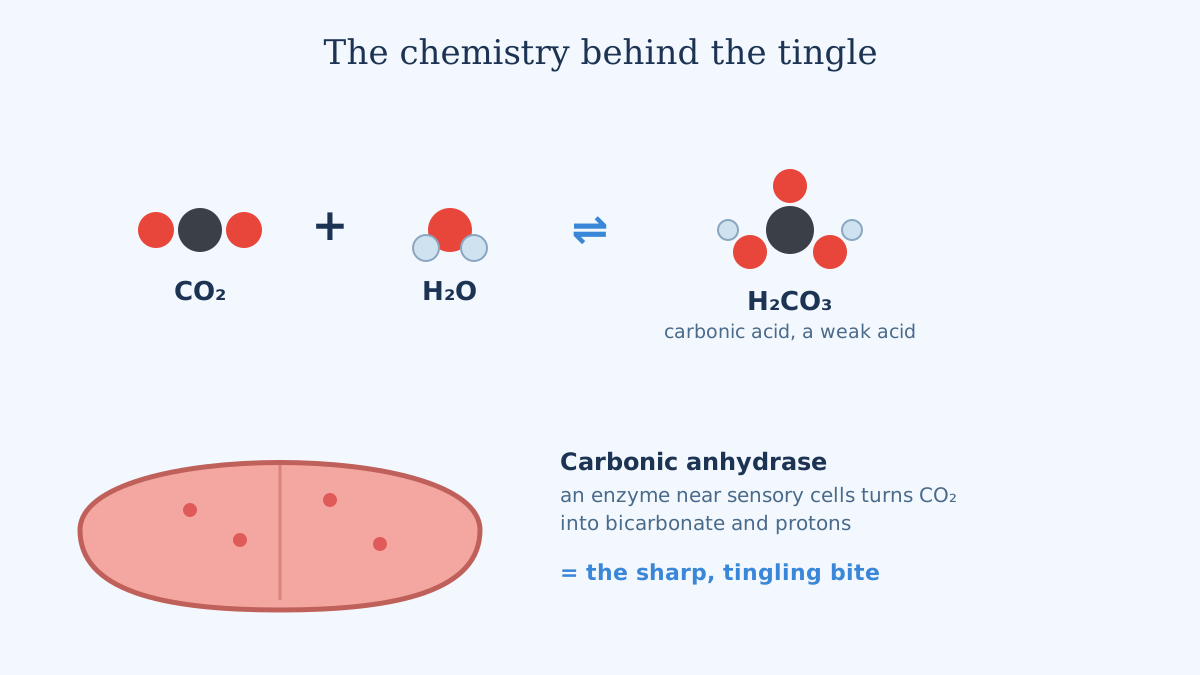
A small proportion of dissolved carbon dioxide reacts with water to form carbonic acid.
The reaction can be represented as:
CO₂ + H₂O ⇌ H₂CO₃
Carbonic acid is a weak acid.
It contributes to the lower pH of carbonated water and gives the drink some of its characteristic acidic quality.
However, the sensation of carbonation is not explained by acidity alone.
Carbon dioxide also activates sensory pathways in the mouth.
Research suggests that an enzyme called carbonic anhydrase helps convert carbon dioxide into bicarbonate and protons near sensory cells.
This process contributes to the characteristic sharp, tingling sensation of carbonation.
In other words, your mouth is not simply detecting bubbles.
It is responding to a chemical and sensory event.
03Why water doesn't fizz forever
The disappearing bubbles
Have you ever left a glass of soda on the table and returned to find it completely flat?
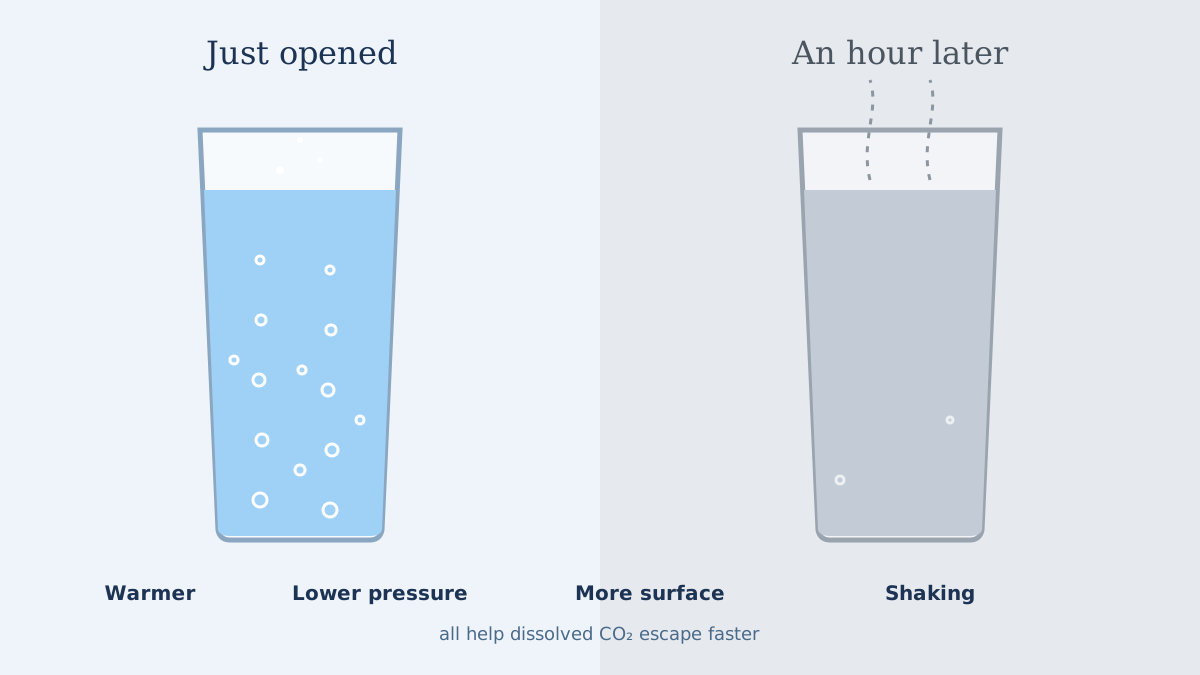
That happens because dissolved carbon dioxide gradually escapes from the liquid.
The gas moves from the beverage into the surrounding air.
Several factors influence how quickly this happens.
Temperature
Cold liquids generally retain more dissolved carbon dioxide than warm liquids at the same pressure.
That is why sparkling beverages are usually served chilled.
Pressure
Higher pressure helps keep more carbon dioxide dissolved.
Opening the bottle reduces pressure, encouraging the gas to escape.
Surface area
A larger exposed liquid surface can provide more opportunity for gas to escape.
Agitation
Shaking or disturbing a drink can help bubbles form and accelerate gas release.
Once enough carbon dioxide escapes, the drink loses its characteristic fizz.
It may still contain sugar, flavour and acidity, but the sensory experience has changed.
04The secret of the bubble: nucleation
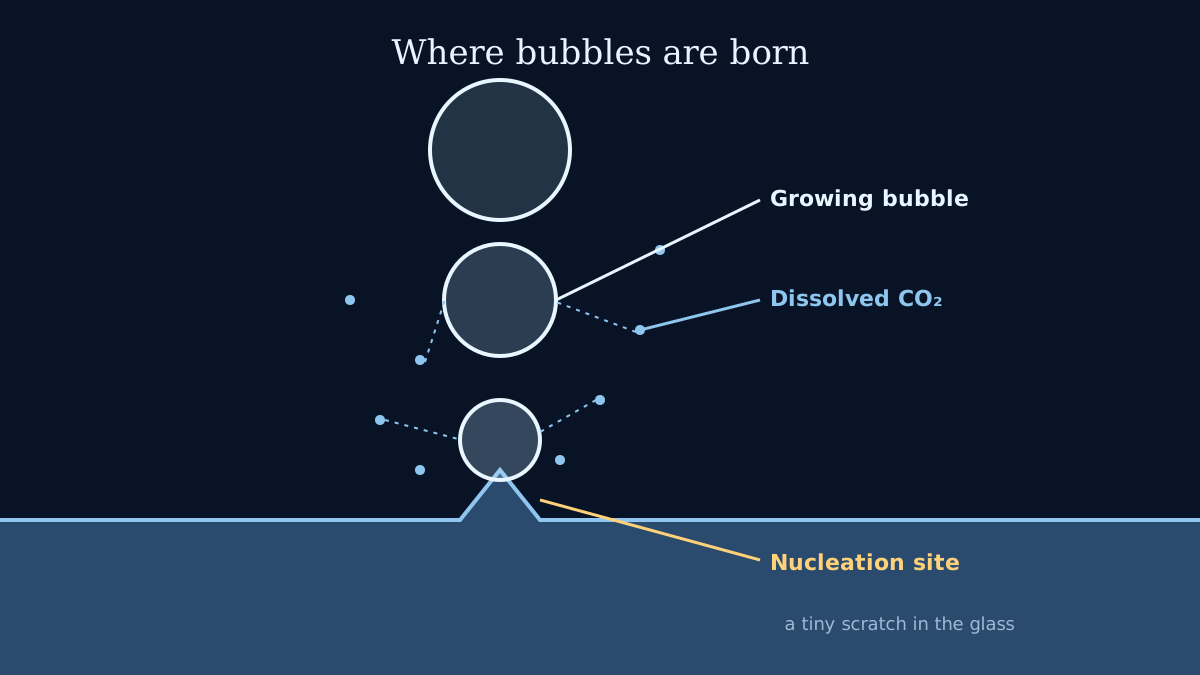
Why do bubbles form in certain places?
Bubbles don't always appear randomly.
They often begin at tiny imperfections or particles in the glass or liquid.
These locations are called nucleation sites.
A nucleation site provides a place where gas can begin forming a bubble more easily.
For example:
- Small scratches inside a glass.
- Tiny particles suspended in the liquid.
- Rough surfaces.
- Specially designed nucleation points in some beverage glasses.
Once a bubble forms, dissolved carbon dioxide can diffuse into it.
The bubble grows and eventually rises towards the surface.
This is why some sparkling drinks produce a continuous stream of bubbles from a specific point in the glass.
A tiny imperfection can become the starting point of an entire bubble show.
05Why champagne bubbles look so beautiful
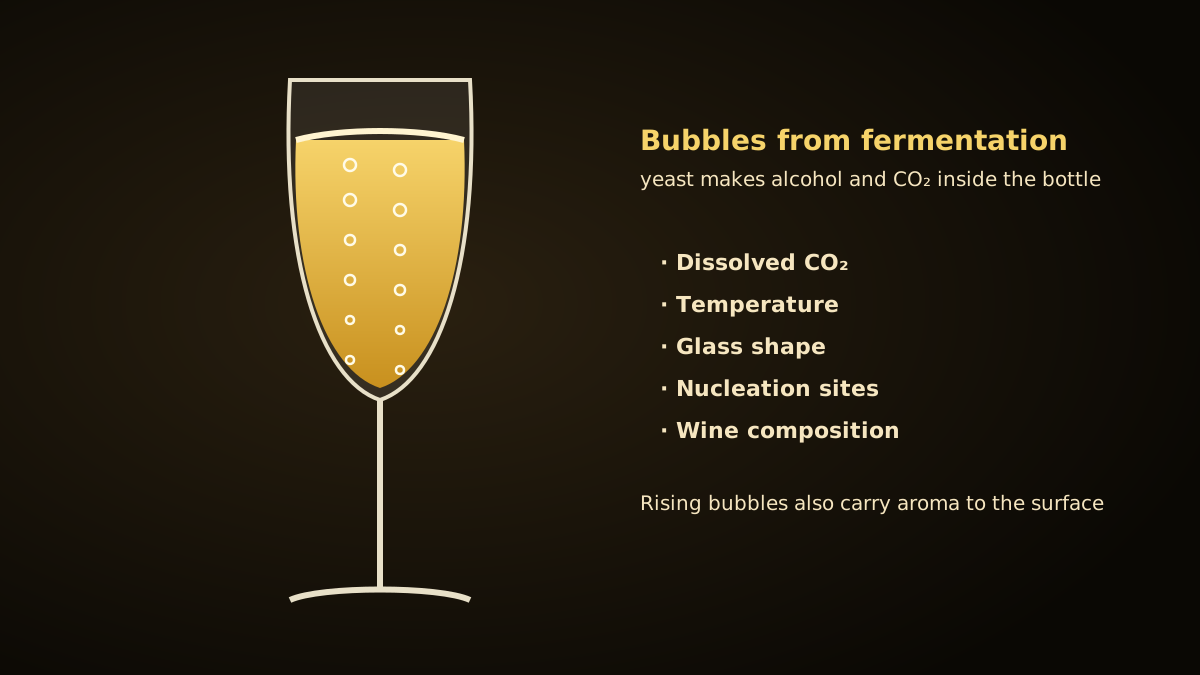
A celebration of tiny bubbles
Champagne and other sparkling wines are famous for their bubbles.
But their fizz develops through a slightly different process from ordinary carbonated soft drinks.
In traditional bottle fermentation, yeast converts sugar into alcohol and carbon dioxide.
When the wine is sealed in the bottle, the carbon dioxide remains dissolved under pressure.
When the bottle is opened, the pressure decreases and bubbles begin to form.
The bubbles rise through the liquid and release gas at the surface.
Their behaviour depends on several factors:
- Dissolved carbon dioxide.
- Temperature.
- Glass shape.
- Nucleation sites.
- Wine composition.
The bubbles can also help transport aromatic compounds towards the surface, influencing how the drink smells.
So the sparkling sensation is connected to more than appearance.
It contributes to the overall sensory experience.
06Why cold soda tastes more refreshing
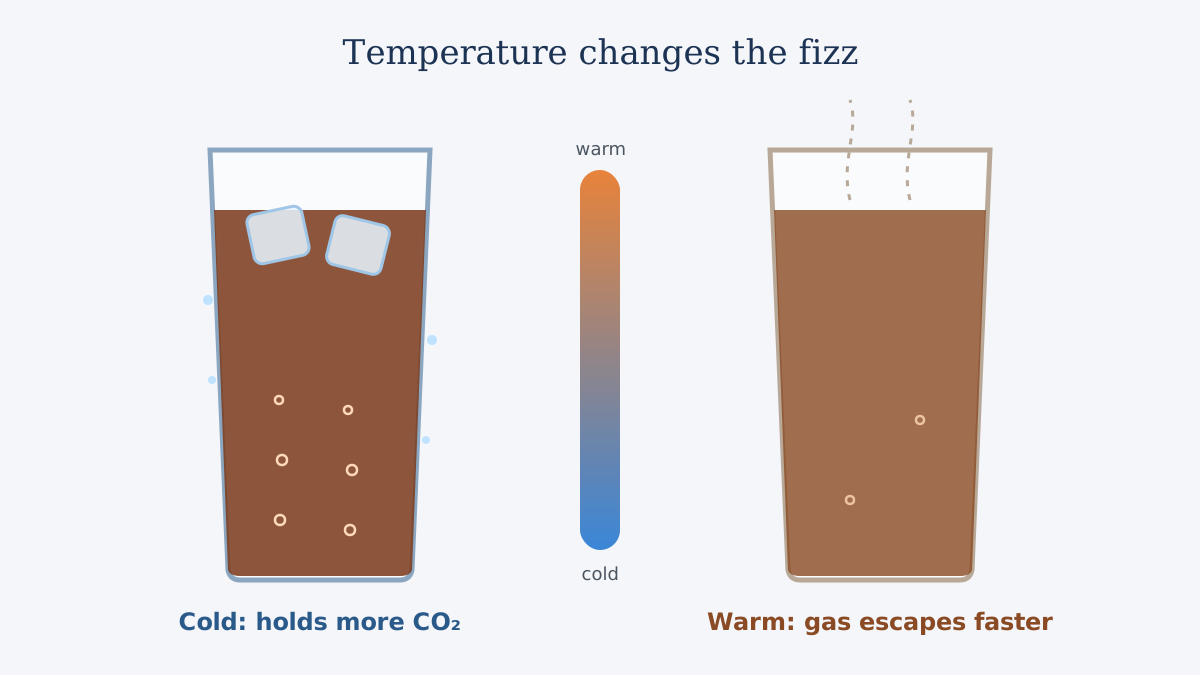
Temperature changes the experience
A cold carbonated drink often feels more refreshing than a warm one.
One reason is that carbon dioxide is generally more soluble in colder liquids.
At the same pressure, a colder drink can retain more dissolved gas.
A warmer drink tends to release carbon dioxide more readily.
Temperature also affects sensory perception.
Cold temperatures influence how sweetness, aroma and other flavour sensations are experienced.
This means a cold soda and a warm soda can taste noticeably different, even if they contain exactly the same ingredients.
The temperature of a drink is therefore an important part of beverage formulation and serving.
07The kitchen experiment: how fast does fizz escape?
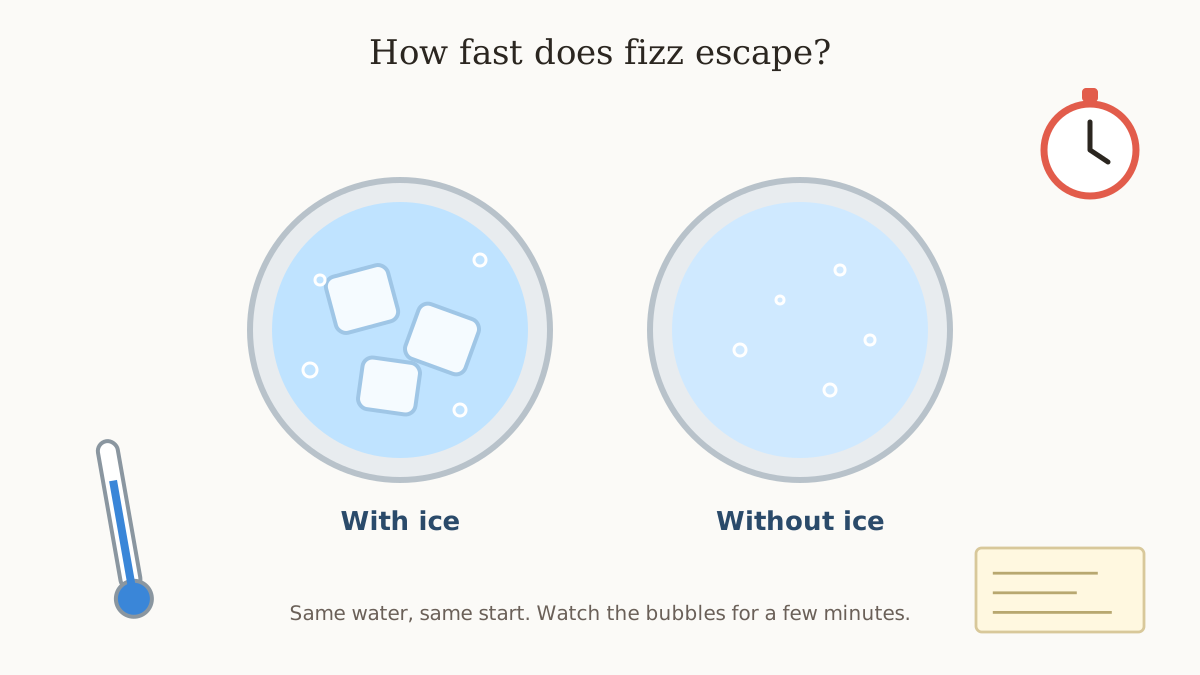
Can you observe the effect of temperature?
Let's compare how carbonation behaves at different temperatures.
What should you notice?
The warmer sample will generally lose dissolved carbon dioxide more readily.
However, adding ice also introduces extra nucleation surfaces, so the chilled sample may initially show plenty of bubbles.
The experiment shows how temperature and surface conditions influence carbonation.
08The science of carbonation in the food industry
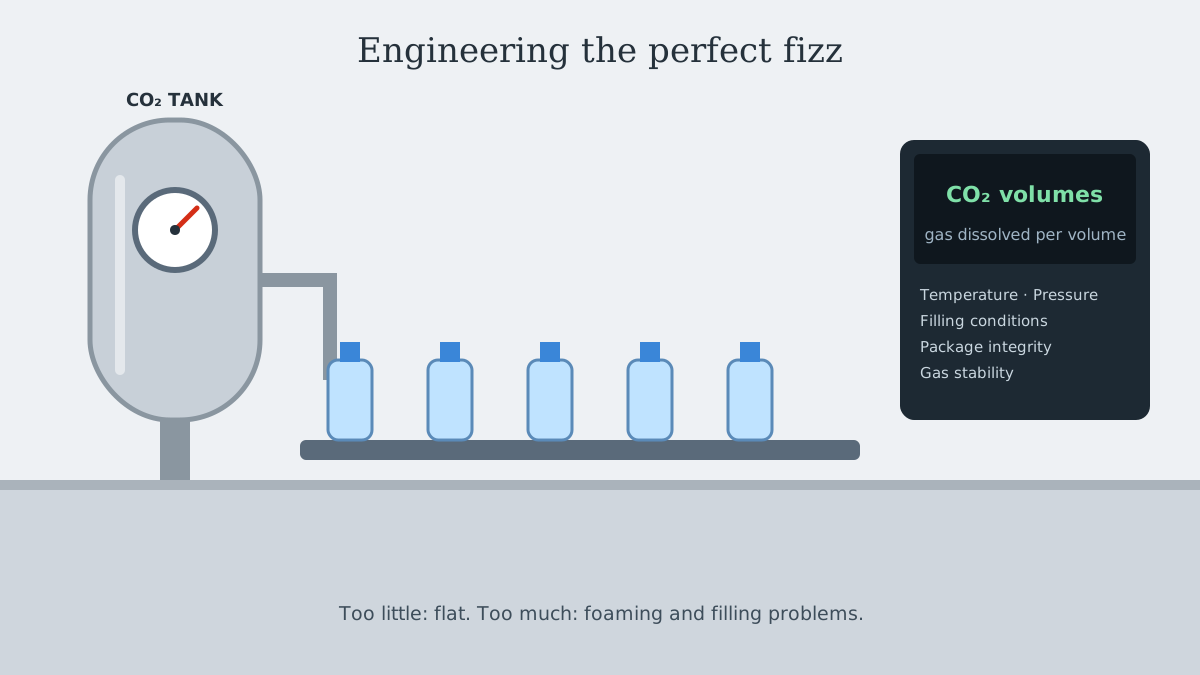
Engineering the perfect fizz
In beverage manufacturing, carbonation is carefully controlled.
Too little carbonation can make a beverage feel flat.
Too much can create excessive foaming and filling difficulties.
Food and beverage manufacturers monitor several parameters:
- Carbon dioxide concentration.
- Beverage temperature.
- Pressure.
- Filling conditions.
- Package integrity.
- Dissolved gas stability.
Carbonation is often measured in volumes of CO₂.
This describes the amount of carbon dioxide gas, expressed as a volume under defined reference conditions, dissolved in a given volume of beverage.
Different beverages have different carbonation targets.
A sparkling water, a soft drink and a sparkling wine do not necessarily have the same carbonation level.
Packaging also plays an important role.
Bottles and cans must be designed to retain pressure and prevent excessive gas loss.
Even the smallest changes in processing conditions can influence the final fizz.
09The science you can hear and feel
A bubble is more than a bubble.
The next time you open a sparkling drink, pay attention.
Listen to the hiss.
Watch the bubbles rise.
Notice the tingling sensation when you take a sip.
Behind that simple experience is an interaction between gas solubility, pressure, temperature, chemistry and human sensory biology.
The bubbles are not just making your drink look exciting.
They are helping shape the way you experience its flavour.
And that is the science of fizz.