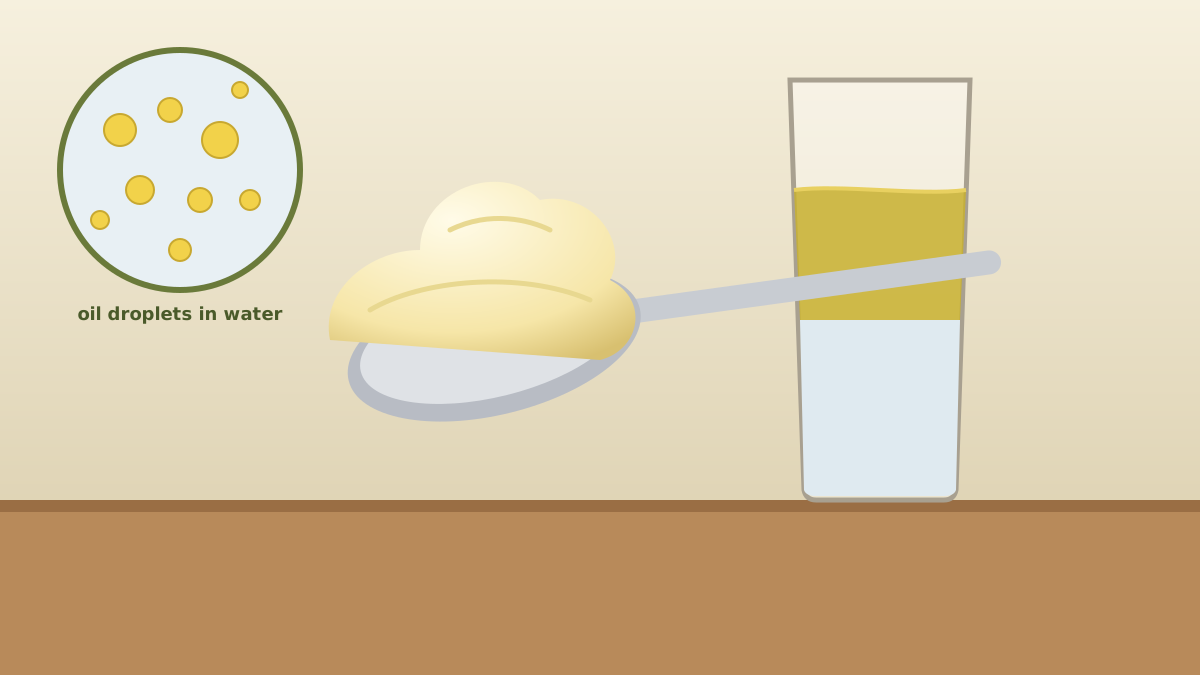
The impossible partnership.
Oil and water have a complicated relationship.
Pour them into a glass, stir them together and watch what happens.
For a moment, they mix.
Then they separate.
The oil rises to the top, while the water settles below.
But somehow, mayonnaise stays creamy. Salad dressings can remain mixed for a while, and sauces can have a smooth, uniform texture.
How is this possible?
The answer is emulsification.
It is one of the most important principles in food science, and it is responsible for the texture of many everyday foods.
Let's discover how food manufacturers and home cooks make two naturally reluctant liquids work together.
01Why don't oil and water mix?
To understand emulsions, we need to understand the chemistry of oil and water.
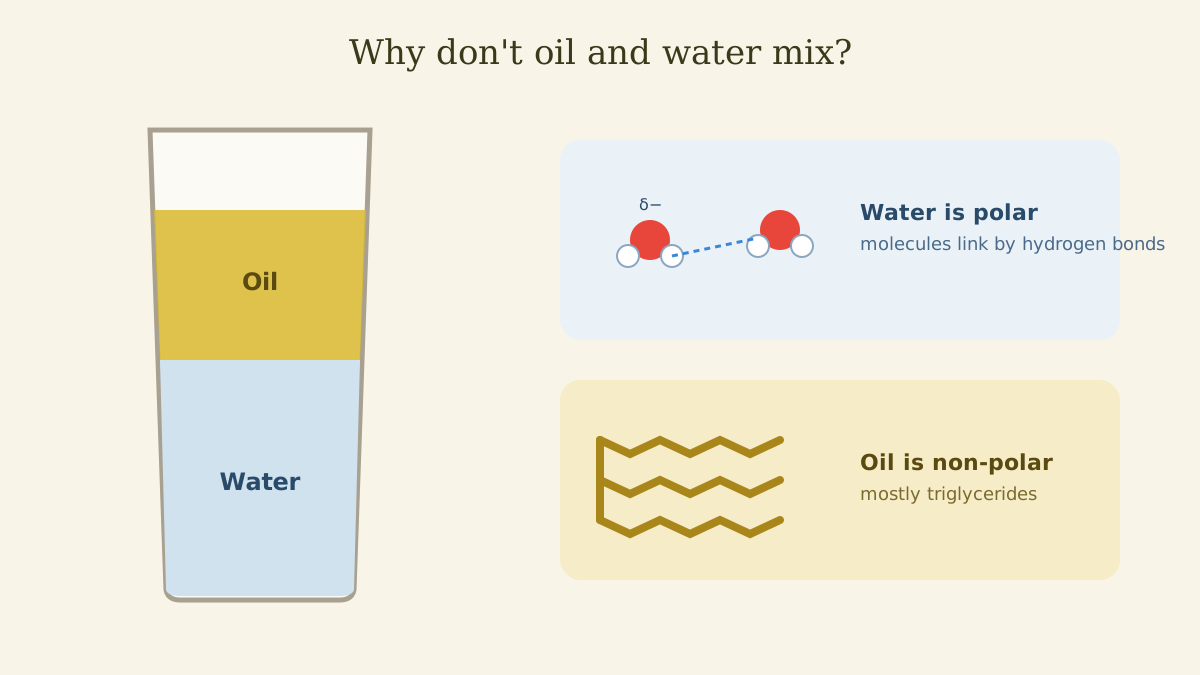
Water is a polar molecule.
Its molecules have an uneven distribution of electrical charge, allowing them to form hydrogen bonds with one another.
Most cooking oils are made mainly of triglycerides, which are largely non-polar.
Because water and oil have very different molecular characteristics, they do not mix easily.
When combined, the system tends to minimise contact between the two liquids.
This is why oil and water separate into distinct layers.
But what if we could break one liquid into extremely tiny droplets and distribute those droplets throughout the other?
That is where emulsification begins.
02What exactly is an emulsion?
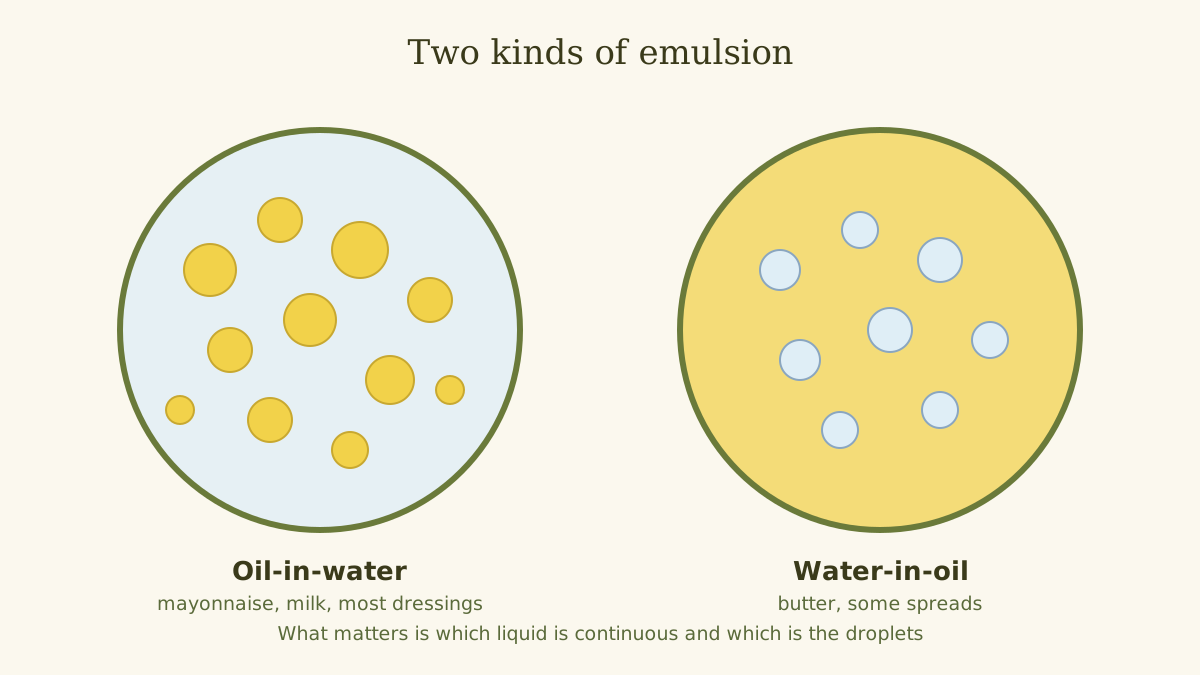
An emulsion is a mixture of two liquids that normally do not mix, where one liquid is dispersed as small droplets within the other.
There are two major types.
1. Oil-in-water emulsion
Oil droplets are dispersed throughout a continuous water-based phase.
Examples:
- Mayonnaise
- Milk
- Many salad dressings
- Some sauces
2. Water-in-oil emulsion
Water droplets are dispersed throughout a continuous oil or fat phase.
Examples:
- Butter
- Some spreads
The difference is not simply how much oil or water is present.
It is about which liquid forms the continuous phase and which one exists as droplets.
That microscopic arrangement has a major influence on texture, appearance and stability.
03The secret ingredient: emulsifiers
An emulsion can be created temporarily by shaking oil and water.
But keeping it stable is more difficult.
This is where emulsifiers become important.
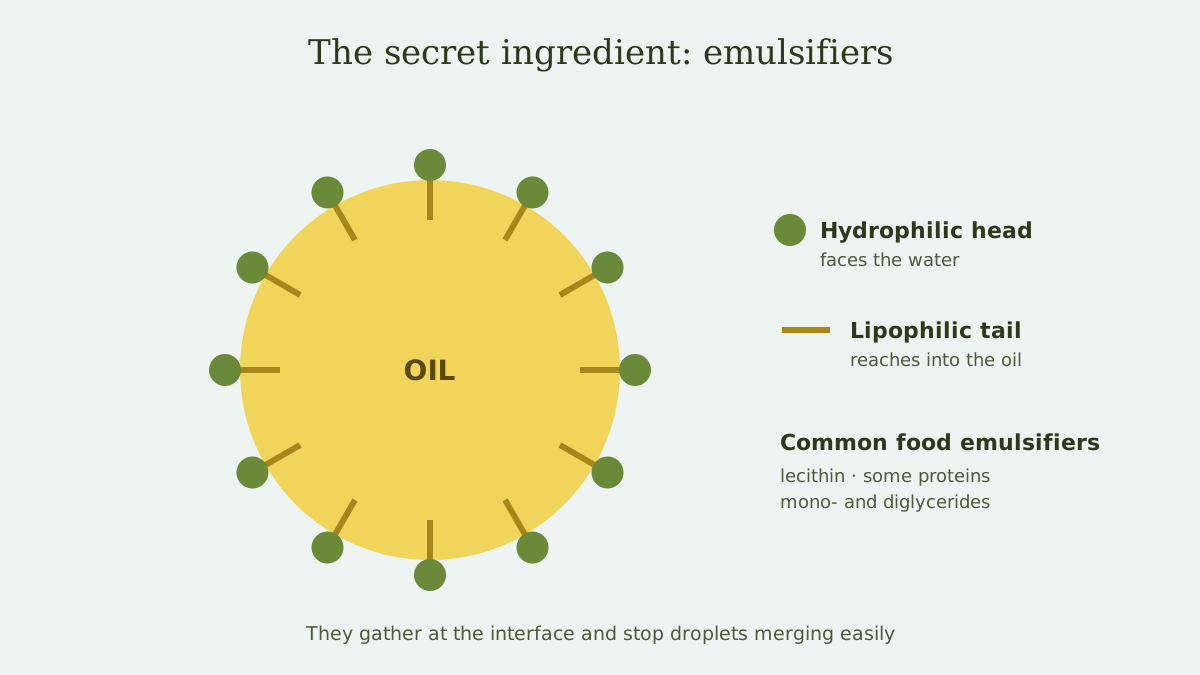
An emulsifier helps reduce the interfacial tension between oil and water and helps stabilise the droplets.
Many emulsifiers have two different regions:
- A hydrophilic region that interacts favourably with water.
- A lipophilic region that interacts favourably with oil.
They gather at the oil-water interface and help prevent droplets from merging easily.
Some common food emulsifying ingredients include:
- Lecithin
- Certain proteins
- Mono- and diglycerides of fatty acids
- Some polysaccharides and other stabilising ingredients, depending on the system
The result is a more stable and uniform mixture.
But one of the best examples of this chemistry is sitting in your refrigerator.
Mayonnaise.
04How does egg yolk create mayonnaise?
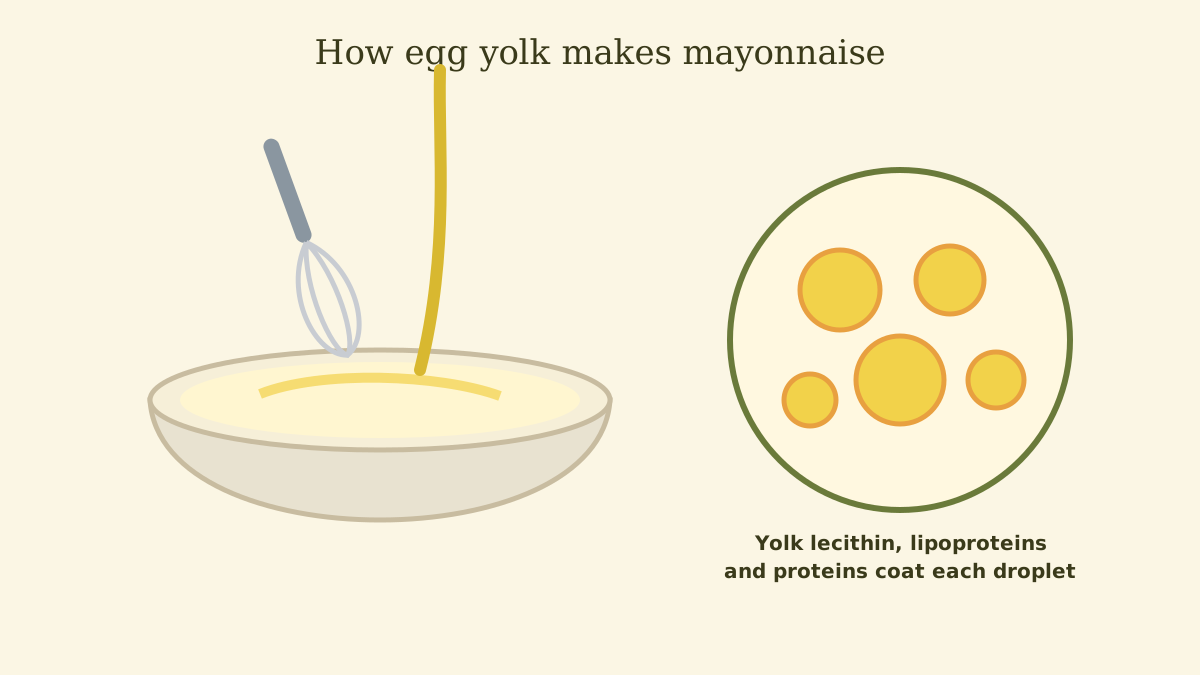
Mayonnaise is a classic example of an oil-in-water emulsion.
Its main ingredients are usually oil, water-based acidic ingredients such as vinegar or lemon juice, and egg yolk.
Egg yolk is especially useful because it contains several components that help stabilise emulsions.
These include:
- Phospholipids, including lecithin
- Lipoproteins
- Proteins
They help form and stabilise the interface around tiny oil droplets.
When oil is added gradually while the mixture is mixed, the oil breaks into increasingly small droplets.
The emulsifying components help keep these droplets dispersed.
As more oil is incorporated, the mixture becomes thicker and creamier.
That familiar mayonnaise texture comes from a highly concentrated arrangement of small oil droplets within a water-based continuous phase.
05Why does mayonnaise sometimes split?
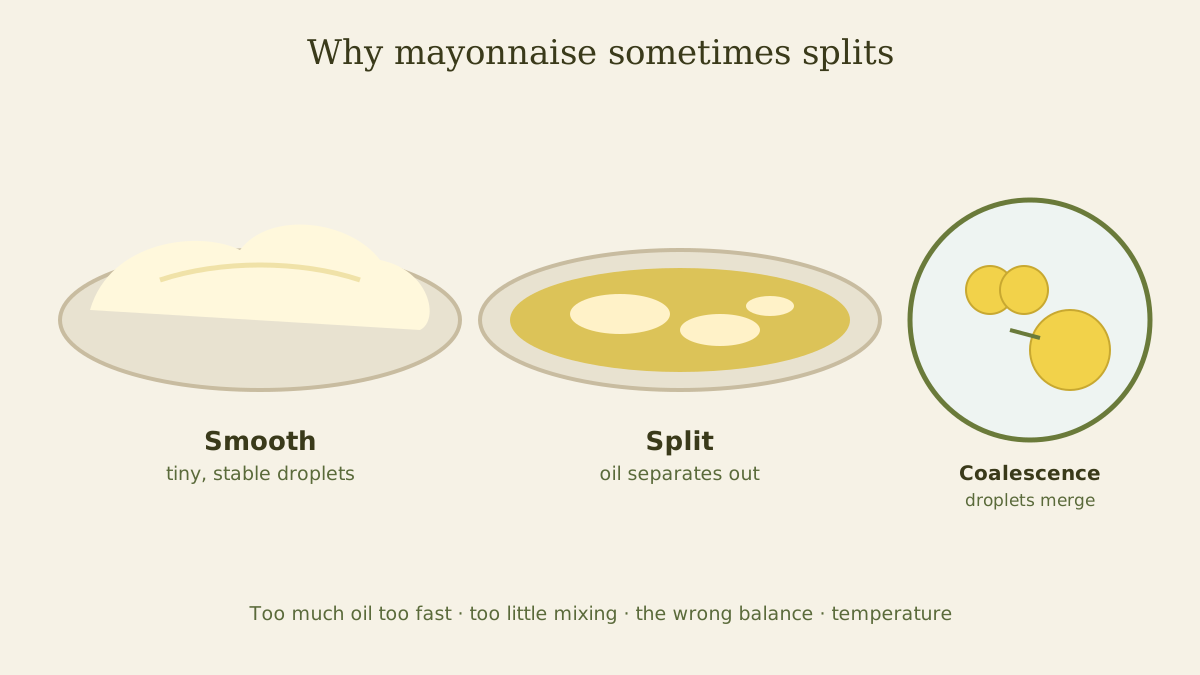
Have you ever made mayonnaise that suddenly turns oily and separated?
This is known as emulsion breaking.
Several things can contribute:
- Adding oil too quickly: The mixture may not have enough capacity to disperse and stabilise the incoming oil.
- Insufficient mixing: Droplets may remain too large or unevenly distributed.
- Incorrect ingredient balance: The amount of oil, water and emulsifier affects the stability of the system.
- Temperature and formulation: Changes in temperature and ingredient properties can influence emulsion behaviour.
When droplets merge together, the process is called coalescence.
Once extensive coalescence occurs, the emulsion can break and separate into distinct phases.
A stable mayonnaise requires the right formulation and the right mixing process.
06Why does salad dressing separate?
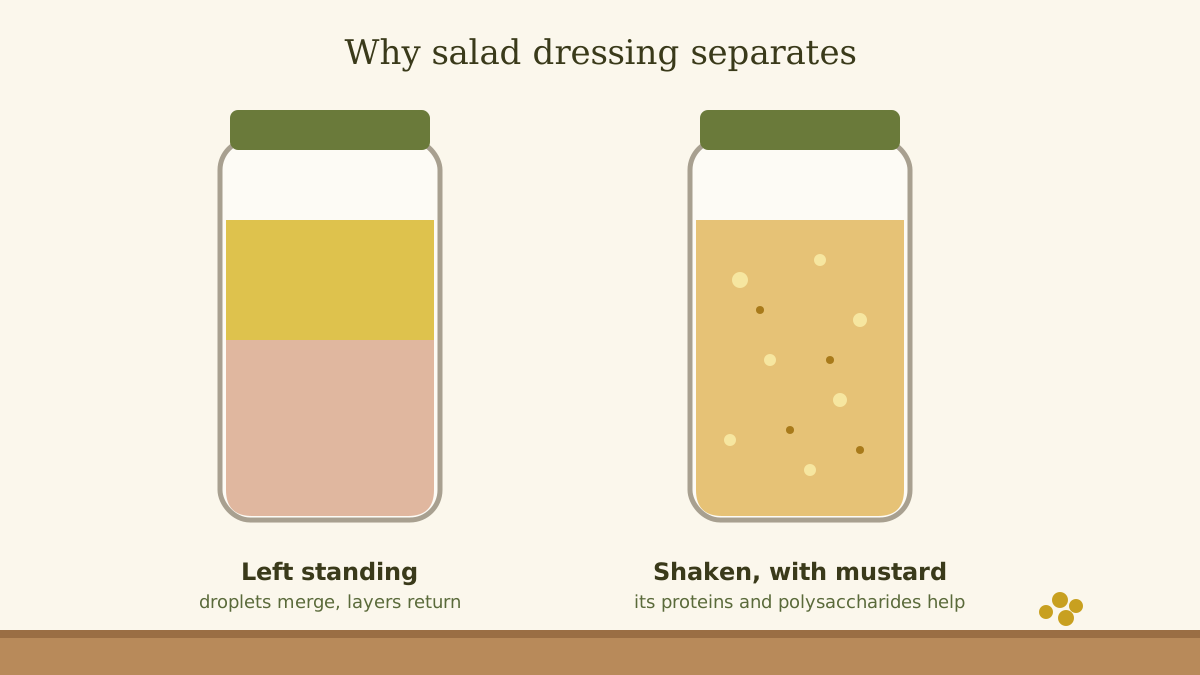
A simple vinaigrette is usually made from oil and vinegar.
Unlike mayonnaise, it often does not contain enough emulsifier or stabiliser to maintain a long-lasting emulsion.
Shake it, and you create many small droplets.
Leave it undisturbed, and those droplets can move, collide and eventually merge.
The oil and vinegar gradually separate again.
But adding mustard can help.
Mustard contains components that can contribute to emulsion stability, including proteins and polysaccharides.
It also helps influence the texture of the dressing.
This is why many vinaigrette recipes use mustard.
It is not just there for flavour.
It also plays a functional role in the mixture.
07How do emulsions become unstable?
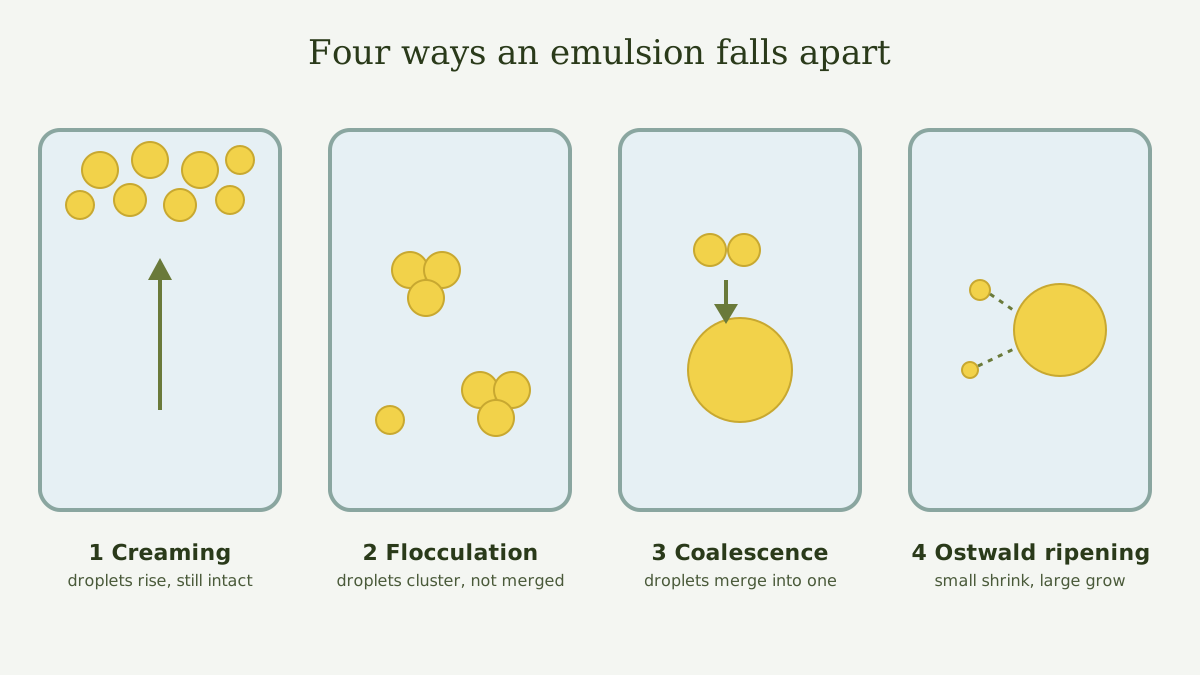
Emulsions can become unstable in several different ways.
Understanding the differences is important in food manufacturing.
1. Creaming
Droplets move upward or downward because of density differences.
The droplets may remain intact, but the emulsion becomes uneven.
2. Flocculation
Droplets form clusters or groups but do not necessarily merge into larger droplets.
3. Coalescence
Two or more droplets merge into one larger droplet.
This can eventually cause the emulsion to break.
4. Ostwald ripening
Smaller droplets shrink while material moves through the continuous phase and contributes to the growth of larger droplets.
This can change the droplet-size distribution over time.
These mechanisms can occur individually or together.
Food scientists study them to design products that maintain their desired texture and appearance during storage.
08How does industry create stable emulsions?
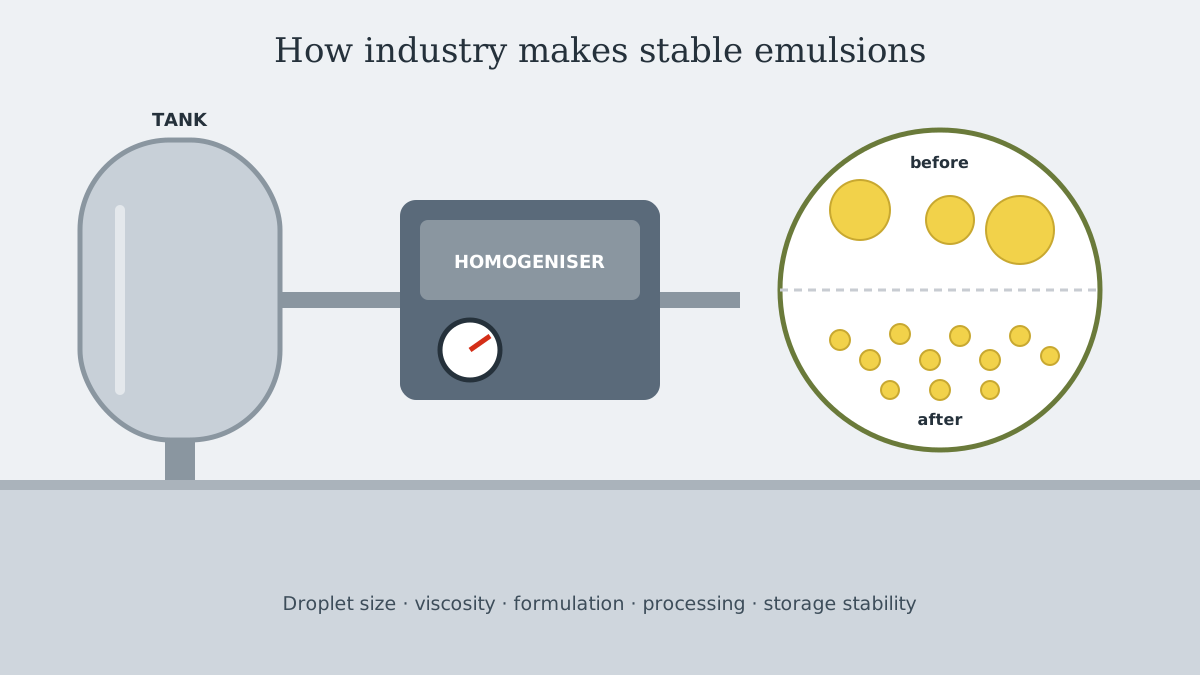
Food manufacturers use several techniques to create and stabilise emulsions.
One important method is homogenisation.
During homogenisation, the mixture is exposed to intense mechanical forces that break larger droplets into smaller ones.
This can create a more uniform droplet-size distribution.
Smaller droplets may reduce the rate of creaming under suitable conditions, although the final stability also depends on the formulation and the interface around each droplet.
Manufacturers also carefully select emulsifiers and stabilisers.
Examples of products that rely on emulsion science include:
- Mayonnaise
- Salad dressings
- Ice cream
- Milk-based beverages
- Creamy sauces
- Plant-based alternatives
For quality assurance teams, important factors include droplet size, viscosity, formulation, processing conditions and storage stability.
An emulsion that looks perfect immediately after production may still separate during its shelf life.
That is why stability testing matters.
09Try this: make your own mini emulsion lab
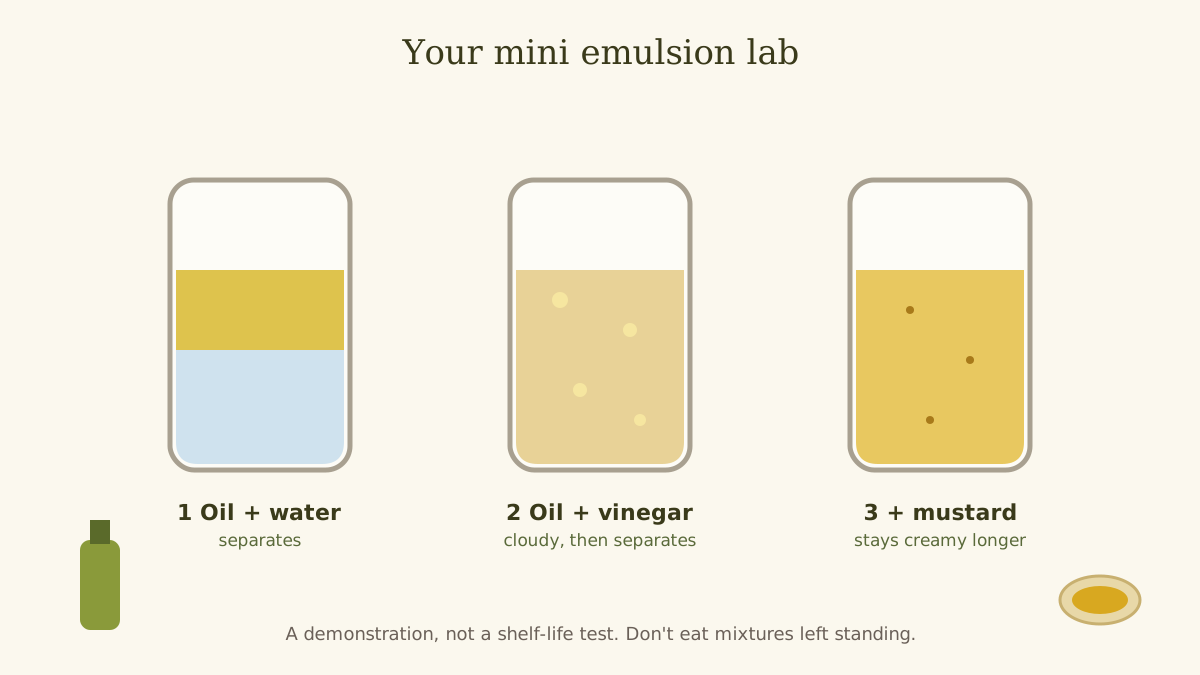
Let's test emulsification in your own kitchen.
What are you learning? You are observing how mixing creates droplets and how an additional ingredient can help stabilise an emulsion.
10The big takeaway
Oil and water may naturally separate, but food science gives us ways to bring them together.
Through emulsifiers, mechanical mixing and careful formulation, we can create creamy, smooth and stable foods.
The next time you spread mayonnaise on a sandwich or pour creamy dressing over a salad, remember:
You are looking at a carefully organised microscopic structure.
Sometimes, the best food chemistry happens in the spaces between two liquids.