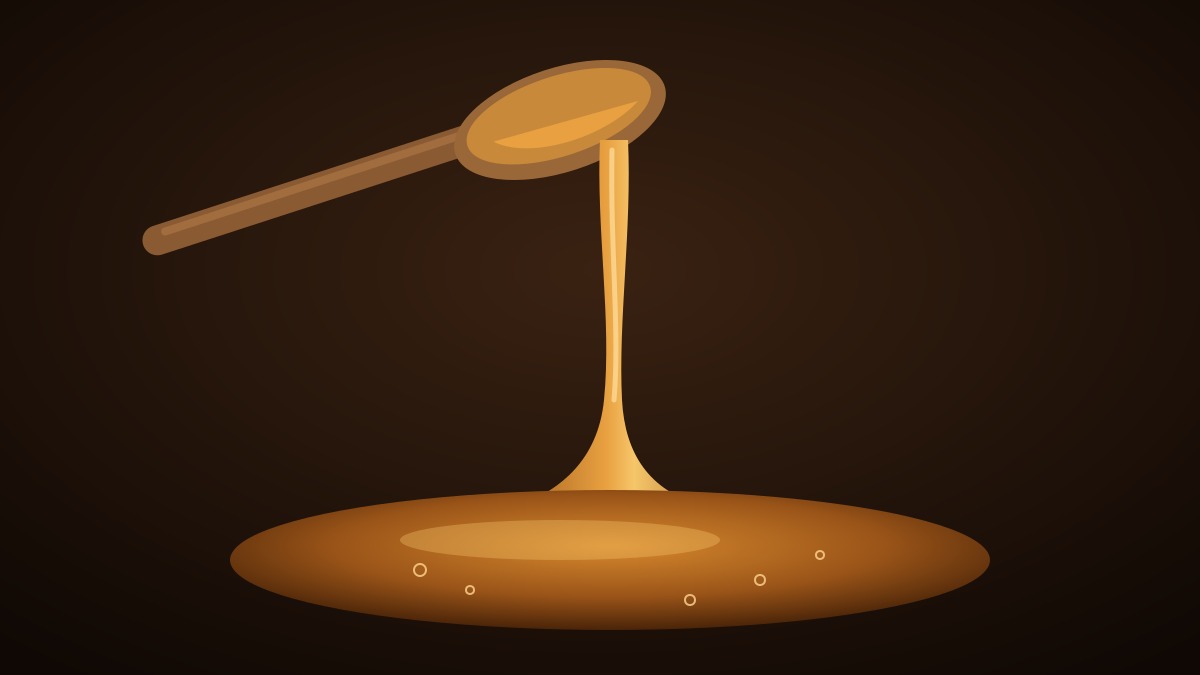
The transformation of sugar.
Imagine placing ordinary white sugar in a saucepan.
At first, nothing seems particularly exciting. The crystals begin to melt, the liquid becomes clear, and then something remarkable happens.
It turns pale gold.
Then amber.
Then deep brown.
And suddenly, your kitchen fills with an unmistakable aroma: warm, sweet, toasted and slightly nutty.
But here's the fascinating part.
You haven't added chocolate, vanilla, coffee or any flavouring. You've transformed sugar itself.
This process is called caramelisation, one of the most fascinating transformations in food chemistry.
And it is responsible for much more than caramel sauce. It helps create the characteristic flavours of crème brûlée, caramel candies, toffee and many baked or confectionery products.
So what exactly happens when sugar meets heat?
Let's look beyond the saucepan.
01Sugar is not as simple as it looks
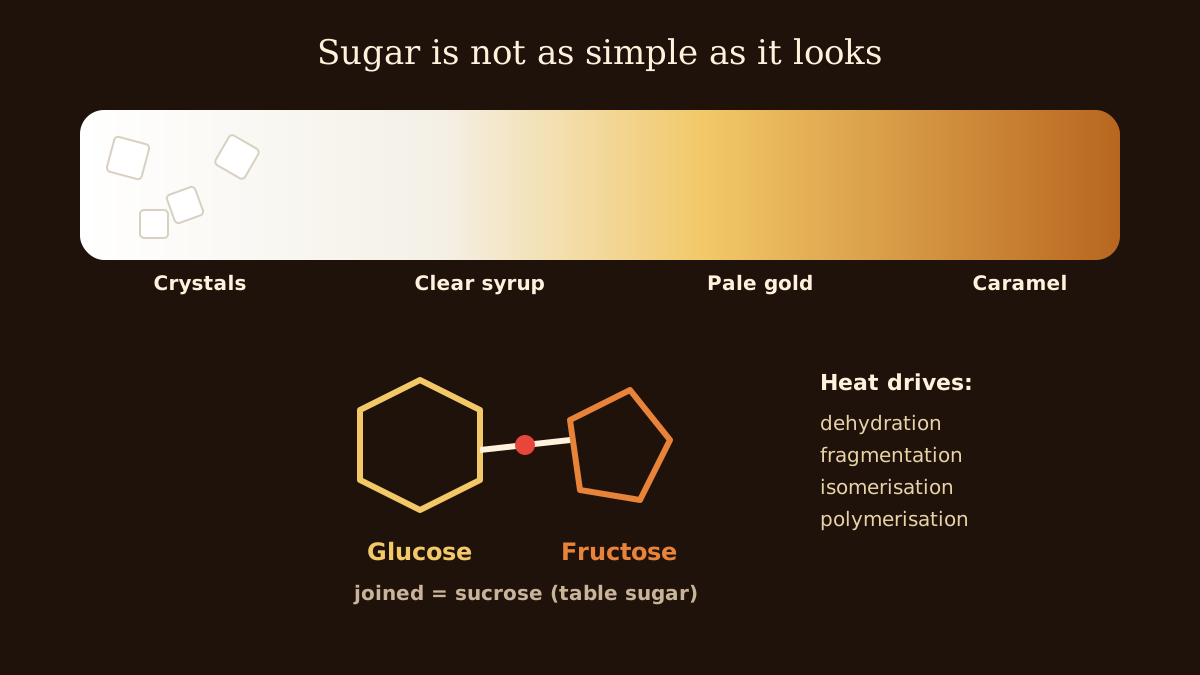
Before sugar becomes caramel, it exists as an organised crystalline structure.
Common table sugar is called sucrose. It is a carbohydrate made from two smaller sugar units:
- Glucose
- Fructose
These units are chemically connected to form one sucrose molecule.
When sugar is heated, its structure begins to change. With sufficient heat, the molecules undergo a complex series of chemical reactions.
These reactions can include:
- Dehydration: removal of water from molecules.
- Fragmentation: breaking larger molecules into smaller compounds.
- Isomerisation: rearrangement of molecular structures.
- Polymerisation: formation of larger, more complex molecules.
The result is not one single new substance.
It is a mixture of many compounds, each contributing to caramel's colour, aroma and flavour.
02The moment sugar changes colour
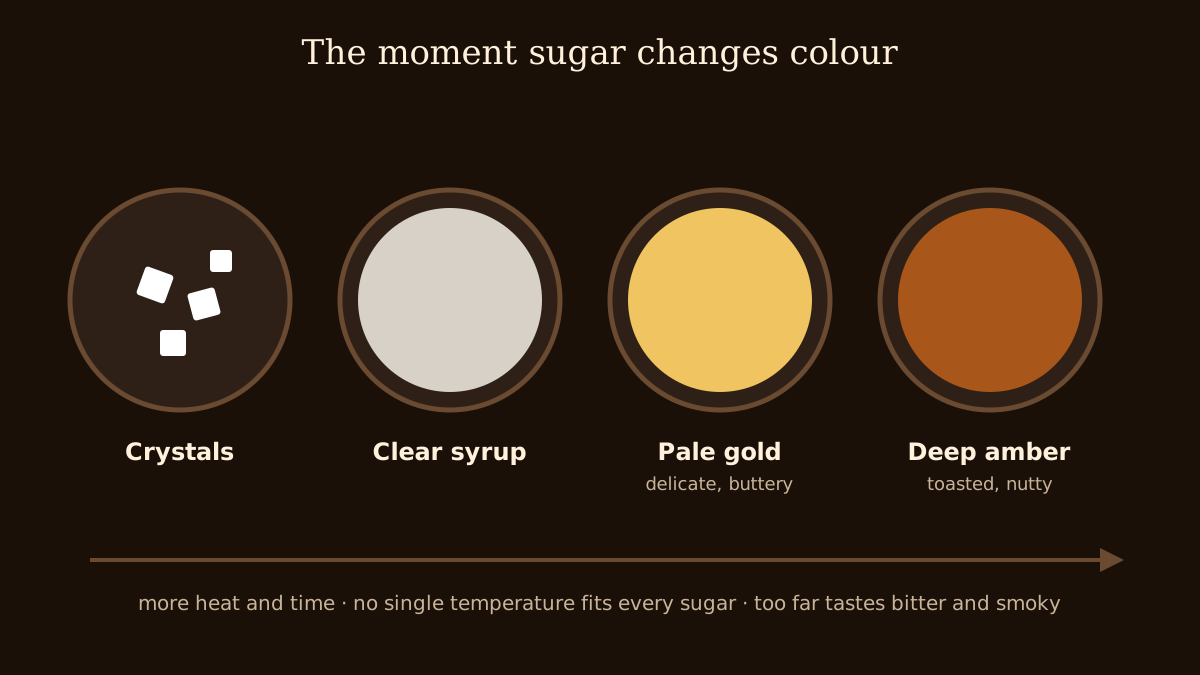
Caramelisation is a temperature-driven process, but there isn't one universal temperature at which all sugars suddenly become caramel.
The result depends on several factors:
- Type of sugar
- Water content
- Acidity or pH
- Heating time
- Presence of other ingredients
- Heating conditions
As the sugar mixture becomes hotter and reactions progress, new compounds form.
Some contribute to golden and brown colours. Others create the characteristic aromas associated with caramel.
This is why lightly caramelised sugar tastes different from dark caramel.
Pale caramel can have delicate buttery and sweet notes.
Medium amber caramel often develops richer toasted and nutty flavours.
Very dark caramel can become intense, bitter and smoky.
There is a fine line between developing complexity and burning the sugar.
And once sugar becomes badly burnt, adding cream or butter cannot reverse the chemical changes.
03Why does caramel smell so good?
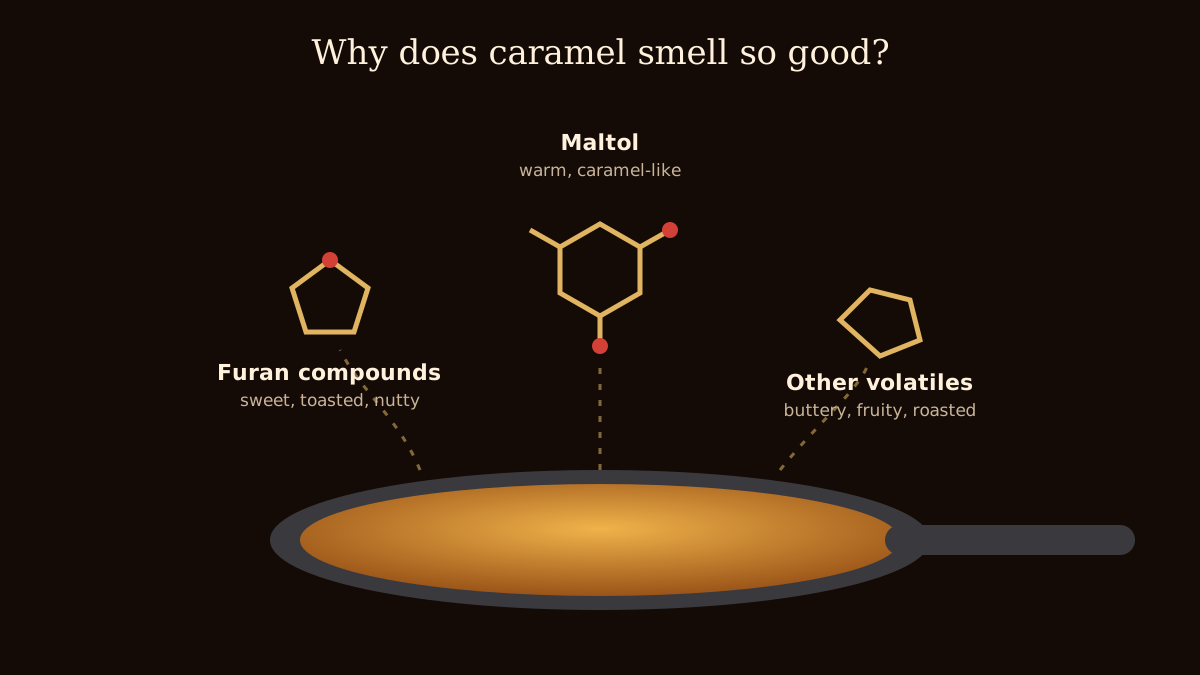
Caramel's aroma is not produced by a single chemical.
It comes from a complex mixture of volatile compounds created during heating.
Some important examples include:
- Furan compounds: These can contribute sweet, toasted, nutty and caramel-like aromas.
- Maltol: Associated with sweet, warm, toasted and caramel-like flavour notes.
- Other volatile compounds: Depending on the sugar and heating conditions, additional compounds contribute buttery, fruity, roasted or slightly smoky aromas.
The exact aroma profile changes as heating continues.
This explains why caramel can smell pleasantly sweet at one stage and intensely toasted at another.
Your nose is detecting a chemical mixture that is continuously changing as the sugar heats.
In other words, the aroma is a signal of the chemistry happening inside your saucepan.
04Caramelisation vs the Maillard reaction
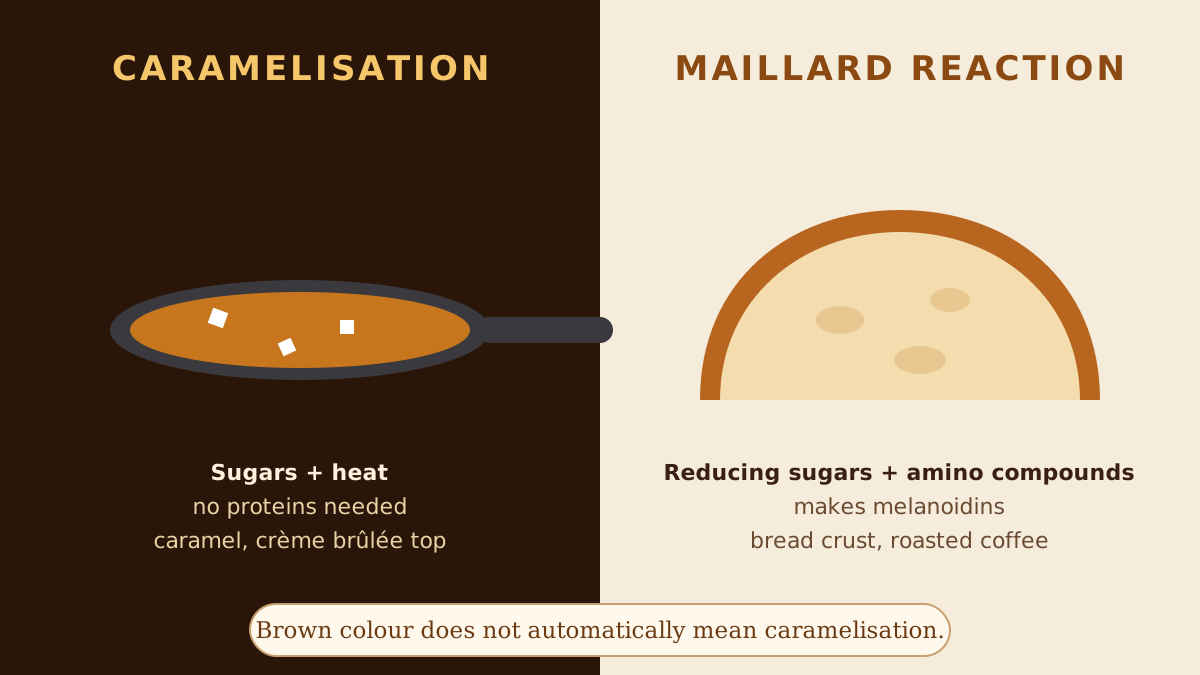
These two reactions are often confused because both can create brown colours and delicious aromas.
But they are not the same.
| Caramelisation | Maillard reaction |
|---|---|
| Involves heating sugars | Involves reducing sugars and amino compounds |
| Does not require proteins or amino acids | Requires amino compounds such as amino acids |
| Common in caramel and heated sugar | Common in bread crust, roasted coffee and browned foods |
| Produces a complex mixture of sugar-derived compounds | Produces a complex mixture of reaction products, including melanoidins |
Think about a crème brûlée.
The sugar sprinkled on top is heated until it forms a thin, crisp caramelised layer.
Now think about a loaf of bread.
Its golden-brown crust develops largely through Maillard chemistry, alongside other heat-driven reactions.
Both processes can happen in the same food, but they have different chemical requirements.
05Dry caramel vs wet caramel
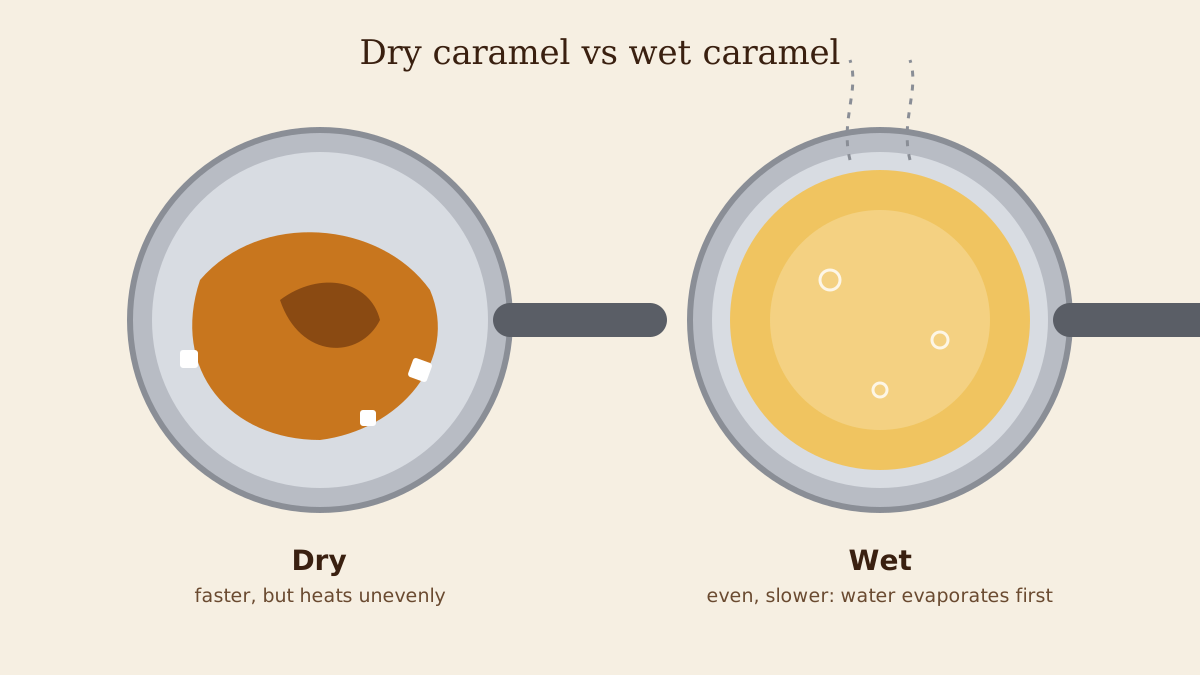
There are two common ways to make caramel.
1. Dry caramel
Sugar is heated directly in a saucepan without adding water.
As the crystals heat, they melt and transform into caramel.
Advantages:
- Faster process.
- No initial water evaporation stage.
- Useful when a concentrated caramel flavour is desired.
Challenges:
- Sugar can heat unevenly.
- Some areas may darken faster than others.
- It requires close attention.
2. Wet caramel
Sugar is first dissolved in water and then heated.
The water initially helps distribute the sugar and creates a syrup.
As heating continues, water evaporates and the syrup becomes increasingly concentrated. Eventually, the sugar mixture reaches conditions where caramelisation develops.
Advantages:
- Sugar can dissolve more evenly.
- Often easier for beginners to manage.
- Useful for making caramel sauces and desserts.
Challenges:
- It takes longer because water must evaporate.
- Sugar crystals can sometimes form again during cooking.
Neither method is universally better. The choice depends on the recipe and the result you want.
06Why does caramel sometimes turn grainy?
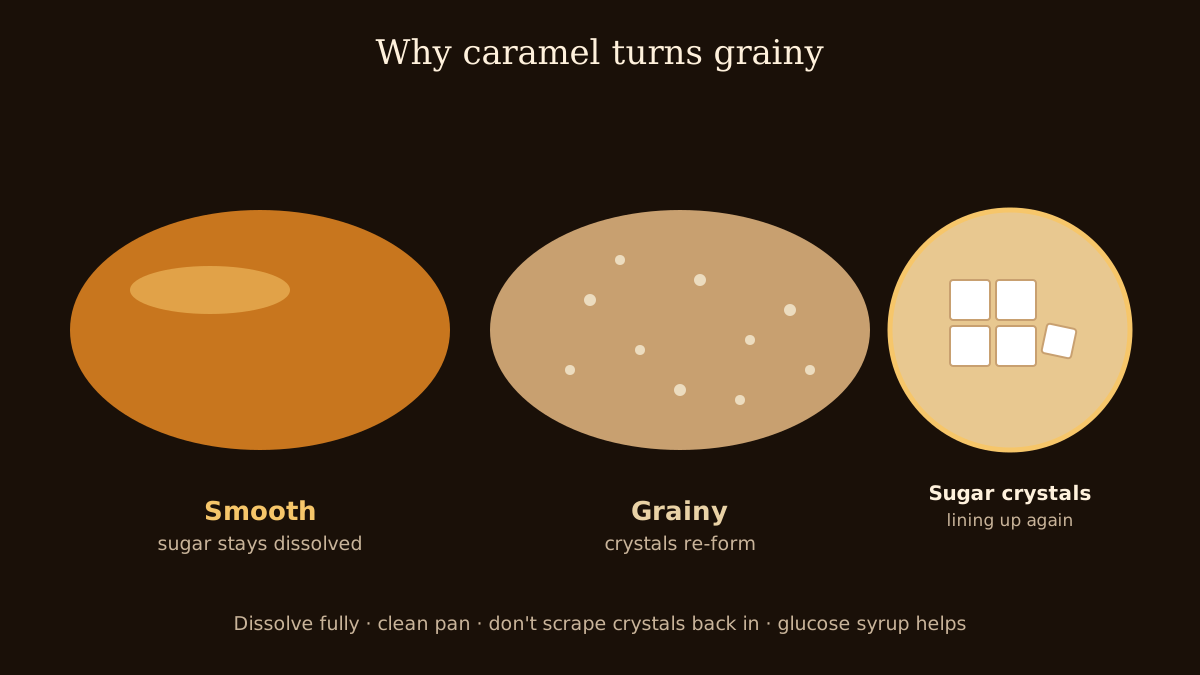
Have you ever tried making caramel only to find that it becomes grainy instead of smooth?
The problem may be sugar crystallisation.
Sugar molecules in a concentrated syrup can reorganise into solid crystals.
This may happen when:
- Undissolved sugar crystals remain on the saucepan.
- Sugar crystals form on the sides of the pan and fall back into the syrup.
- The mixture is disturbed at an unsuitable stage.
- Conditions allow the dissolved sugar to crystallise.
A smooth caramel is not just about heat. It is also about controlling how sugar molecules behave as the mixture cools.
07Why does caramel harden when it cools?
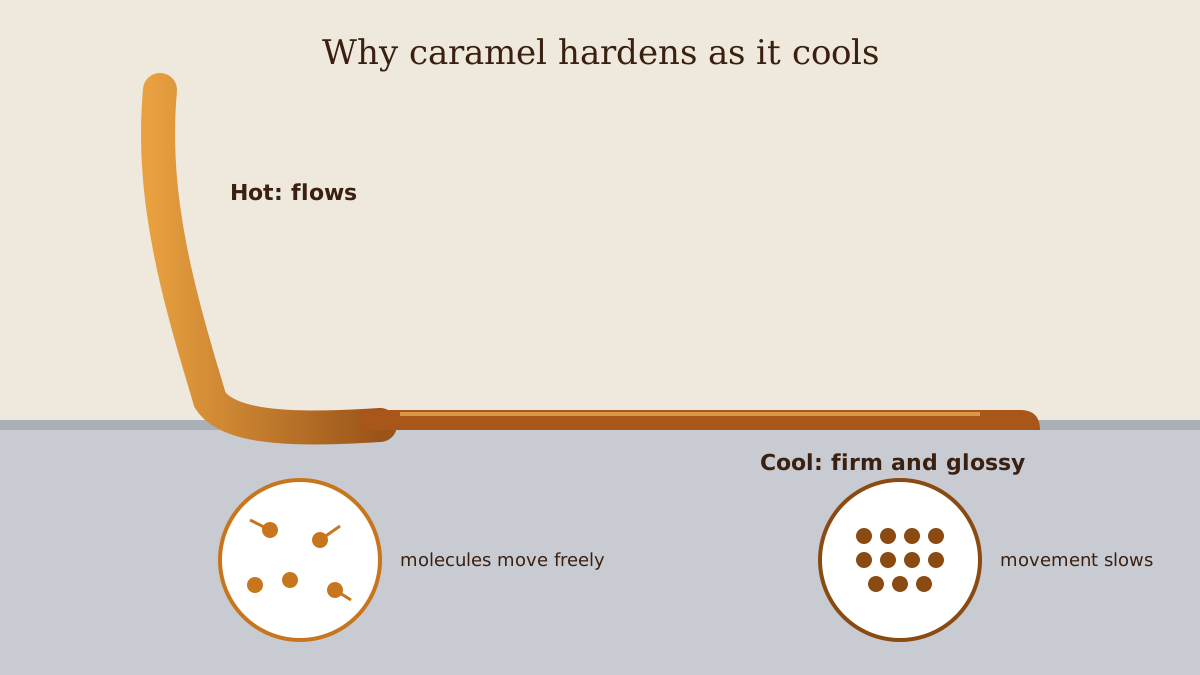
Hot caramel flows.
But leave it to cool, and it becomes thicker, firmer or even brittle.
Why?
Temperature strongly influences how molecules move.
When caramel is hot, its components have greater molecular mobility, allowing the mixture to flow.
As it cools, molecular movement decreases and the mixture becomes more viscous.
Depending on its composition and water content, caramel may form a soft, chewy texture or a hard, brittle candy.
For example:
- Caramel sauce contains more water and other liquid ingredients.
- Soft caramel candies have a controlled composition that creates a chewy structure.
- Hard caramel candies contain relatively little residual water and become glass-like when cooled.
This is why the same basic ingredient, sugar, can create such dramatically different textures.
08The food industry: caramel is everywhere
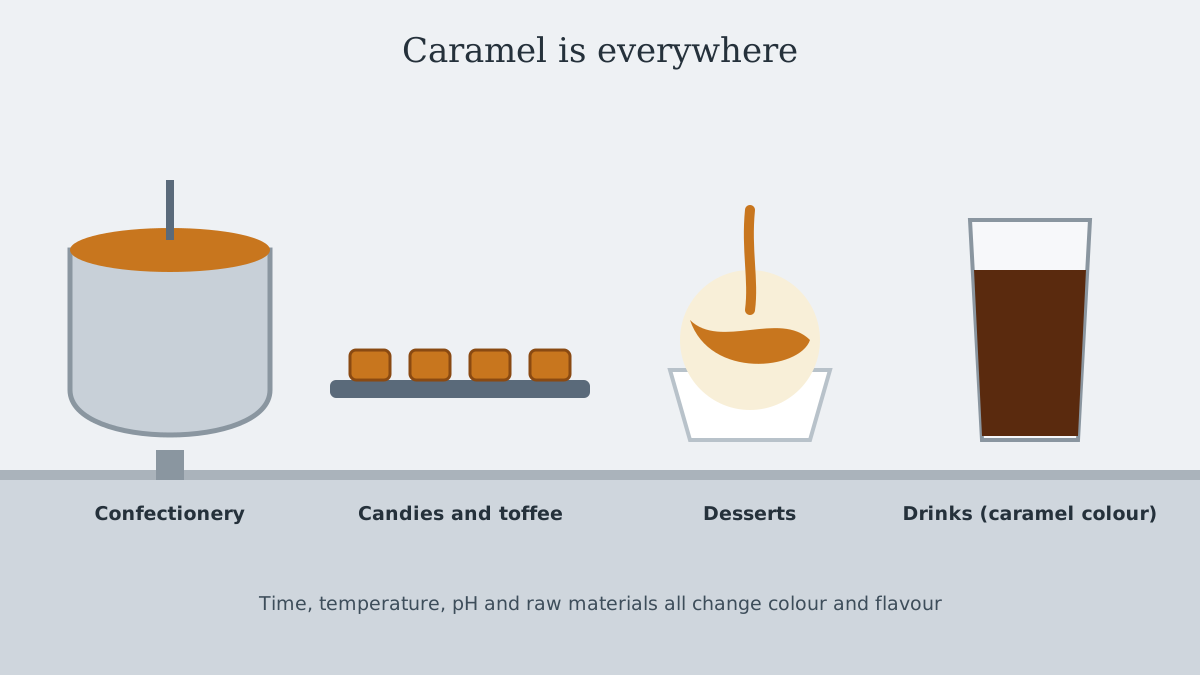
Caramelisation is not limited to home kitchens.
The food industry uses caramel chemistry and caramel-derived ingredients in many products.
Examples include:
- Confectionery: Caramel candies, toffee, brittle and fillings rely on controlled sugar heating and cooling.
- Bakery: Caramelised sugar notes contribute to the flavour profiles of various baked products.
- Desserts: Sauces, toppings and confectionery inclusions use caramel for flavour and texture.
- Beverages: Commercial caramel colours are used in some drinks and food products to provide consistent brown colour.
For manufacturers, consistency matters.
Small changes in heating time, temperature, pH and raw-material composition can affect colour, flavour and final product quality.
This is why caramel production requires process control, not just a good recipe.
09Try this: the caramel colour experiment
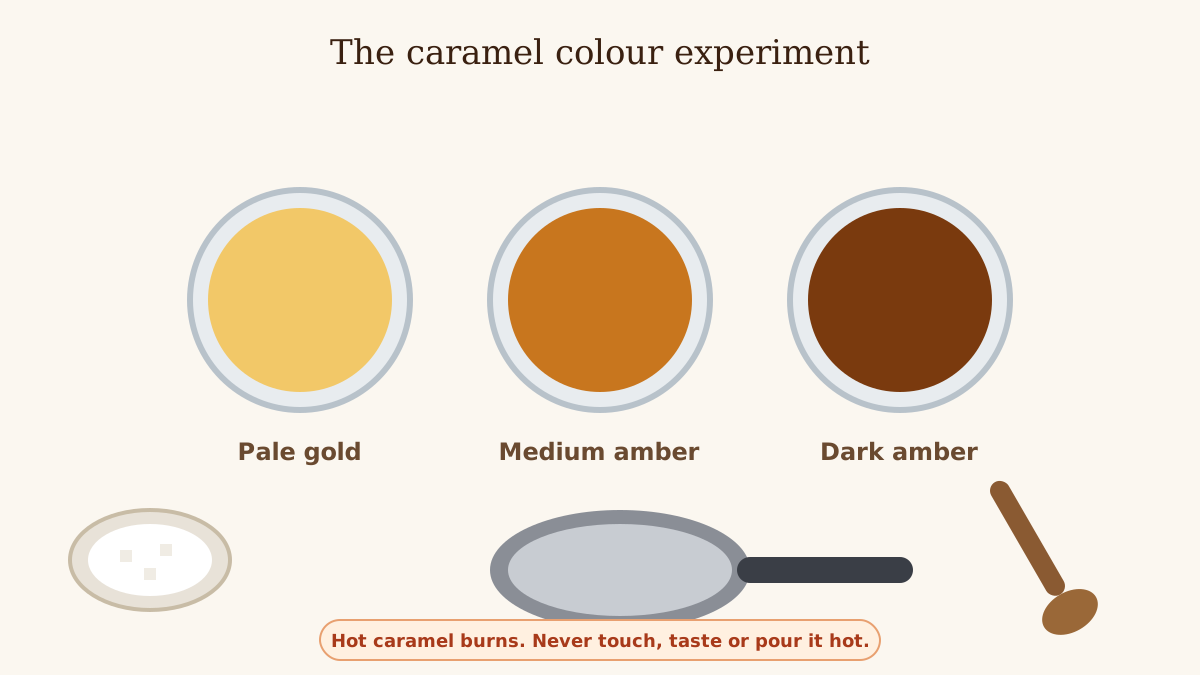
You can observe caramelisation at home with a simple demonstration.
What you are learning: Heating changes sugar chemically, creating new compounds that influence colour, aroma and texture.
10The big takeaway
Caramelisation is a beautiful example of how a familiar ingredient can become something entirely different through chemistry.
A simple sugar crystal can transform into a glossy sauce, a brittle candy, a golden dessert topping or a complex mixture of aromatic compounds.
The next time you smell caramel cooking, remember that you're not just smelling heated sugar.
You're experiencing chemistry in action.