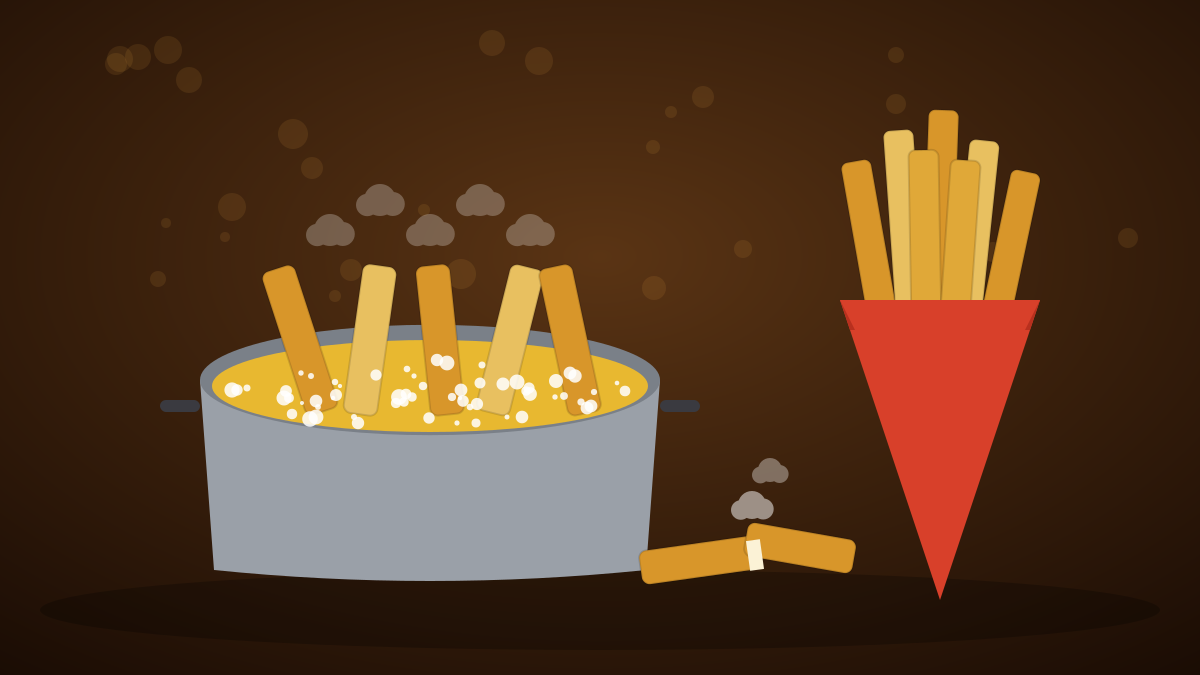
The science behind the perfect crunch.
Imagine biting into a freshly fried French fry.
The outside is golden, crisp and crunchy. The inside is soft, fluffy and warm.
But how does a simple potato develop two completely different textures during the same cooking process?
And why does fried food sometimes turn soggy, absorb too much oil or become dark before the inside is properly cooked?
The answer lies in a fascinating combination of heat transfer, moisture movement, steam formation and chemical reactions.
Deep frying is not simply about putting food into hot oil. It is a carefully balanced process that transforms the structure, colour, aroma and texture of food.
Let's explore the science behind that irresistible crunch.
01What happens when food enters hot oil?
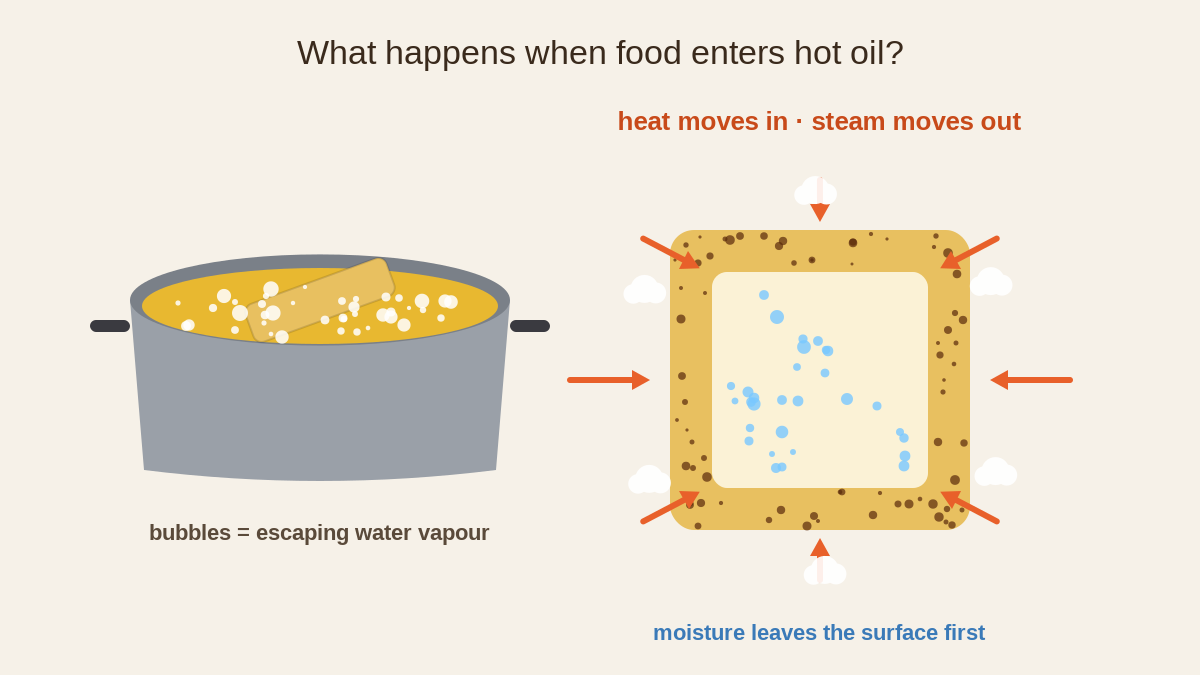
The moment food enters hot oil, heat begins moving from the oil into the food.
Unlike boiling, where food is surrounded by water, deep frying uses hot oil as the heat-transfer medium.
As the surface heats up, water inside the food begins to evaporate.
This water turns into steam, which moves through the food and escapes from its surface.
You can actually see this happening.
Those bubbles surrounding a piece of food during frying are largely water vapour escaping from the food, although some bubbling can also come from other volatile compounds.
As moisture escapes, the surface gradually becomes drier.
This is the beginning of crust formation.
The science: Deep frying combines heat transfer and mass transfer. Heat moves into the food, while moisture moves out.
02The secret behind crispy texture
Why does a fried potato feel so different from a boiled potato?
The answer is moisture and structure.
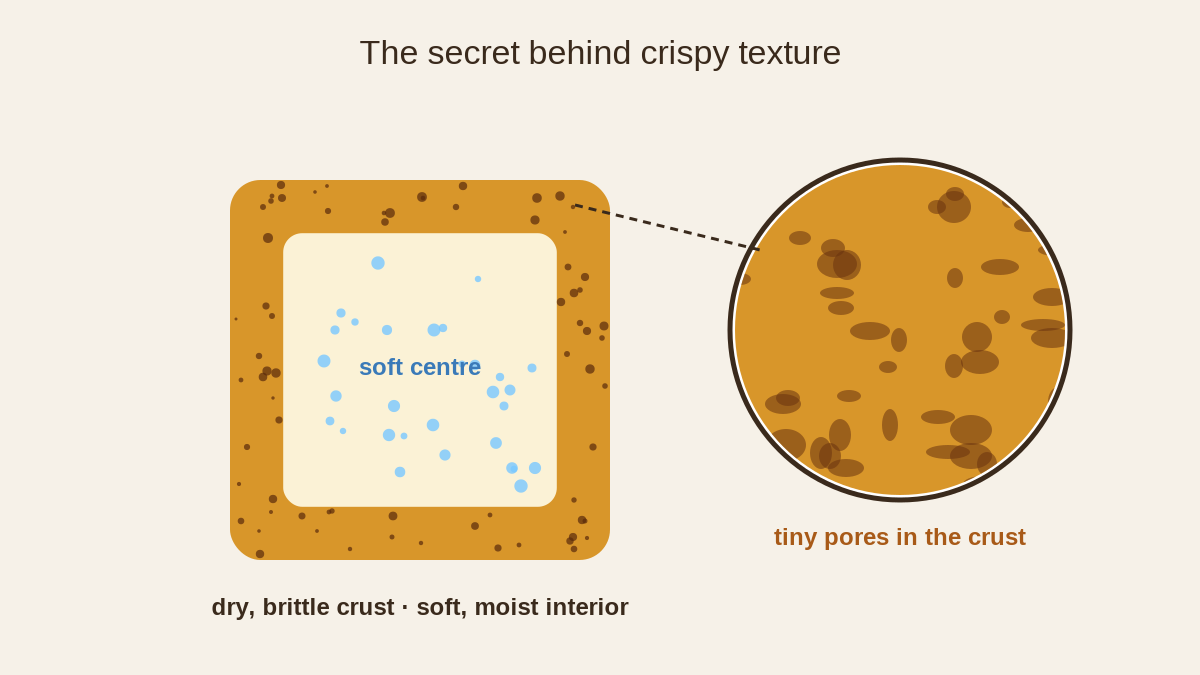
During frying, water evaporates from the surface and nearby regions of the food. This creates a dehydrated outer layer.
As the surface loses moisture, its structure becomes more rigid and brittle.
Tiny pores develop as steam escapes, contributing to the characteristic porous structure of fried crusts.
When you bite into fried food, this brittle layer fractures into smaller pieces.
That fracture is what produces the familiar crunch.
Meanwhile, the centre may retain enough moisture to remain soft.
This contrast is important:
- Dry, brittle exterior.
- Softer, moist interior.
- A distinct texture difference between the two layers.
A perfectly fried French fry is a beautiful example of how controlling moisture can transform food texture.
03Why does fried food turn golden brown?
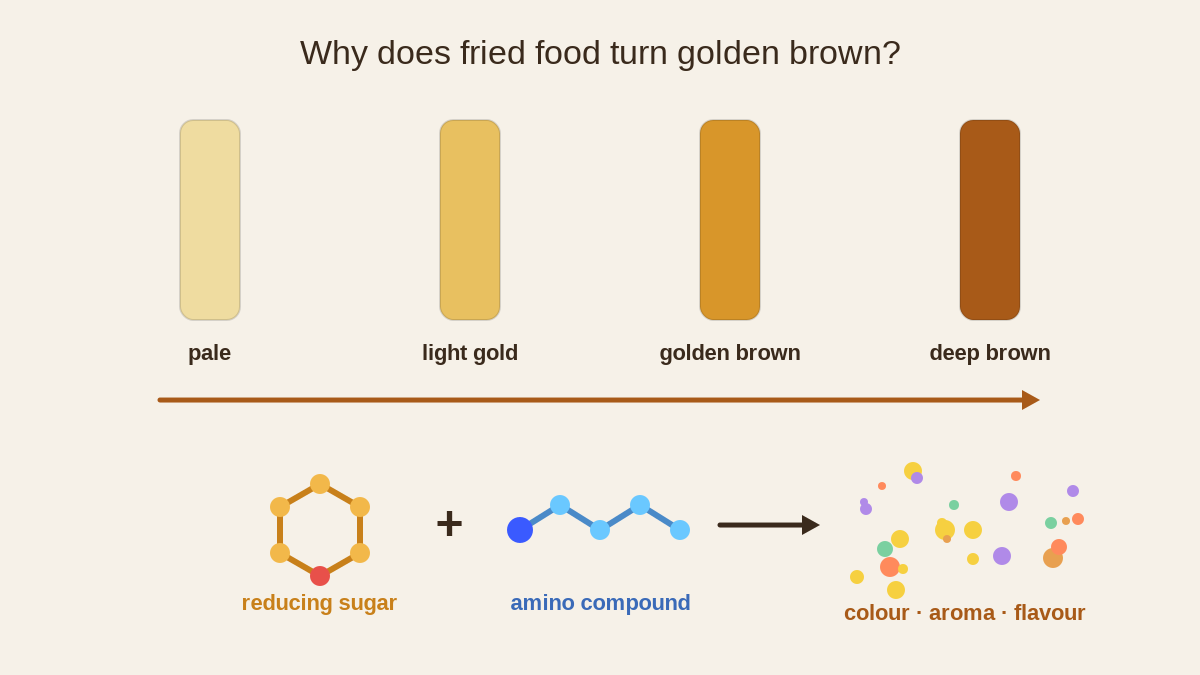
The golden colour of fried food is not just a result of oil coating its surface.
It is also the result of chemical reactions.
One of the most important is the Maillard reaction.
This reaction occurs between reducing sugars and amino compounds, including amino acids and proteins.
Under suitable heating conditions, these compounds react through a complex series of chemical changes, producing hundreds of new substances.
Some contribute to:
- Golden and brown colour.
- Roasted aromas.
- Toasted and savoury flavours.
- Complex flavour development.
This is why fried potatoes develop a more complex flavour than simply cooked or boiled potatoes.
Other heat-driven reactions may also contribute to browning, depending on the food's composition and cooking conditions.
04Why is oil temperature so important?
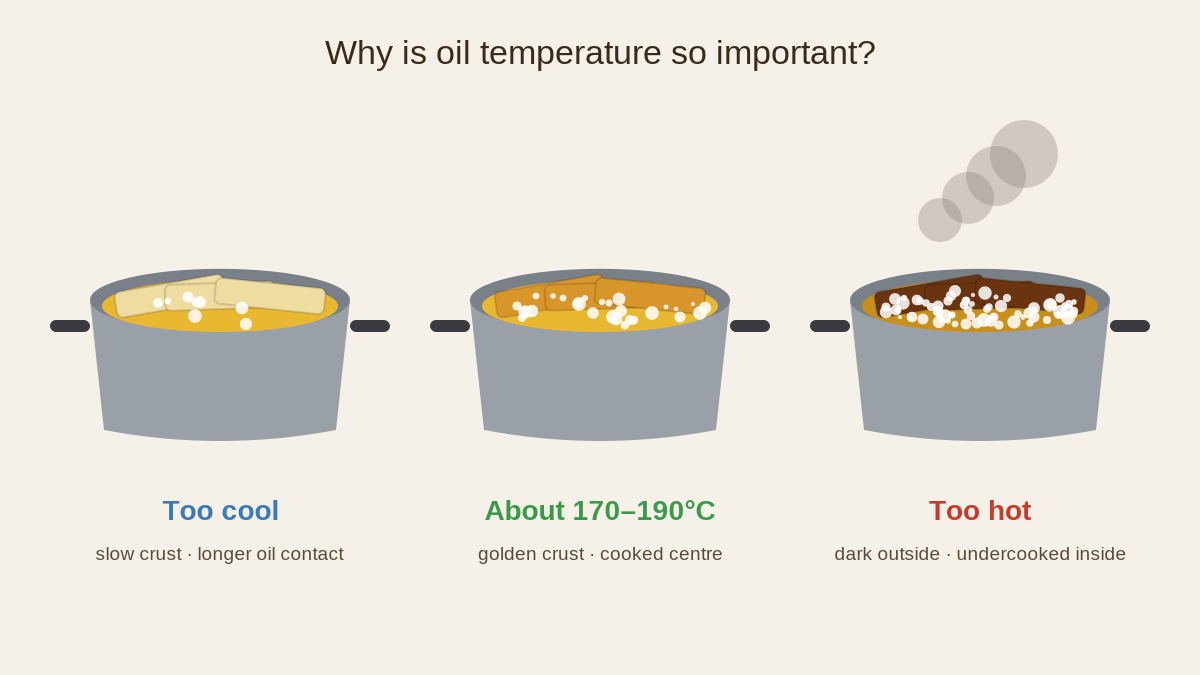
Temperature can make or break the frying process.
If the oil is too cool, the food heats more slowly.
Its surface takes longer to develop a dry, rigid crust. The food may spend more time in contact with the oil, and the final texture can become greasy or uneven.
If the oil is excessively hot, the outside may brown too quickly while the inside remains undercooked.
High temperatures can also accelerate the degradation of frying oil.
For many common frying applications, temperatures around 170–190°C are used, although the appropriate range depends on the product, size, coating and equipment.
The goal is to achieve:
- Adequate cooking inside.
- Controlled moisture loss.
- Proper crust formation.
- Attractive colour and flavour.
This is why professional kitchens and food manufacturers carefully monitor fryer temperatures.
05Does fried food absorb oil?
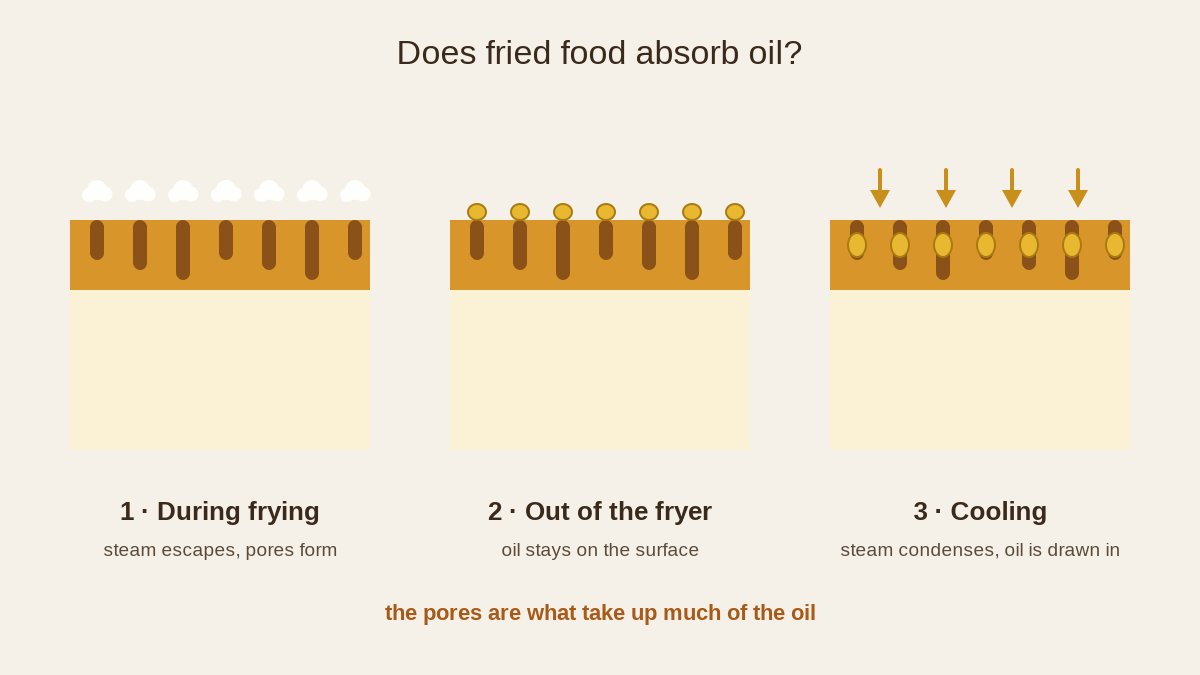
Here's a common question: if food is surrounded by oil during frying, why doesn't it absorb all that oil immediately?
Oil uptake is more complicated than simply soaking food in fat.
During frying, water escapes and creates pores in the developing crust.
Some oil remains on the food's surface when it is removed from the fryer.
As the food cools, steam within the pores condenses and pressure changes can contribute to oil being drawn into the porous structure.
The amount of oil absorbed depends on several factors:
- Food composition.
- Surface area.
- Moisture content.
- Frying temperature.
- Frying duration.
- Coating and crust structure.
- Draining and cooling conditions.
This explains why two foods fried in the same oil can have very different oil contents.
A thin potato chip, a battered vegetable and a thick potato wedge have different structures and surface-area-to-volume ratios.
Their oil uptake will not necessarily be the same.
06Why does crispy food become soggy?
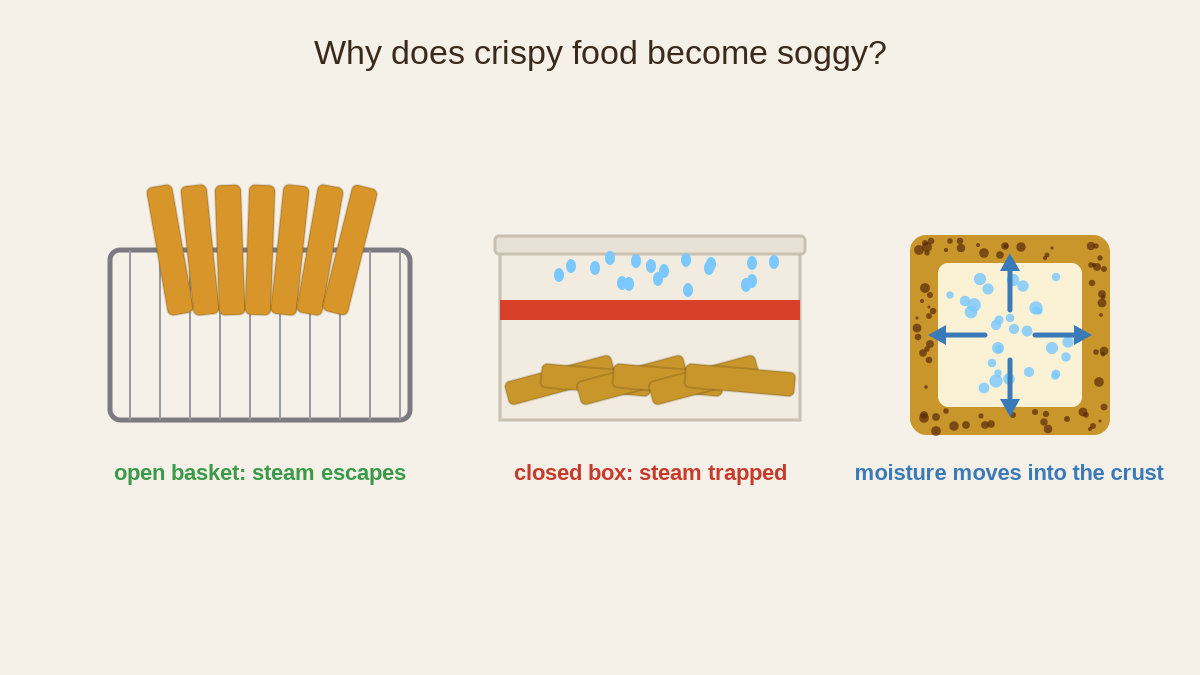
Freshly fried food is often at its best immediately after cooking.
But leave it in a closed container, and that satisfying crunch can disappear.
Why?
The secret is moisture migration.
Immediately after frying, the outer crust is relatively dry while the interior contains more moisture.
Over time, moisture can move from the interior towards the crust.
If hot food is stored in a closed container, water vapour can also become trapped and condense.
The crust absorbs moisture and becomes softer.
Its brittle structure gradually loses the properties responsible for crispness.
This is why takeaway fries often become softer during transportation.
Ventilated packaging can help release excess moisture, although it cannot prevent all texture changes.
The challenge for food manufacturers is to design products and packaging that maintain desirable texture for as long as possible.
07Why do some foods need a batter or coating?
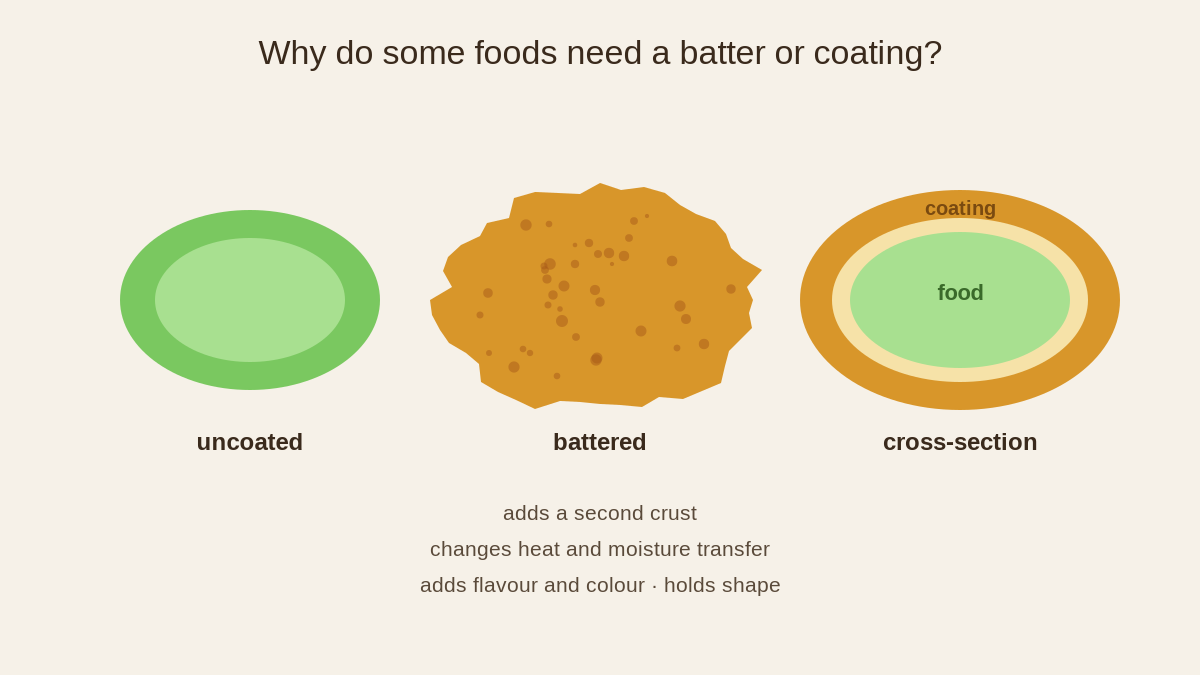
Batter and breading are not just added for appearance.
They can influence the final texture and moisture behaviour of fried food.
A coating can:
- Create an additional crust.
- Change heat and moisture transfer.
- Influence the amount of oil retained on the surface.
- Add flavour and colour.
- Help maintain the shape of delicate ingredients.
Different coatings behave differently.
A thin batter may create a delicate, crisp layer.
Breadcrumb coatings produce a more textured crust.
Some coatings include starches, proteins and leavening ingredients that influence expansion, structure and browning.
The final result depends on the formulation and frying conditions.
This is why fried chicken, onion rings, tempura vegetables and French fries all have different textures despite being cooked in hot oil.
08What happens to frying oil when it is reused?
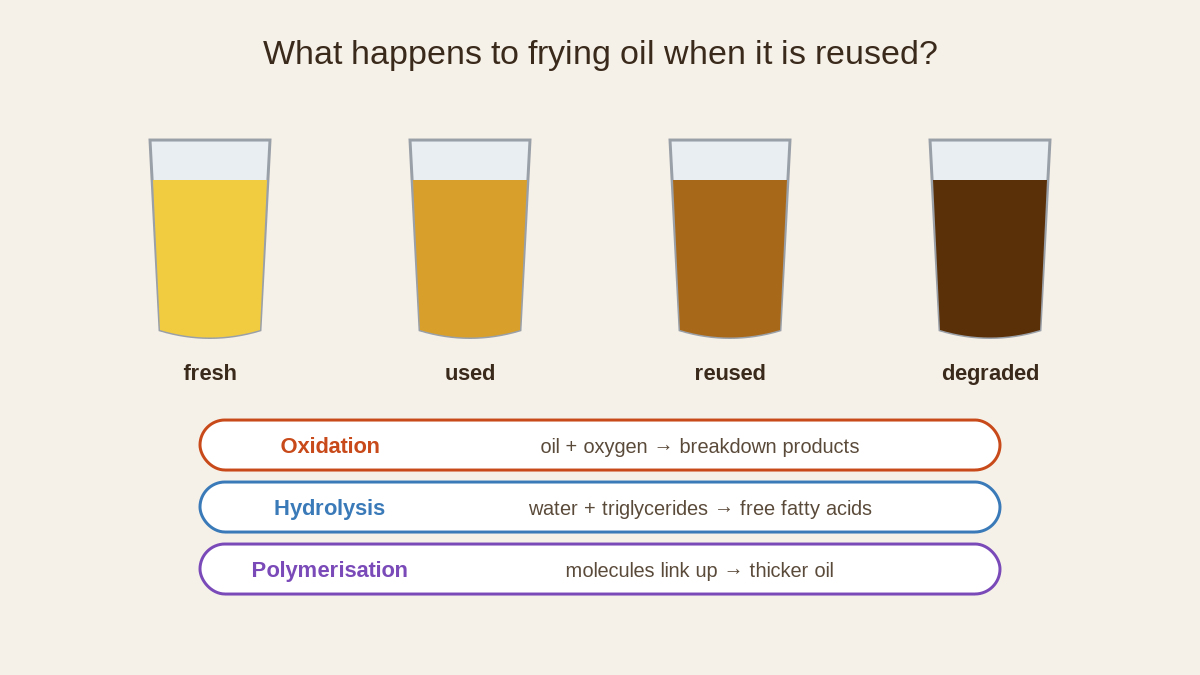
Frying oil does not remain chemically unchanged during repeated heating.
Exposure to high temperatures, oxygen, moisture from food and food particles can gradually change its composition.
Three important processes are involved:
Oxidation: Oil components react with oxygen, producing various breakdown products.
Hydrolysis: Water from the food can react with triglycerides, releasing free fatty acids and other products.
Polymerisation: Some oil components react with one another, forming larger compounds that can increase oil viscosity.
These changes can affect:
- Oil colour.
- Odour.
- Flavour.
- Viscosity.
- Frying performance.
- Product quality.
Commercial food operations monitor oil condition and follow appropriate filtration, maintenance and replacement procedures.
Simply filtering oil does not reverse all chemical degradation.
This is why frying oil management is an important part of food quality and food safety programmes.
09Deep frying in the food industry
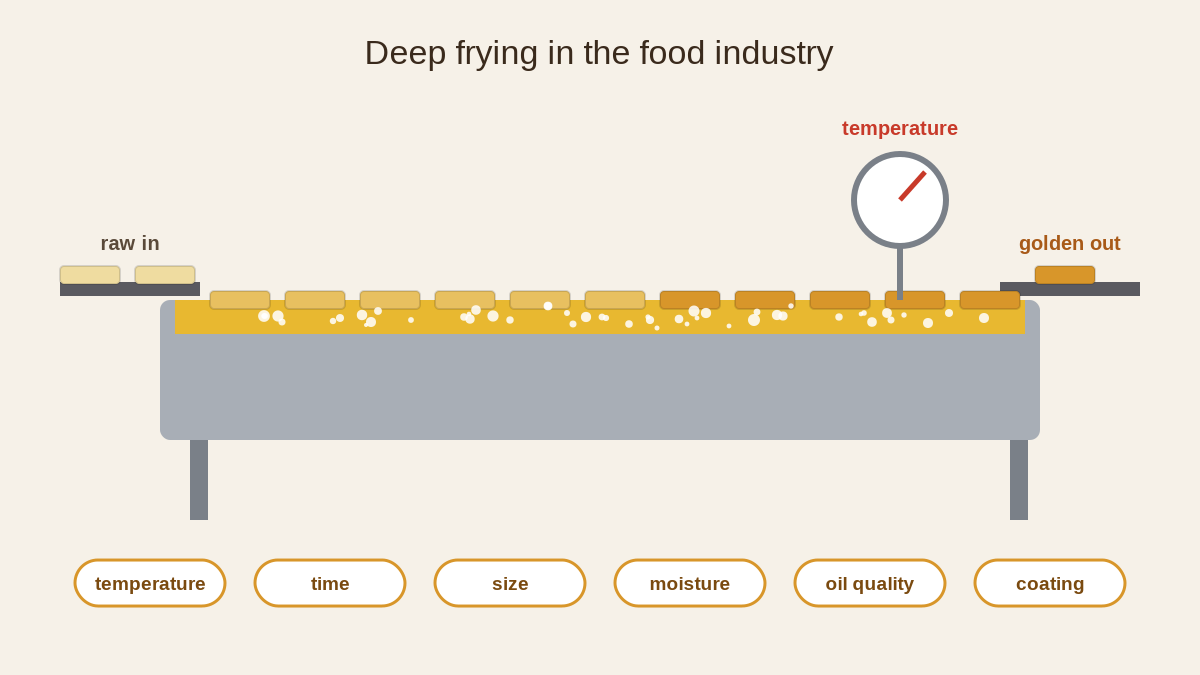
Deep frying is one of the most widely used processes in commercial food manufacturing.
It is used to produce products such as:
- French fries.
- Potato chips.
- Fried snacks.
- Breaded vegetables.
- Fried meat and seafood products.
- Various confectionery and bakery products.
Manufacturers need to achieve consistent colour, texture and flavour across large production batches.
This requires careful process control.
Important parameters include:
| Process parameter | Why it matters |
|---|---|
| Oil temperature | Influences heat transfer and browning |
| Frying time | Determines cooking and moisture loss |
| Product size | Affects cooking uniformity |
| Moisture content | Influences crust formation |
| Oil quality | Affects flavour and product quality |
| Coating formulation | Influences texture and surface characteristics |
Food scientists and quality teams use these controls to make sure products meet their specifications.
Deep frying may look simple, but producing consistent results on an industrial scale requires a detailed understanding of food physics and chemistry.
10Try this: your own crispy food experiment
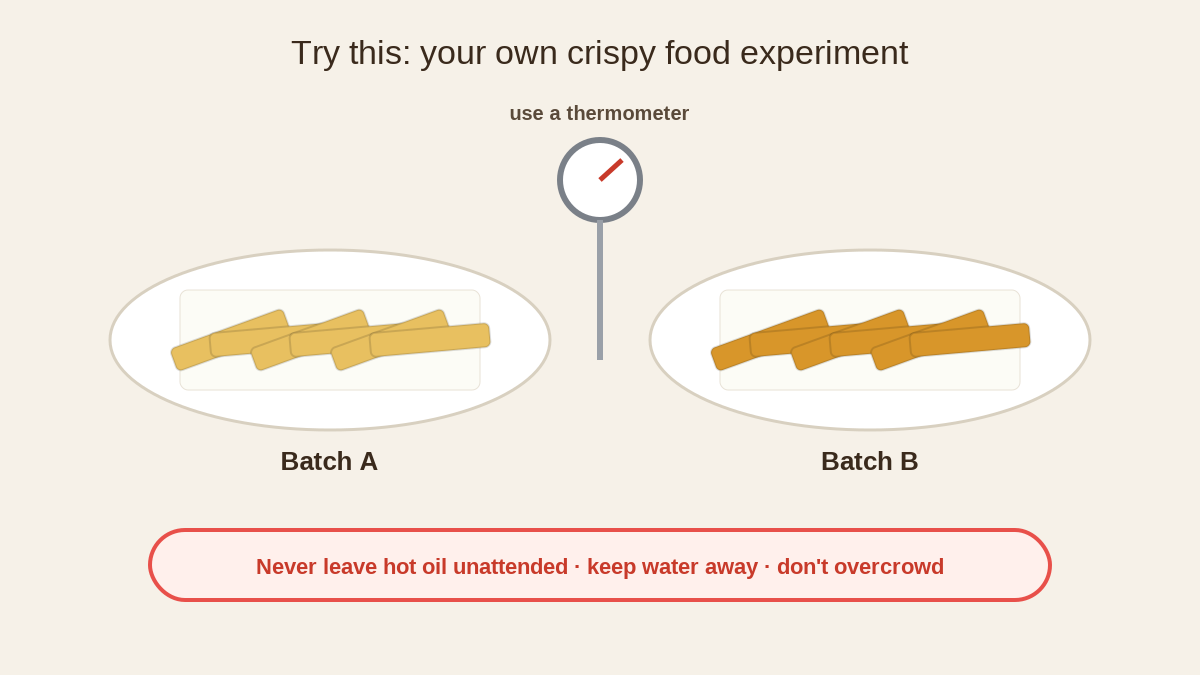
Want to observe how frying conditions affect texture?
Try a simple comparison using two small batches of potato pieces.
Questions to explore:
- Which batch developed a crispier exterior?
- Did the colour change with frying conditions?
- Did the centre remain soft?
- How did the texture change after standing?
Safety: Hot oil can cause severe burns and fires. Never leave it unattended, never add water to hot oil, avoid overcrowding, and use a thermometer and suitable equipment. Keep water away from the fryer. Follow a reliable recipe and never attempt to cool hot oil with water.
11The big takeaway: the science behind every crunch
Deep frying is a fascinating combination of physics and chemistry.
Heat moves into food. Moisture evaporates. Steam escapes. A porous crust develops. Chemical reactions create golden colour and complex aromas.
The result is a food with contrasting textures: crisp on the outside and often soft on the inside.
The next time you hear a French fry crunch, remember that it is not just a cooking technique.
It is food science at work.