
From milk to something extraordinary.
Milk is a liquid.
Cheese is solid.
Yet both can begin with exactly the same ingredient.
Some cheeses stretch like elastic threads. Others crumble into tiny pieces. Some are creamy and mild, while others develop powerful aromas after months or years of ageing.
How can one ingredient produce so many different foods?
The answer lies in proteins, microorganisms, enzymes, acidity and time.
Welcome to the science of cheese.
01The protein that makes cheese possible
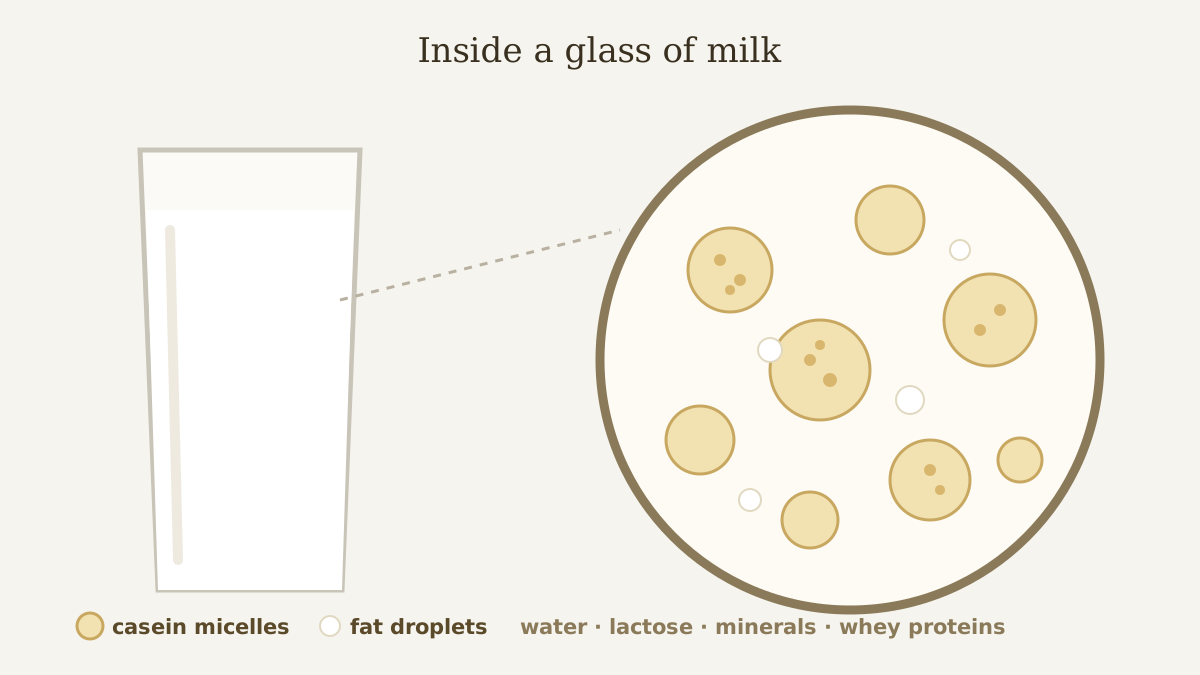
Milk contains water, fat, lactose, minerals and proteins.
One group of proteins is especially important in cheesemaking: caseins.
Casein proteins exist in milk as tiny structures called casein micelles.
These micelles help keep casein dispersed throughout the milk.
Under suitable conditions, they can be brought together to form a network.
That network is the foundation of cheese.
Milk also contains whey proteins, which behave differently during processing.
The balance between these proteins, along with fat content and milk quality, influences the characteristics of the final cheese.
02How does milk turn into curds?
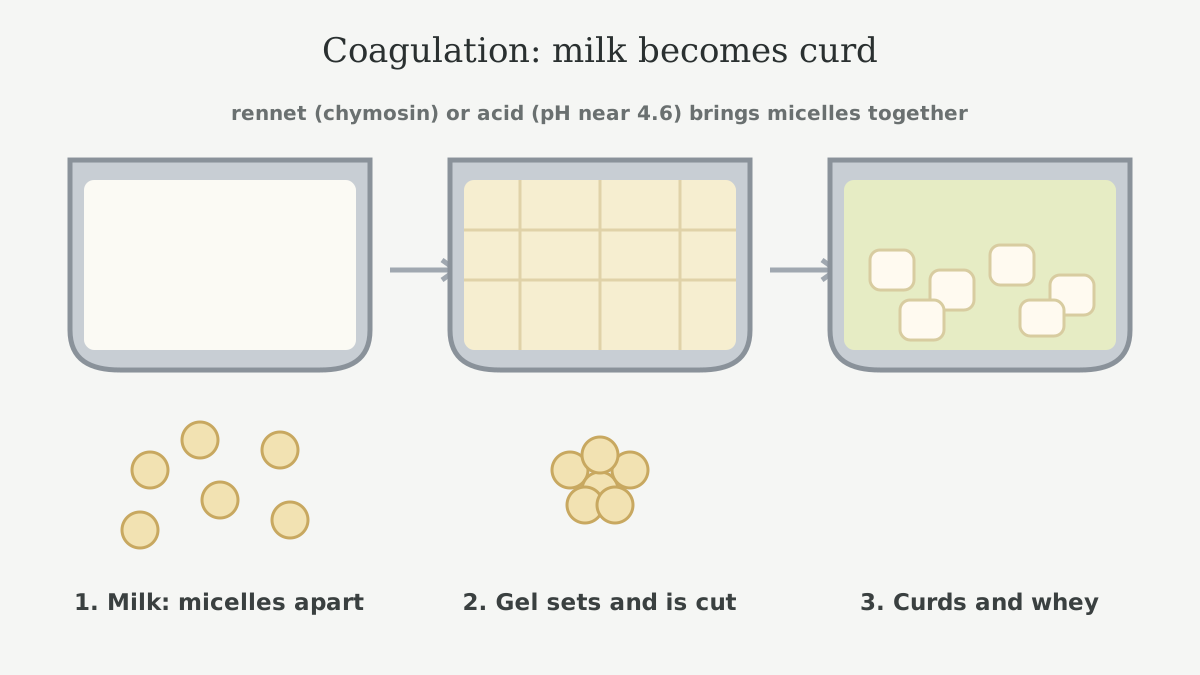
Cheesemaking generally involves turning milk into a gel-like structure that can be cut and separated.
This process is called coagulation.
There are two important approaches.
Rennet coagulation
Rennet contains enzymes that act on casein proteins.
A key enzyme, chymosin, acts on kappa-casein, helping destabilise the casein micelles so they can aggregate into a curd.
Acid coagulation
Acidification lowers the pH of milk.
As the pH approaches the isoelectric point of casein, approximately 4.6, the casein particles lose much of their stability and form a coagulated structure.
Some cheeses use rennet, some rely mainly on acidification, and others use a combination.
The method influences the final texture and structure.
03Curds and whey: two very different products
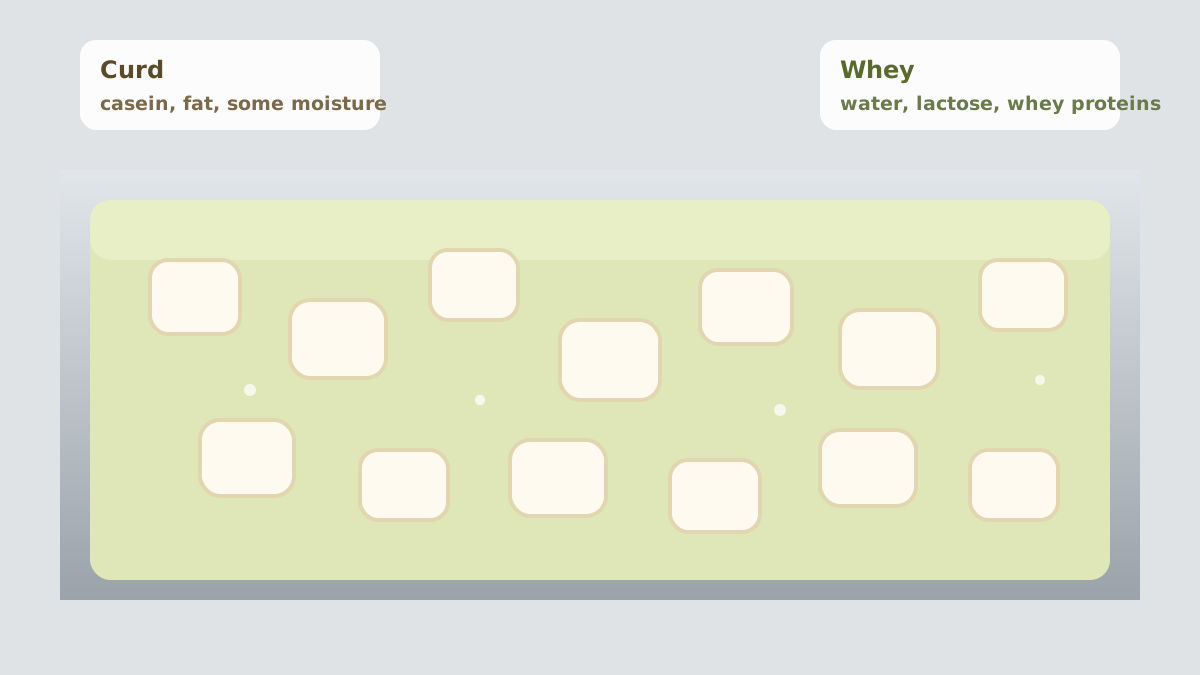
Once milk coagulates, cheesemakers separate the solid curd from the liquid whey.
But what exactly is whey?
Whey is the liquid portion that remains after curd formation and separation.
It contains water, lactose, soluble minerals and whey proteins.
The curd contains much of the casein and varying amounts of fat, moisture and other milk components.
The cheesemaker controls how much moisture remains in the curd.
This is extremely important.
More moisture can contribute to a softer cheese, while lower moisture often produces a firmer structure.
Curd cutting, stirring, heating, draining and pressing all influence the final moisture level.
Cheese texture begins taking shape long before the product reaches the ageing room.
04Why does mozzarella stretch?
Mozzarella is famous for its stretchy texture.
But why does it behave differently from many other cheeses?
The secret is in its manufacturing process.
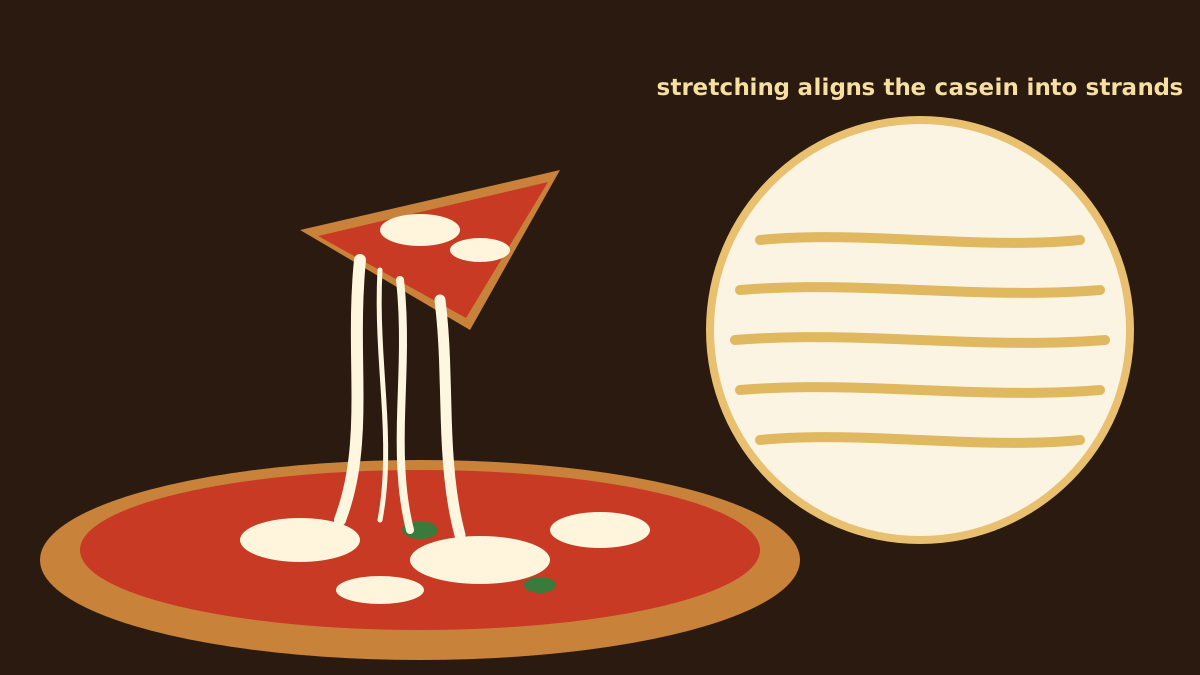
Mozzarella is a pasta filata cheese, meaning the curd undergoes a stretching and kneading process.
The curd is first acidified to an appropriate pH.
It is then heated in hot water or another suitable hot processing medium and stretched.
This helps reorganise the casein structure into aligned protein strands.
The resulting structure can stretch when heated.
This is why mozzarella develops those long, satisfying strings when melted.
However, stretching depends on several factors:
- Acidity
- Moisture
- Calcium balance
- Heating conditions
- Protein structure
- Cheese age
Too much or too little acidification can interfere with the desired stretching properties.
Mozzarella is therefore a beautiful example of how chemistry and mechanical processing work together.
05Why do some cheeses crumble?
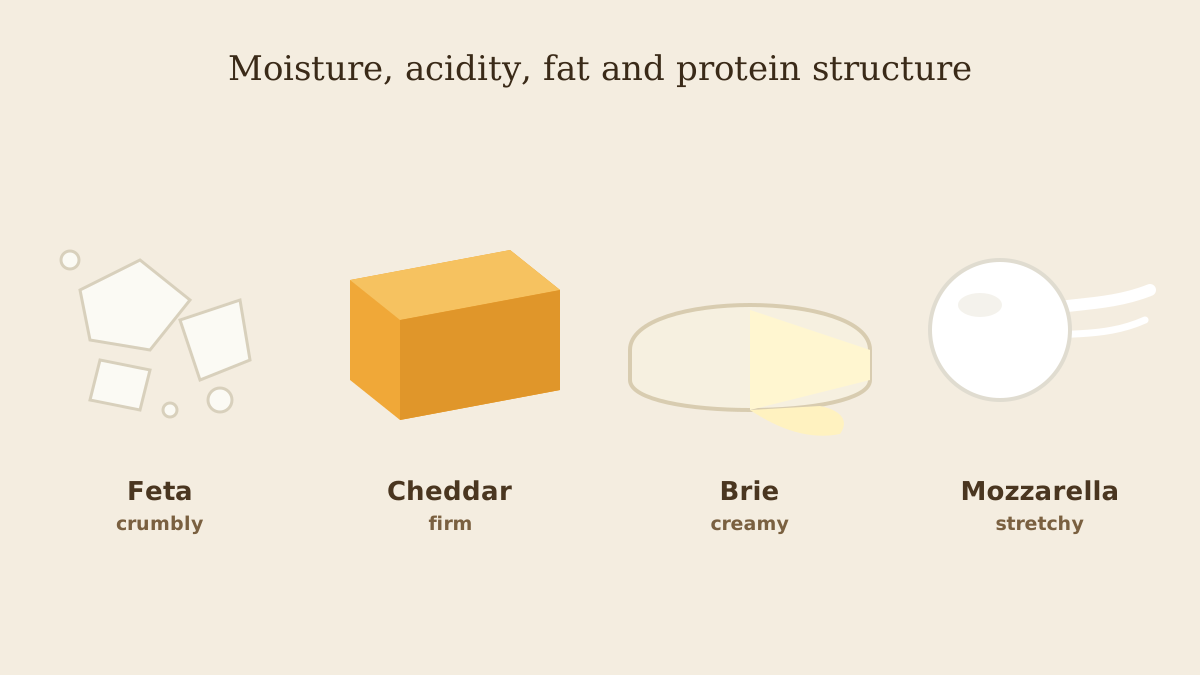
Not all cheese is supposed to stretch.
Some cheeses are intentionally made to be firm, crumbly or creamy.
These differences depend on the composition and structure of the cheese.
Feta: Often has a crumbly texture influenced by its moisture, acidity and protein structure.
Cheddar: Develops a firm texture through curd processing, pressing and ageing.
Brie: Develops a soft, creamy interior through moisture, fat and surface-ripening activity.
Parmesan-style hard cheese: Has relatively low moisture and a dense structure.
Small differences in moisture, acidity, fat distribution and protein breakdown can produce dramatically different textures.
Cheese is essentially an engineered protein-and-fat structure.
06What happens during cheese ageing?
Fresh cheese and aged cheese can taste completely different.
Why?
Because cheese continues to change after it is made.
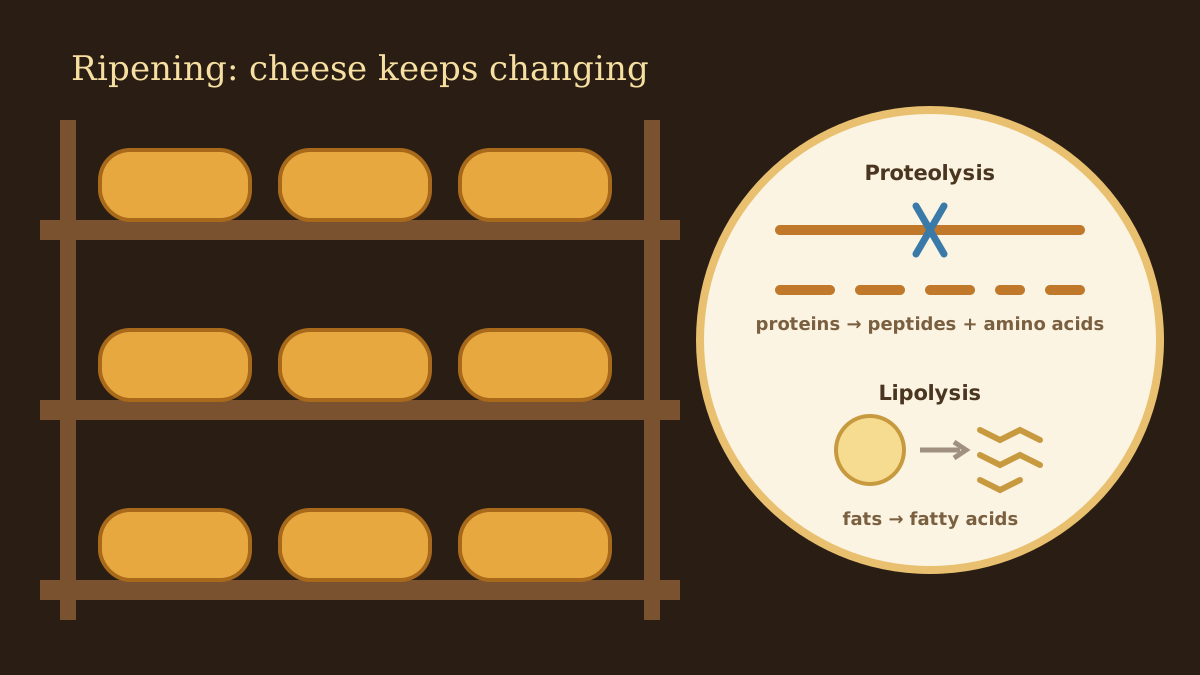
This process is called ripening or maturation.
Several biochemical processes contribute.
Proteolysis: Enzymes break proteins into smaller peptides and amino acids.
This changes texture and contributes to flavour.
Lipolysis: Enzymes break down fats into fatty acids and other compounds.
These compounds can contribute to characteristic aromas and flavours.
Microbial activity: Bacteria, yeasts and moulds can contribute to further flavour development, depending on the cheese.
For example, some surface-ripened cheeses develop a soft interior through enzyme activity originating at the surface.
Aged cheeses may develop stronger, more complex flavours over time.
The exact process depends on the cheese variety and maturation conditions.
07Why does cheese melt differently?
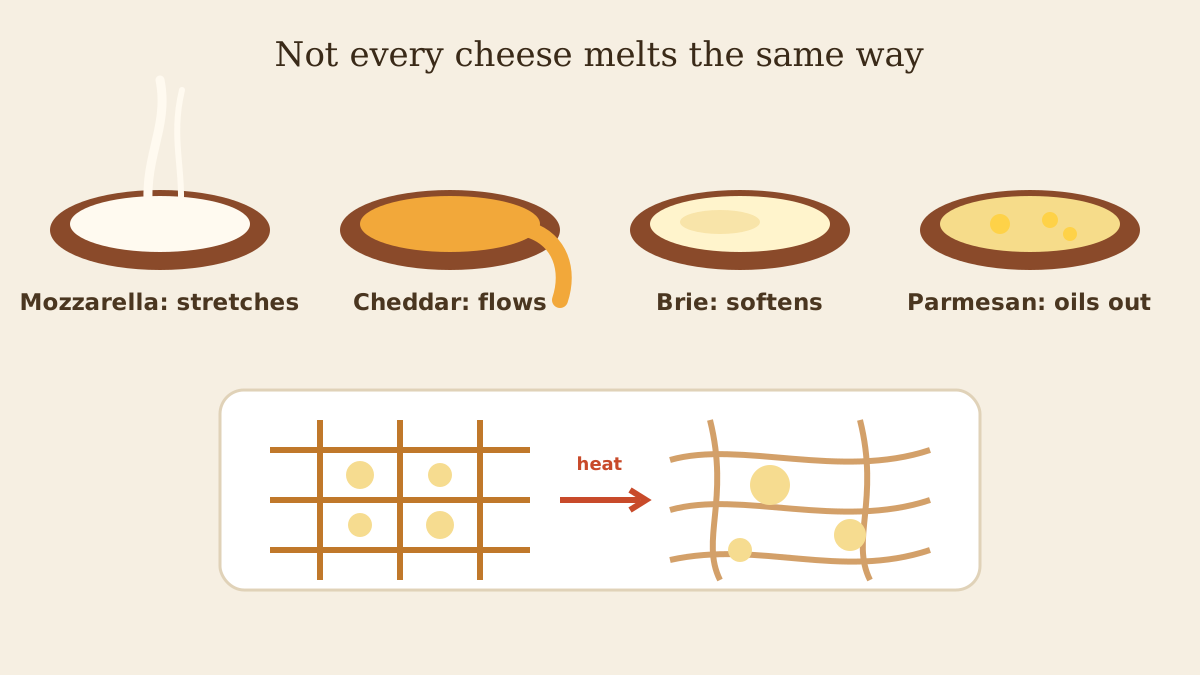
Have you ever noticed that mozzarella stretches, cheddar flows, and some cheeses become oily when heated?
Cheese melting is influenced by its protein structure, fat content, moisture, acidity and age.
When cheese is heated:
- Fat softens and melts.
- The protein network changes.
- Moisture becomes more mobile.
- The structure may lose its ability to hold its original shape.
A well-formulated melting cheese softens and flows without excessive separation.
But if the structure cannot retain fat and moisture effectively, the cheese may release oil or become grainy.
This is why not every cheese is equally suitable for every cooking application.
The best cheese for a pizza may not be the best choice for a smooth cheese sauce.
08Cheese in the food industry
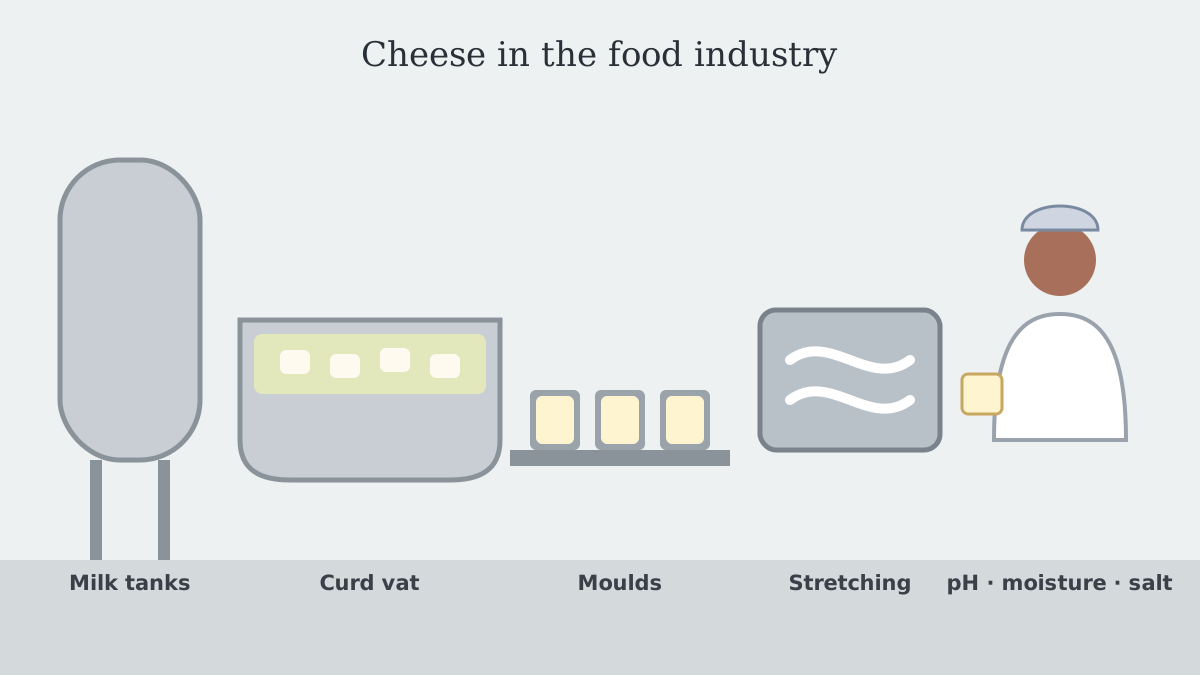
Modern cheesemaking combines traditional techniques with precise food engineering.
Manufacturers monitor:
- Milk composition
- Starter culture activity
- Coagulation time
- Cutting size
- Cooking temperature
- pH
- Moisture
- Salt
- Ageing conditions
Quality-control teams assess texture, flavour, moisture, acidity and microbiological quality.
In large-scale production, even small variations in milk composition or process conditions can affect the final cheese.
For mozzarella manufacturers, stretch and melt performance are particularly important.
For aged cheeses, maturation conditions and microbial activity are essential to achieving the desired flavour.
09Try this: the milk coagulation experiment
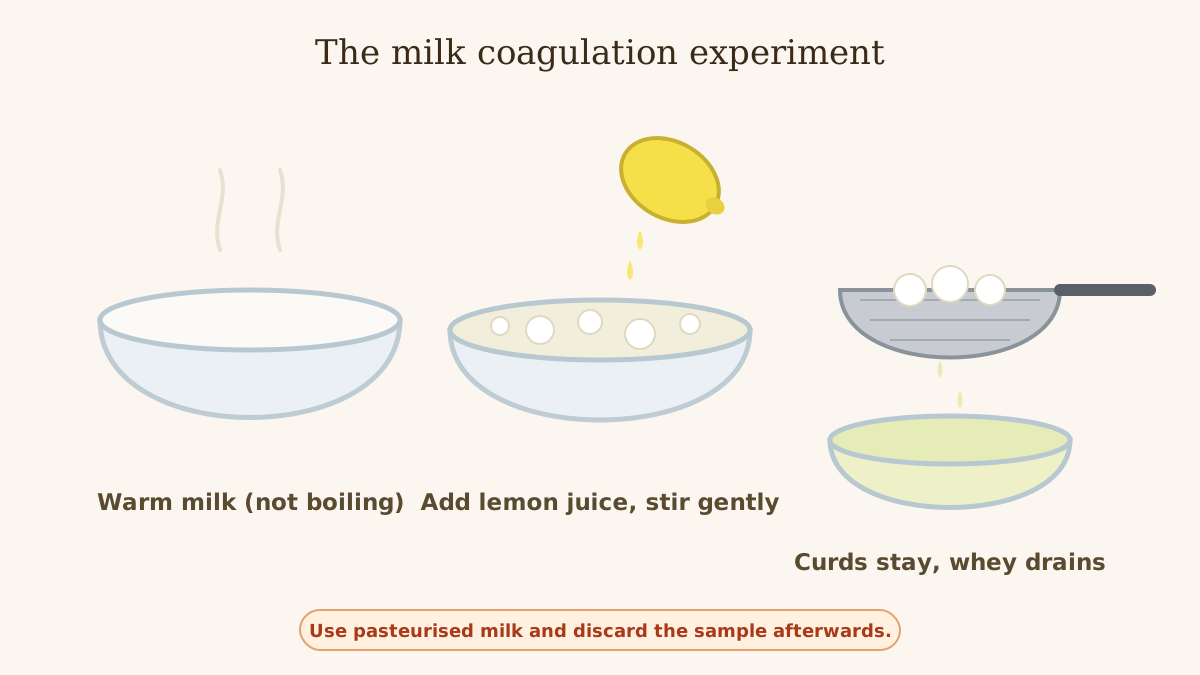
You can observe acid coagulation using ordinary kitchen ingredients.
10The big takeaway
Cheese is a remarkable transformation of milk.
Through proteins, enzymes, microorganisms, acidity and processing, a simple liquid ingredient becomes hundreds of different textures and flavours.
From stretchy mozzarella to crumbly feta, every cheese tells a different story about food chemistry.