What makes something as simple as air taste so interesting?
Think about whipped cream.
You pour liquid cream into a bowl, switch on a whisk, and suddenly it becomes fluffy, thick and light.
But what actually happened?
You didn't add flour. You didn't freeze it. You didn't create a new ingredient.
You introduced air.
The same principle appears in meringue, cappuccino foam, chocolate mousse, beer and even certain baked products.
What looks like a collection of tiny bubbles is actually a carefully structured system.
Food scientists call this a foam.
A foam is made when gas bubbles become dispersed throughout a liquid or a material that behaves like a liquid during preparation.
The surprising part?
Creating bubbles is relatively easy. Keeping them from disappearing is the real challenge.
01What exactly is a foam?
A structure made of almost nothing
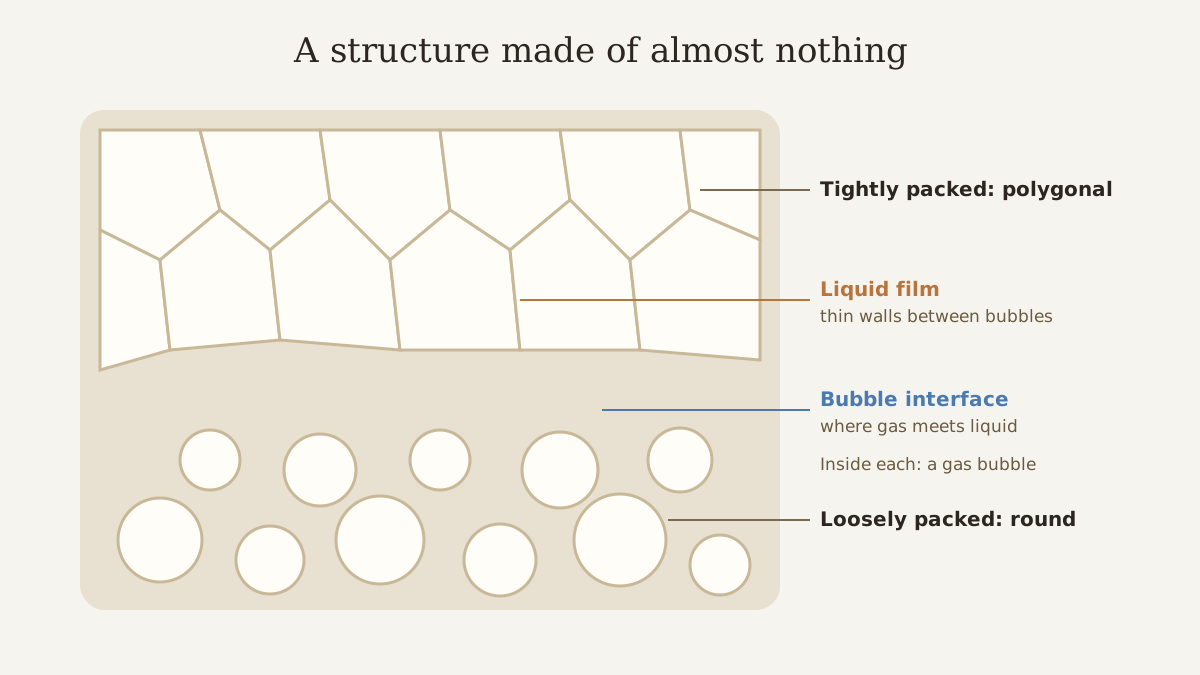
Foam is a fascinating arrangement of gas and liquid.
When you whisk a liquid, air becomes incorporated into it.
The air forms bubbles, and the surrounding liquid creates thin films around them.
But bubbles naturally want to disappear.
Why?
Because creating a large amount of gas-liquid surface requires energy. Surface tension encourages the system to reduce that surface area.
In simple terms, bubbles tend to merge, shrink or collapse unless something helps stabilise them.
Food foams therefore need ingredients that slow down these processes.
Depending on the food, those ingredients might include:
- Proteins.
- Fats.
- Sugars.
- Starches.
- Natural surface-active compounds.
These ingredients influence how bubbles form and how long they survive.
The foam in your coffee, the foam on a beer and the foam in a meringue may look similar, but their internal structures are quite different.
02Why egg whites turn into a cloud
The protein trick behind meringue
Egg whites are one of nature's most impressive foam-forming ingredients.
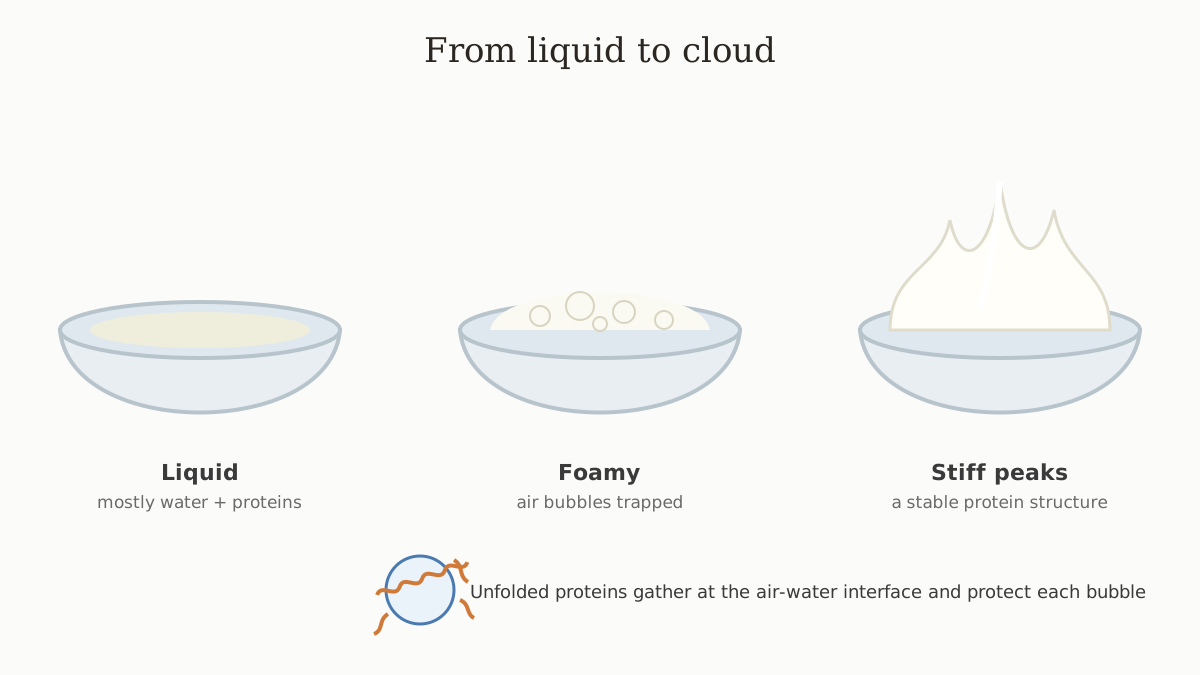
Before whipping, egg white is mostly water with dissolved proteins.
When you whisk it, air gets incorporated into the liquid.
At the same time, the mechanical action helps some proteins unfold.
These proteins move towards the air-water interface, the boundary between the air bubble and the surrounding liquid.
There, they rearrange and interact with one another, helping create a protective layer around the bubbles.
This makes it harder for the bubbles to merge and disappear.
As whipping continues, the foam becomes thicker and more stable.
Eventually, it can form stiff peaks.
This is why a bowl of liquid egg white can become a structure capable of holding its shape.
A successful meringue is not just about adding air. It's about building a stable protein-supported structure.
03Whipped cream: when fat becomes the hero
Why does cream become thick when whipped?
Whipped cream behaves differently from egg-white foam.
Its secret is fat.
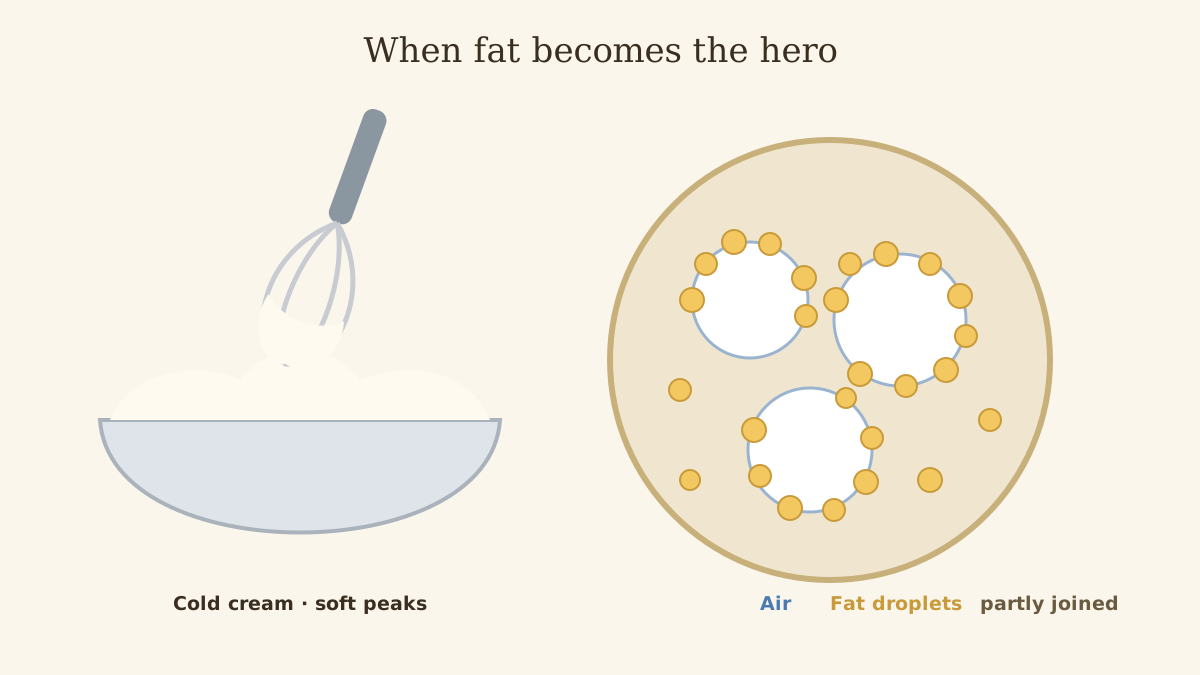
Cream contains tiny fat droplets dispersed throughout a water-based liquid.
When cold cream is whipped, air is incorporated and the fat droplets begin to partially join together.
This process is called partial coalescence.
Rather than completely merging into one large mass, some fat droplets connect to form a supporting network around the air bubbles.
That network helps hold the foam together.
This is why properly whipped cream can form soft or firm peaks.
Why must cream be cold?
Temperature makes a major difference.
When cream is cold, some of its milk fat is in a crystalline, partially solid state.
This helps fat droplets interact and form the supporting structure needed for whipped cream.
If the cream becomes too warm, too much of the fat melts.
The network becomes less effective, and the foam may lose its structure.
And what happens if you whip it too much?
The fat droplets can aggregate excessively and eventually form butter.
The smooth whipped cream begins to look grainy, then separates into butter and liquid buttermilk.
So there's a narrow window between beautifully whipped cream and butter.
04The golden secret of coffee crema
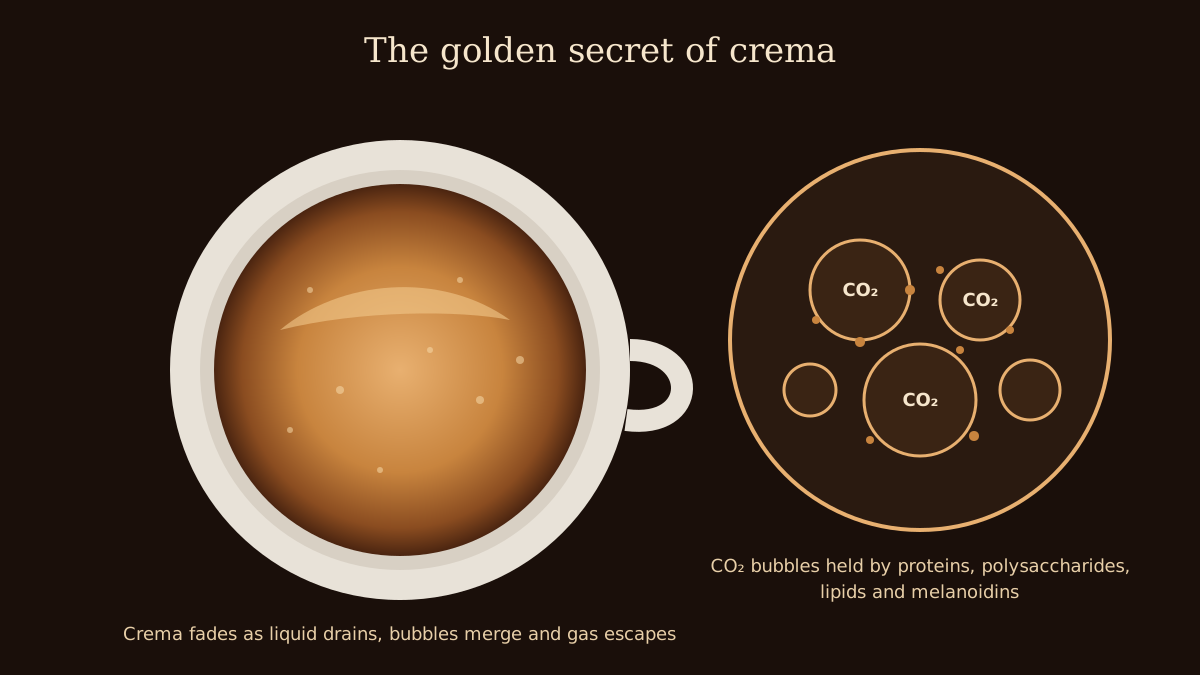
Why does espresso have a layer of golden foam?
Fresh espresso often arrives with a beautiful golden-brown layer on top.
This is called crema.
But it isn't simply ordinary coffee foam.
During espresso extraction, hot water passes through finely ground coffee under pressure.
Carbon dioxide that was retained in the roasted coffee becomes released and forms bubbles as the pressure changes.
Coffee also contains compounds such as proteins, polysaccharides, lipids and melanoidins that influence the properties of the crema.
These compounds help affect bubble formation, foam structure and stability.
The result is a layer of tiny bubbles containing gases, surrounded by a complex liquid mixture of coffee compounds.
Why does crema disappear?
Because the bubbles are not permanent.
Over time:
- Liquid drains from the foam.
- Bubbles merge.
- Gas escapes.
- The foam structure becomes less stable.
The crema gradually disappears.
Its appearance can vary depending on coffee freshness, roast, bean variety, grind size, extraction conditions and equipment.
That beautiful golden layer is a small display of food engineering happening inside your coffee cup.
05Why does beer have a foamy head?
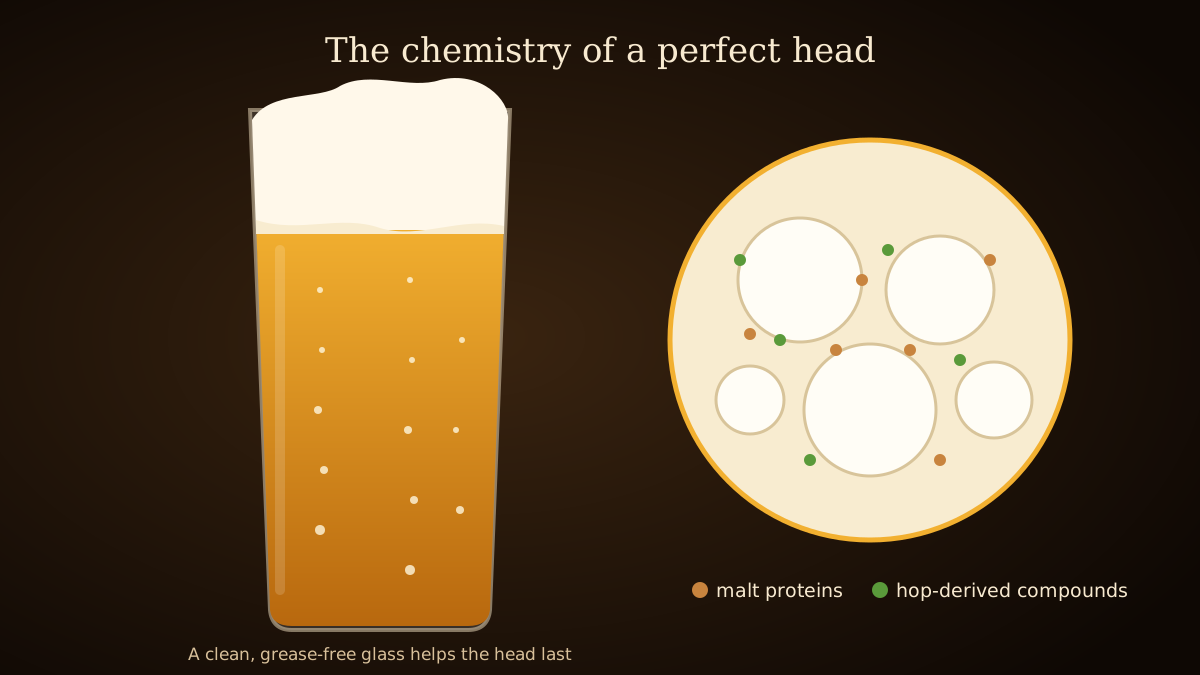
The chemistry behind the perfect head
Beer foam is another example of a gas-liquid structure.
When beer is poured, dissolved carbon dioxide escapes and forms bubbles.
But carbon dioxide alone doesn't explain why some beers maintain a beautiful foam head while others lose it quickly.
Beer contains compounds that influence foam stability.
These include:
- Proteins and protein fragments from malt.
- Hop-derived compounds.
- Other surface-active substances.
Together, these can help form and stabilise the films around bubbles.
The glass itself matters too.
Oil, grease and detergent residues can interfere with foam formation and stability.
This is why a properly cleaned beer glass is important for maintaining a good foam head.
The foam is not simply decoration.
It can influence aroma release, mouthfeel and the overall drinking experience.
06Why do some foams collapse so quickly?
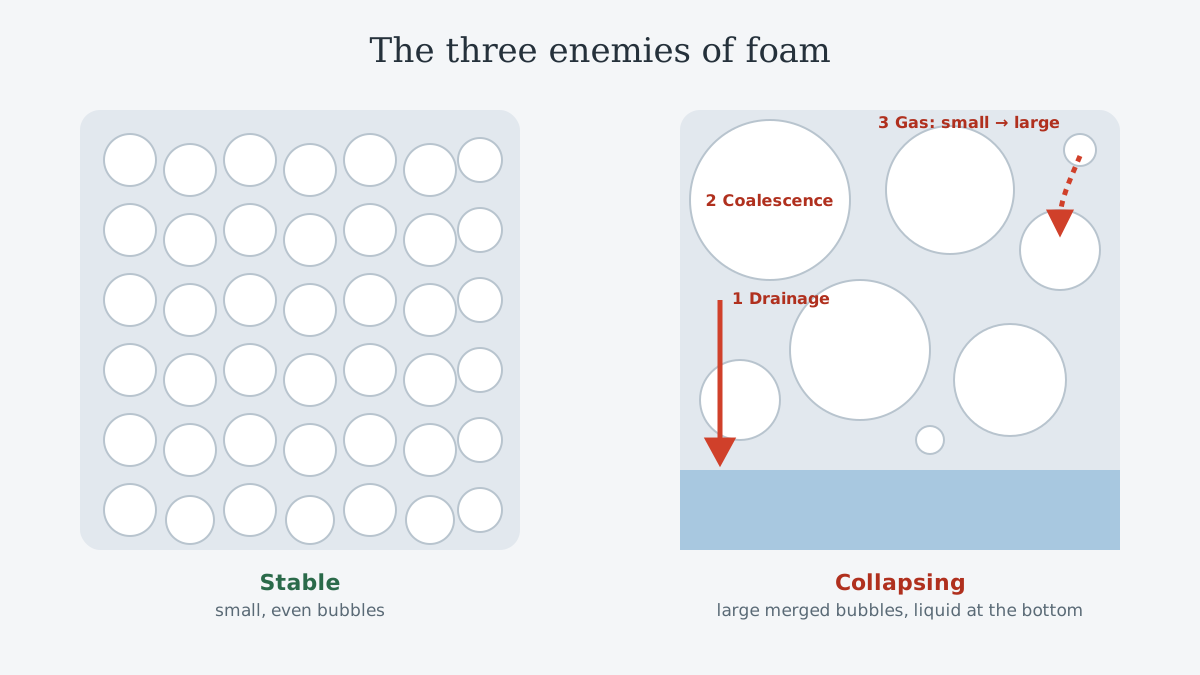
The three enemies of foam
Not every foam is designed to last.
Some disappear in seconds, while others can hold their shape for hours.
Three major processes explain why foams become unstable.
1. Drainage
Gravity pulls liquid downwards through the foam structure.
As the liquid films become thinner, bubbles become more vulnerable to rupture.
2. Coalescence
Two or more bubbles merge when the liquid film separating them breaks.
This produces larger bubbles and changes the foam structure.
3. Disproportionation
Gas can move from smaller bubbles towards larger bubbles because of differences in internal pressure.
Smaller bubbles tend to have higher internal pressure than larger ones.
As gas transfers, smaller bubbles shrink while larger ones grow.
Eventually, the foam can lose its original structure.
Food scientists try to control these processes by adjusting ingredients, temperature, viscosity and processing conditions.
A foam that looks beautiful at the moment of preparation may not remain stable during storage.
And that's a major challenge in food product development.
07The kitchen experiment: which foam lasts longer?
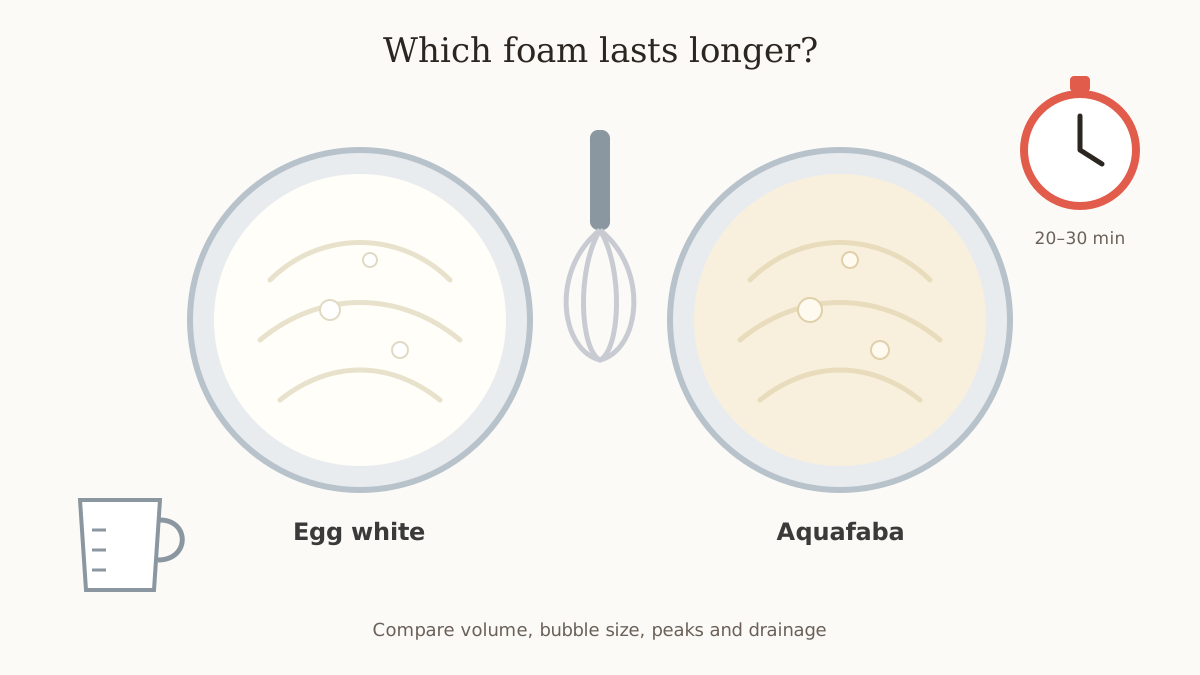
Can you compare different foams at home?
Let's test how different ingredients create and maintain foam.
What should you expect?
Egg whites and aquafaba can both form impressive foams, but their performance depends on the ingredient quality, concentration, preparation and whipping conditions.
Aquafaba contains water-soluble chickpea components, including proteins and carbohydrates, that help it form and stabilise foam.
The experiment demonstrates that different ingredients can create similar-looking structures through different combinations of surface and bulk properties.
08Foam in the food industry
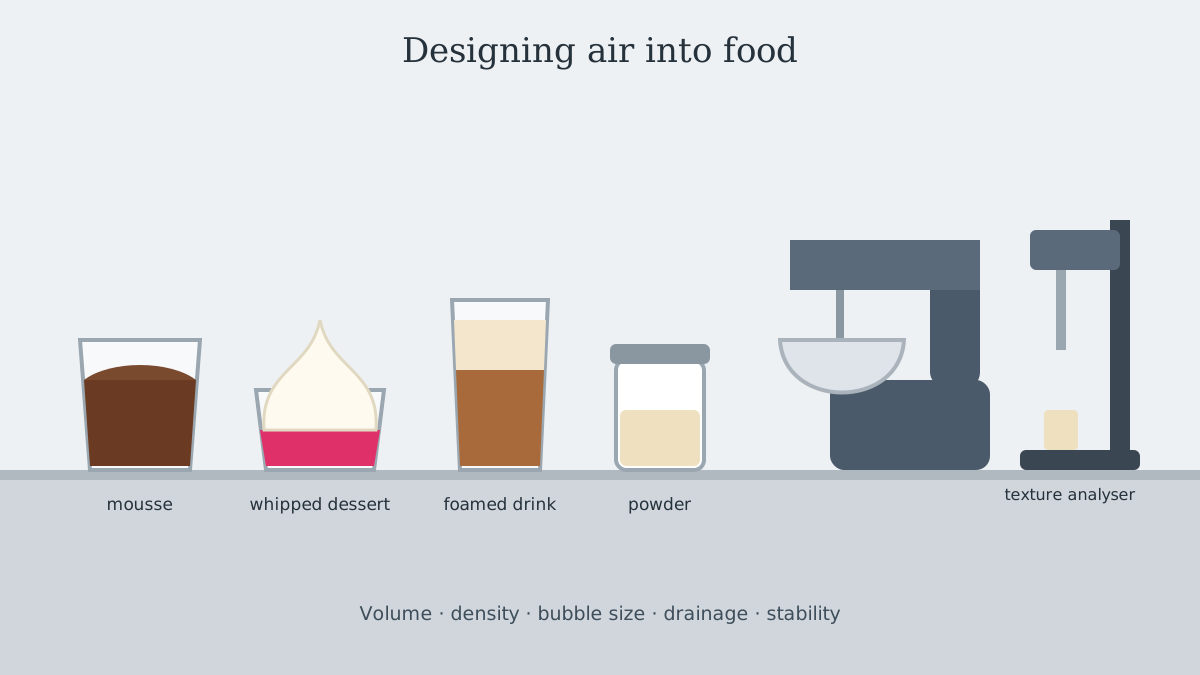
Designing air into food
Foam is not just something that happens in a kitchen.
Food manufacturers deliberately engineer foam to create specific textures.
Examples include:
- Whipped desserts. Air creates volume and a light mouthfeel. Fat and stabilising ingredients help maintain structure.
- Mousses. A combination of air incorporation, proteins, fats and setting ingredients creates a soft, aerated texture.
- Ice cream. Air is incorporated during freezing and mixing. The amount of air affects volume, texture and how the product feels in the mouth.
- Baked products. Air bubbles formed during mixing and fermentation help create the structure of bread, cakes and other baked foods.
Food scientists may measure foam volume, density, bubble size, drainage and stability.
They also examine how a foam behaves during transportation, storage and serving.
The goal is not always to make the biggest bubbles or the thickest foam.
It is to create the right structure for the product.
Because in food science, texture is designed as carefully as flavour.
09The beauty of something we cannot hold
Sometimes, the most interesting ingredient is air.
A bowl of egg white becomes a cloud.
Cream transforms into a structure that can hold its shape.
Coffee develops a golden layer of bubbles.
Beer forms a delicate foam head.
All of these transformations depend on the same fascinating idea: introducing gas into a food system and finding a way to keep it there.
The next time you see a perfectly whipped dessert, remember that it is not simply air trapped in food.
It is a carefully organised structure of bubbles, films, proteins, fats and other molecules.
And that is the science of foam.